Once loaded and compacted in the hopper of a collection truck, the waste has to be offloaded at a material recovery facility (MRF), transfer station, or landfill. The methods of depositing waste at its appropriate location can vary with location requirements. These include standard waste collection trucks; tractor-trailers for long distance waste hauling; and specialized mechanisms such as tippers, hydraulic rams, and moving floors.
Waste Offloading Operations
Once they arrive at their destination, refuse hauling trucks can use several means to offload their waste. These include tippers, moving floors, and hydraulic rams.
The use of a tipping platform in landfills is intended to reduce the size of the working face and decrease the time for offloading waste. Portable and fixed tippers are both utilized for efficient waste disposal at the landfill working face. When a landfill has the services of a dedicated tipper, expensive self-unloading trailers are no longer needed. This saves on overall truck weight, allowing the transfer trailers to carry even heavier loads. During disposal operations, the waste hauling trailer backs onto the tipper and decoupled from the truck cab. The tipper then lifts the front end of a load, tilting it to a 90-degree slope that allows the load to fall out of the back quickly and efficiently. A tipper usually takes half the time to empty refuse than a traditional moving floor trailer. A tipper is hydraulically operated and highly efficient, due to it having its own engine, which typically runs on propane for cleaner emissions. Shorter offload times resulting from faster operations allows trash trucks to make more round trips in a workday to bring waste to the landfill. This can result in significant operational cost savings and increased revenues.
The Tipping platform transfer trailer is typically used for high-volume movements. It requires a sizeable capital investment in a tipping platform to raise the trailer to empty the load at the landfill. This kind of platform is not easily moveable. However, the primary advantage of a tipping platform transfer trailer is that it’s less expensive to purchase and operate, easier to maintain, and its lighter weight allows it to handle more payload per trip than a moving floor transfer trailer. A tipping platform is also often used with wet materials. The trailer’s floor is a flat sheet, welded solidly around the perimeter, making it resistant to leaking. It’s also ideal for heavy loads with big items, where a thicker floor and thicker walls are needed.
A moving floor installed in the truckbed is another offloading option. The use of a moving floor avoids the need for capital costs associated with a landfill tipper, while allowing for greater operational flexibility. A moving floor is basically a system of independently moving parallel planks or slats running horizontally the full length of the floorbed. By moving in sequence (usually three at a time), starting at the end adjacent to the truck cab, the moving floor creates a wave motion that carries waste to the open rear end of the trailer. This wave lifts and pushes the waste backwards and is repeated until the load is cleared of the trailer. A moving floor can be retrofitted into an existing trailer floor, and eliminates the need to fit trucks out with expensive hydraulic, heavy-duty lift jacks to raise the trailer for dumping.
The moving floor transfer trailer is ideal for remote locations because it is self-unloading, not dependent on a separate means of unloading. The primary advantage of the moving floor transfer trailer is it walks the load out to discharge the load through the rear of the trailer without raising the trailer. Designed for solid waste, it can be more versatile than the tipping platform because it operates as a standalone trailer. A moving floor trailer is more likely to acquire backhaul loads, unlike the tipping platform trailer. However, additional hydraulics and a reservoir kit are required on the tractor to operate the floor, which makes each trailer a higher investment and heavier than the tipping platform trailer.
More specialized offloading operations occur at transfer stations. Transfer stations utilize surge pits. This is the lower level of the tipping floor that allows for temporary storage of peak waste inflows. Being surrounded by walls, a surge pit can allow compaction equipment to efficiently push waste up against the side walls and increase its density. This greatly improves overall operational efficiency since the reduced volume reduces the number of trucks needed for long haul transport of waste to the regional landfill. As a result, the costs of hauling are reduced, and profit margins for the transfer station are increased.
Some transfer stations also use waste compaction equipment in order to maximize the waste’s density. Such a facility uses a surge pit, a lower level of the tipping floor that allows for temporary storage of waste from peak inflows. In the confined space of the surge pit, equipment can push waste up against a side wall, increasing its density and reducing the number of truck needed for hauling waste to the landfill. This reduces the overall cost of long distance hauling associated with the transfer station operations. Even greater efficiency and profitability can be achieved with the use of hydraulic rams and pre-compactors. This equipment allows for even higher waste densities. Installed in one side of the surge pit, hydraulic rams exert very high pressures as they push the accumulated waste into the opposite wall. Pre-compactors are a form of precision hydraulic ram that pushes waste into a tube. This results in a very high-density waste “log” that is extruded into the transfer trailer by means of the truck bed’s moving floor.
Wear-and-tear is a serious concern for trailers during transfer operations. The last 4–8 feet of the floor and sides at the rear of the trailer get the most wear in the transfer operation. When top loading trailers over a period of time, one will see damage to the top rail from loading or tamping the loads on most Tipping platform and moving floor transfer trailers.
Kurt Swihart, marketing director at the Kenworth Truck Company says, “The frequent stops and starts by trucks in waste environment applications place an increased emphasis on spec’ing and maintaining the cooling system, transmission, and brakes.
“It’s important to select a large air compressor to maintain sufficient air volume during the frequent braking applications,” he continues. “Trucks in this demanding application often operate in dusty and dirty environments while traveling in and out of disposal facilities, so choosing a larger-than-normal air filter is important…. Disc brakes can be specified to help provide the braking capability required to handle the duty cycle and extend change intervals. An automated or automatic transmission may also be selected for the waste application. With the frequent starting and stopping, the driver will appreciate automated shifting.”
Trailers are not all the same—they can have unique features, frames, alignments, and body designs. Performance and reliability considerations are paramount to a trailer truck fleet manager. And to protect their investments and ensure optimum safety and performance, truck fleet managers should ensure that their trailers are subject to rigorous and routine maintenance. Performance, safety, and ease of operation can be further improved by customized and specialized suspensions, wheels, tires, brakes, and tarps, in addition to standard packages.
The waste environment can impose special challenges and concerns to waste hauling trucks. These operational considerations result in a design that differs somewhat from other over-the-road (OTR) trucks. Waste hauling trailer trucks will tend to have unique engine specifications (in regards to size, type, and fuel), transmissions and drive train configurations, and suspension systems.
The choice between tippers and moving floors depends on the situation at the landfill. There can be several benefits to using moving floors instead of tippers. Tipper trailers maximize payloads. With tippers, waste trucks often have to wait in line until the tipper is available for offloading. The resulting queue represents lost productivity, which means wasted time and money. Waste can accumulate around the tipping platform, and the site operating has to clear this waste away at regular intervals, resulting in further delays.
However, trucks equipped with moving floors can offload simultaneously. Their unloading operations would be limited only by available space on the current working face. There is no need for the facility to provide specially constructed areas for offloading since waling floors can allow for waste disposal even on unlevel ground. This allows for an inherently safe offloading operation. Moving floors are also not limited by height restrictions like dump trailers and tipper trailers. Trucks equipped with moving floors can operate under obstructions without interference. This is especially important for waste of loading inside buildings such as MRFs and transfer stations. This ability to offload at a wide variety of locations provides operating flexibility and provides opportunities for backhauling loads.
Trucks
Mack Trucks’ upcoming Mack LR series of low-entry cabover refuse trucks will be available in three-axle 6 x 4 configurations, and can be powered either by diesel, or natural gas. The design and engineering of the LR series is based on customer input and emphasizes comfort, visibility, safety, and efficiency.
“The Mack LR series showcases what Mack does best—building rugged, robust trucks to the exact specifications of the application and the customer,” says Stephen Roy, president, Mack Trucks North American Sales and Marketing. “The new cab will be configured to improve driver comfort and productivity, while also maintaining the excellent maneuverability identified with Mack refuse models.”
The LR body is designed for add-ons with additional access points and mounting locations for wiring, controls, and joysticks. Comfort is emphasized in its driver environment, which has been enhanced to include tilt and telescopic steering, power windows and door locks, memory mirrors, in-dash air-conditioning, standard in-cab LED lighting, and an instrument cluster with color LCD display. The LR series will be spec’d with a Mack MP7 11-liter diesel engine with 325–345 hp and torque ratings from 1,200 to 1,280 lb-ft. An optional Cummins Westport ISL G natural gas engine will also be available. Its drive train includes an Allison RDS five-speed or six-speed automatic transmission.
“Refuse vehicle customers and their drivers want a comfortable, safe work environment, great visibility, and controls where they need them,” says Curtis Dorwart, Mack refuse product marketing manager. “All of these elements were taken into consideration and incorporated into the design of the new Mack LR series.” The Mack LR series will be available in 2015.
Navistar has built on the same battle-tested truck platform as the International MaxxPro MRAP (Mine-Resistant Ambush-Protected) armored vehicle, the WorkStar has the strength and intelligence to take on the challenges of any environment. The WorkStar boasts multiple-frame rail options, a double-sided galvanized steel cab protected by an extensive five-step corrosion protection, and comes standard with Diamond Logic electrical system—the most advanced multiplexing architecture available in commercial trucks—for easy upfitting. The WorkStar features unique advantages like a hood and radiator package with available integral front frame extension and FEPTO without requiring a hole in the radiator or horsepower restrictions. The WorkStar also features one of the roomiest cabs in the industry and offers both standard and high-visibility sloped-hood configurations for enhanced driver comfort and ease of operation. The model can be spec’d with a right-hand side, standup-drive prep package for easy third-party modifications. WorkStar is available with a wide range of powertrain options, including the recently released Cummins ISB6.7 and the Navistar N13 engine with up to 475 hp and 1,750 lb-ft.
Kenworth Truck Company manufactures a series of medium and heavy waste hauling trucks. The Kenworth T880 comes with a pre-cleaner that mounts to the hood air intake. Engine requirements depend on the specific weight or weight range hauled. For the Kenworth T680 and T880, Kenworth offers the PACCAR MX-13 engine from 380 hp and 1,450 lb-ft of torque, with up to 500 hp and 1,850 lb-ft of torque to meet customer needs. Available for the Kenworth T370 and T440 medium-duty trucks are the PACCAR PX-7 engine rated up to 360 hp and 800 lb-ft torque, and the PACCAR PX-9 engine rated up to 450 hp and 1,250 lb-ft torque. Kenworth also offers natural gas engine options in several truck models in 9- and 12-liter displacement. The cost savings result in a positive return on investment.
Peterbilt Motors’ primary vehicle for transfer station and landfill point-of-disposal applications is the Model 567 tractor. Since transfer tractors split time between running on- and off-road, the optimized spec for these tractors is a blend of standard parts and heavy-duty components and systems. The recommended drive train is the 13-liter engine, which provides power and weight savings, as well as greater fuel efficiency than a larger block engine. Therefore, the PACCAR MX-13 engine is often specified with their vehicles. In general, the optimum power rating should be between 430 and 500 horsepower, and 1,550–1,850 lb-ft. of torque. These trucks can be spec’d with automated and automatic transmissions such as Eaton Ultra Shift Plus and Allison transmissions. Peterbilt’s Air Trac rear suspension is rated at 46,000 pounds and is well designed for transfer station and landfill operations. Maneuverability is important in transfer station and landfill point-of-disposal applications so the turning radius on the Model 567 has been improved by almost 9 feet, compared to previous models.
An optional feature for the Model 567 used by refuse haulers is the air pre-cleaners that provide extra protection against job site dust and debris from getting into the engine and other components. They are designed to trap larger material before it has a chance to reach the primary air cleaner. These pre-cleaners are located under the hood by the side intake vents. As the air enters the pre-cleaners, it goes through a cyclone-like spin cycle that forces larger particles and debris to the bottom through centrifugal force and deposits away from the vehicle through an exit tube.
The tractor could be equipped with PTO, and a wet-line kit to operate the tipper or moving floor trailers. The Model 567 is engineered with electric-over-air technology control features that eliminate air switches in the dash, except for the parking brake and trailer air supply valve. This technology works with the PTO to power trailers and auxiliary equipment. Since air leaks are virtually eliminated, the air system stays charged, and the operator has reliable power for tilting the trailer. Safety features include programmable interlocks to prevent operation of the PTO unless the parking brake is engaged or if the air was dumped from the rear suspension. This ensures that the body could be raised and the electric-over-air controls will limit vehicle speed until the air suspension is re-inflated. A further safety feature is the improved visibility provided by an expansive windshield; narrow A-pillars; and large, door-mounted mirrors.
Trailers
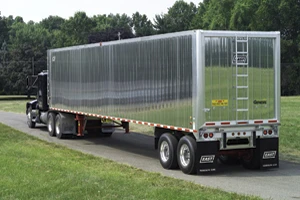
East Manufacturing designs and manufacturers waste Transfer Trailers l. These trailers are either built to use a Tipping platform to empty its load at the landfill, or come equipped with a moving floor. To meet the increasing demand for smooth-sided transfer trailers, the East Genesis design provides more capacity than the external post-style walls with extruded 2-inch aluminum panels, providing the same, or more, strength as a 4-inch traditional external post-style wall. The aerodynamic design consists of unique 2-inch-thick, double-wall extruded aluminum panels, robotically welded vertically inside and out for superior strength and resistance to bowing. It protects the outer wall from dents. Vertical panels are lighter than competitive horizontal-panel systems, resist bowing better, and reduce maintenance costs. In addition to maximum strength, welding inside and out reduces corrosion from road salt penetration. Other designs are welded inside only.
Their advanced wall-to-floor construction secures the critical point for trailer strength—the welded union of cross members, floor plates, and side walls. For a super strong floor-to-wall attachment joint, cross members and floor plates interlock into the bottom rub rail, forming a pocket to accept the side wall panels. The 3-inch spacing of interior panel ribs give eight times more wall support than external posts positioned every 25 inches. And the inside walls stay flatter, creating fewer high points to decrease wear. East offers optional thicker aluminum in higher wear areas, like the inside last 4 feet of the trailer. East Genesis transfer trailers are aerodynamic and easier to clean. In addition, the smooth-sided walls will not show any pings and dings on the outside, like the traditional external post-style walls. Genesis increases the width of East’s Tipping platform trailer by 4 inches, for up to 7.75 cubic yards of extra payload.
East also designs and manufacturers traditional external post-style walls. When a traditional external post trailer fits a customer’s application, East has advantages in its welding process there as well. Maximum-strength side walls are thicker than most competitive models, and posts are continuously welded for greater durability. Side posts are welded directly to the bottom rail. Then dirt-shedding wedge plates are added. A full-length boxed top rail interlocks with the side walls and side points, which prohibits the side walls from deflecting. And all outside joints are continuously welded for greater load-bearing strength and durability. Stronger 5 ¼-inch extruded I-beam floor cross members offer 30% more bending resistance than the 4-inch cross members used by competitors.
Great Lakes Trailers has been a custom trailer builder since 1980. The company specializes in logging, refuse, and material handling industries, and its in-house engineering has resulted in a number of patented designed for aluminum structural products such as aluminum stakes, headboards, and steel bunks.
MAC Trailer Manufacturing is a supplier of tipper and moving floor transfer trailers. The company’s trailers are designed for the harsh environment and demanding conditions associated with the loading and unloading of mass volume and heavy bulk materials from waste, to wood, to agricultural, to recyclables, to scrap. Every aspect of the trailer structures (top rails, the rear gates, hinges, bumpers, and rear pockets) is designed for durability. Their original moving floor designs include fully welded aluminum sheet and post with side skins to a gauge of 0.250, or the smooth-sided “MVP” (MAC Vertical Panel) MACLOCK configuration that incorporates 2 ¼-inch hollow core aluminum extruded panels. Also included is the floors drive unit (which can be leakproof or conventional) with the applicable slat profile. Slats or decking range from the aluminum smooth surface traditionally used for movement of agricultural-wood materials, and high-impact designs for solid waste.
The MAC Tipper trailer maximizes volume with low tare weight. These models include designs with lengths up to 53 feet, and volumes up to 148 cubic yards. The trailers can be designed with either the fully welded sheet and post, or the greater-capacity “MVP” MACLOCK extruded aluminum panel construction. MAC can also meet specifications for multi-axle trailers that meet regulatory requirements for axle configurations from tri-axle to eight axles, to multiple spreads, and lifts or sliders.
Manac Trailers US manufactures custom trailers, flatbeds, CPS dumps, hoppers, and Trailmobile dry vans. These vans are designed to carry waste and wood chips. They come with a coupler plate reinforced with fabricated beams, providing a sturdy and lightweight structure. Reinforced bottom rails eliminate potential damage from the tipper platform. Roof bows bolted to the frame facilitate maintenance.
Tippers can handle up to four trailers per hour.
Houston, TX-based Travis Body & Trailer Inc. has been building truck bodies and trailers since 1989. These include end dumps, bottom dumps, transfer trailers, and specialty dump trailers. The company specializes in lightweight trailers made for heavy-duty hauling. Its newest innovation, the Vertex, is a patented trailer design, which combines Vertical panels of an Extruded, dual-wall trailer. The patented Vertex comes with many advanced features, including frameless, frame-type, or quarter-frame configurations. It can come with Tandem, tri-axle, quad-axle, or spread-axle. Its dual wall–extruded 6061-T6 aluminum walls provide both durability and aesthetics as the thin outer wall adds capacity, and inner wall hides any dents.
Western Trailers began building refuse trailers in the early 1980s with a combination of aircraft aluminum and high-tensile steel. Manufacturing trailers for hauling C&D, MSW, dewatered sludge, green waste, and recyclables. Trailer lengths range from 28 to 56 feet, with payload capacities and axle configurations to maximize payload capacities across North America.
High-tensile steel is used in the chassis, rear door frames, and buck plates for a strong foundation. This chassis is completely steel grit blasted and painted with urethane enamels before any aluminum is installed. High strength aircraft grade aluminum is precision punched and riveted with CNC controlled machines to high-strength extruded aluminum top rails that are not only self-cleaning, but also anti snag to help eliminate top rail damage. Should a trailer get damaged, this method of construction makes repairs much easier.
Western continues to work to engineer and build a better trailer this is evident in the companies drop center refuse trailer adding an average of 20 yards to trailer volumes. This allows for less compaction of the load to get up to weight, causing less damage to the trailer. Western builds both moving floor and flat floor tipper trailers to the same exacting standards.
Moving Floors
Hallco Industries Inc. is one of the pioneers of the moving floor industry. The company’s high-performance Live Floor conveyor system utilizes bidirectional, moving slat floors. Safer and easier to maintain than conveyor belts, these moving floors have been used in used in transfer stations, material recovery facilities, and waste-to-energy plants, as well as trailers and stationary bunkers or bins. At landfills, Live Floor equipped trailers have shown themselves to be efficient at working face operations since each trailer is a self-unloader with material being pushed off automatically. As many as 15 trucks can unload simultaneously, without having to wait with no waiting in line for tippers. This also avoids pote
Latest from Waste Today
- Vermeer announces plan to build new facility in Des Moines metro area
- Buffalo Biodiesel shares updates on Part 360 application to DEC, Tonawanda facility progress
- Capstar Disposal expands roll off dumpster rental services
- Supreme Court strikes down IEEPA tariffs
- Casella details facility closures, expansion efforts
- Zero harm: Building a SIF prevention program for waste and recycling operations
- Casella posts a loss in Q4 2025
- McNeilus names Haaker Equipment first Dealer Partner of the Year