When it comes to recycling, the path of least resistance is most appealing—the least effort, the lowest cost, and minimal aggravation. However, under the pressure of China's National Sword policy effectively eliminating that mindset, the industry has been forced to rethink What to Do Now—and not a temporary band-aid solution, but rethink the long-term answers for efficient recycling.
"Certainly now, given the new constraints, the push is definitely in growing domestic markets, enhancing technology, and reducing contamination," says Michelle Leonard, senior vice president at Long Beach-based SCS Engineers. As a specialist in recycling and market solutions, she adds, "We have been doing studies on contamination in recycling with a number of major collectors, haulers, and processors.
“What we find is, it is still a problem, and that in a number of the studies there is 15–40% contamination of the material going to a MRF for sorting. Based on the studies, we provide recommendations for enhancing processing, and also enhancing community awareness and education to reduce that contamination level.”
Leonard says that there has been a shift in domestic markets, most notably with paper and plastic products.
The two wastestreams most severely impacted by the China National Sword policy are paper and plastic. We have seen the development of some new capacity for paper in the US; however, with plastic, the variability of types and grades has made it more challenging to process some of these materials domestically.
The pressure to use more recycled content in manufacturing will increase the demand for commodities, Leonard adds.
“As long as the cost difference between virgin and recycled materials remains wide, the use of [these] along with social and political pressures to produce packaging with recycled content will be the direct drivers that increase the demand for that content,” Leonard says. “The beverage brands, for one, are leading the way on this with committing to using recycled content, and this drives the market in that regard.”
Another factor Leonard cites as advancing the entire market is equipment innovation.
"The industry has been stepped up to address these issues with new and better sorting ability at MRFs.
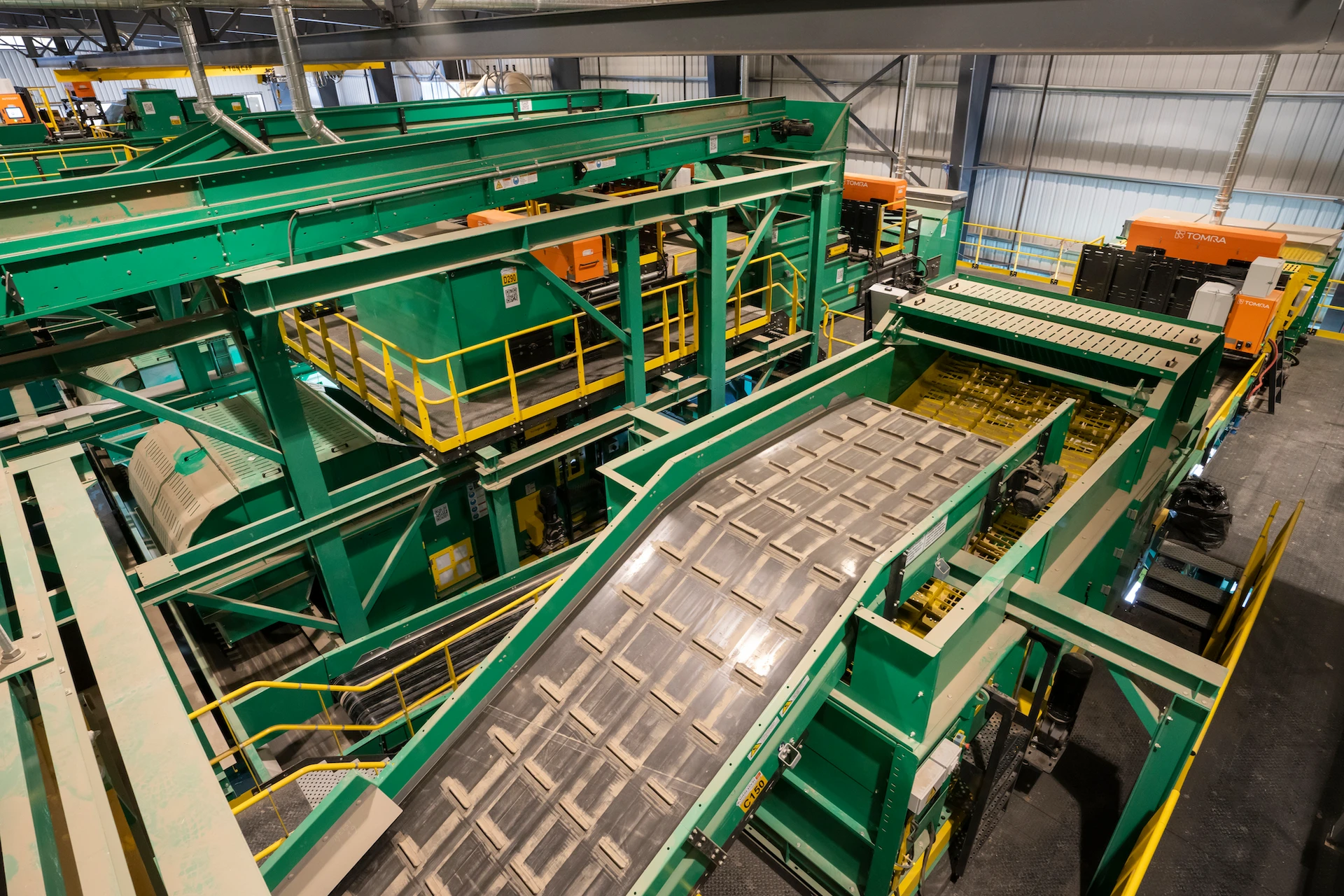
"These next generations of machinery, including optical sorters, robotics, artificial intelligence, and new screens, can do amazing things."
Adapting to change with positive measures can arise from multiple arenas, Leonard says, but sometimes you need the voice of authority to push things along.
“For example, last fall in California we passed Assembly Bill 793 which stipulates all plastic bottles covered by the state’s container redemption program must contain at least 15% post-consumer resin (PCR) by 2022.”
Leonard says the bill starts in 2022 and will increase PCR levels to 25% in 2025 and by 2030 will require 50% of PCR.
"The important piece here is first, this will boost demand for PCR, which will push companies and governments to come up with ideas for capturing more bottles. Secondly, it provides the ability to enforce the rule. And while we always hope we incentivize people to do the right thing, when there is a penalty for failure it gives some teeth to doing the right thing."
According to the Bill, manufacturers that are not compliant will be subject to administrative penalties.
When talking to clients, Leonard says that they come up with options to help them achieve their goals. But first, they have to hear what those goals are.
“Typically it is driven from the top by financial concerns, and then decisions are balanced by environmental and social/political drivers. Everything is formulated around these three pillars: economic, environmental, and social.
Pouring On the Progress
While most people think of achieving purity and efficiency as priority transfer station goals, they are probably considering conveyors, screens, sorters, and processors. But while the sorting and processing world launches one sophisticated unit after another, there is an unsung innovation going on “right under your feet,” says Jim Andrews.
Andrews, the founder and CEO of Huntington Beach-based American Restore, says his specialty concrete might just be the last word in durable cement floors. And it is ideal for the trash and recycling world.
“Years ago, one of my longtime customers put it perfectly. He said that yes, he had a dozen loaders, trucks, and more machinery than you can list, but he only had one tipping floor. So, I tell people, we are like the dentist, sooner or later, you’re probably going to call us. Inevitably, your floor is eventually going to need repair.”
As a concrete specialist, Andrews didn't know what a transfer station was 30 years ago, but he accepted the task when asked "by one of the big names in trash" to perform a durability test by laying down multiple flooring surfaces. After that experiment, and as a result of the Clean Water Act, things moved quickly. The leachate from trucks that now needed capturing began to quickly destroy floors of transfer stations and processing centers. The problem had to be addressed, and who would be better than a concrete expert to take on that challenge?
“What we saw happening was that floors, particularly those with fibers in their concrete mix, were suffering an accelerated degradation. The fibers were snagged on the heavy machinery and they acted as wicks when in contact with the acidic leachate from each load. The wicking action and concrete damaging pH levels of that leachate created microspalls that eventually lead to exfoliation. When you are unloading thousands of tons a day, it doesn't take long for a floor to fall apart.
"So, customers were frantic and were calling me wanting help. The problem, however, was how to create a surface that was super hard and durable, one that could withstand the rigors of heavy machinery and hold up to the leachate. And on top of that, one that could be installed quickly since you can't take a week or even a few days out of the trash schedule to close down, pour a new floor, and let it dry and cure," Andrews explains.
He describes collaborating with engineers and chemists in the early 2000s to experiment with some exotic types of cement that had additives and aggregates and that would be fast drying and stand the test of time.
"We needed to come up with a more dense, less permeable solution. Eventually, we found that microfine cement with other additives was the winning recipe."
He describes microfine cement as, “Imagine a particle of regular cement the size of a softball in one hand, and the microfine particle the size of a head of a pin in your other hand. That’s the difference, and when you have microfine particles you have less surface area and better compaction, like a box of golf balls versus a box of peas.”
But his specialty mix, which originated from Denmark, requires such deft handling to manage this fast-drying mix that gives off tremendous heat when curing—literally in minutes—it is only sold to three contractors/installers in the US. Andrews illustrates how they managed this enormous exothermic curing action while installing a huge floor in Texas.
"It was already hot, so what we had to do was purchase about 4,000 pounds of ice before we began. We needed ice to cool the mix water and ready-mix trucks to slow down the reaction time. As the floor began to cure, we had guys with temperature gauges testing it, and we were already walking on it, but once it reached 80–90 degrees we began applying ice to manage the cure rate," Andrews says.
He adds that one of the latest technologies will enhance the validity of his product's superior performance and will act as a resource for owners to measure their floor wear.
"We are basically taking a laser digitized photo of your floor after it is done. Then, we take subsequent photos at different intervals. We can overlay these in a digitized mapping schematic so you will be able to see over time where your floor is getting the most wear and tear.
"This is important because if you need repairs you have to plan and budget for it, or maybe wait for an appropriation until the money comes. Second, if you need evidence to demonstrate you need to spend that money, we can present it easily with these documents."
The specialty cementitious toppings the company offers come in two grades, so MRF owners can decide if they want to put the more expensive, heaviest duty floor in their highest wear areas, and the less expensive surface on lighter duty areas. From initial preparation, surveying and laying of rebar, mixing and pouring to final finish, Andrews says the floor takes 30 hours on average to install. American Restore regularly does floors over 10,000 square feet over one weekend and the facility of the typical client “does anywhere from 100 TPD to over 5,000 TPD,” he says.
"When people call us they want that floor done quickly and they want it to hold up and they want it to last and to get their money's worth. Our microfine cement floors do all that and in every case exceed the customer's expectations."
Better Sorting Through Intelligence
With the pressures from China’s National Sword policy, our customers are looking for alternative export markets, but they also look for domestic markets," says Mark Neitzey, Director of Sales for Van Dyk Recycling Solutions.
"Moving bales consistently has become a more urgent focus than fetching the highest price for them. And of course, they are forced to look harder at the purity of their products,” he adds.
Originally the company was founded by Dutch brothers Pieter and Erik Eenkema van Dijk who went to New York and began promoting the Bollegraf recycling balers in the early 1980s. However, they soon realized that recycling in America was a new market with much potential. Known today as Van Dyk Recycling Solutions (VDRS), the firm offers multiple waste processing solutions to customers throughout North America.
“In the past few years we have seen some significant advancements in intelligent sorting in MRF technology,” Neitzey says.
"These include optical and robotic sorters with ever-increasing ability to recognize more and more materials, yet for them to work the stream has to be well prepared. Sending deep piles of contaminated material through these machines and expecting miracles is doing a disservice to them and your operation," he says. "There are some simple tweaks or additions you can make to your system to achieve an even spread of quality material that is more easily sorted by these intelligent devices." He cites multiple options available to customers.
“One method of getting your materials to a single layer on the belt is by using an air tunnel, which can be installed on top of an optical sorter’s feeding conveyor to increase the accuracy of their picks.
"The air system applies a steady flow of air to stabilize light materials on the belt. What this does is minimize the floating of light film and sheet paper which can cause missed picks. Then, with this tunnel the belt can operate up to two times faster while maintaining or exceeding the sorting volume," he explains.
To avoid dense clumps of material falling from one conveyor to another, Neitzey says a disc spreader is another solution to spread out the loads for sorting.
“If you have a narrow conveyor dumping its material on a wider conveyer the disc spreader effectively fans out the material to give an even feed, even up to 3 meters for the wide conveyors.”
Neitzey adds elliptical/ballistic separators as another solution to manage the stream.
"Think of how the rotation of the health club elliptical machine operates and then imagine the same motion but with paddles, handling your material before intelligent sorting.
"These separators remove fines smaller than 2 inches with specialized screening holes. They then separate out the light, two-dimensional material such as films and light-sheet paper. This leaves you with a clean three-dimensional fraction and allows for your rigid container stream to be uniform and homogenized for either optical or robotic sorting, and free of fines and films."
Neitzey adds that the Van Dyk expertise comes into play when they visit processors for evaluation. The team analyzes what the client is doing, how they can do it better, and the economic benefits realized from proposed improvements. He says that MRFs improve when both mechanical and intelligent technology play vital roles in achieving cleaner end products, and domestic markets improve with the availability of those cleaner end products.
"There seem to be several idled domestic paper mills being considered for conversion into dry pulp mills," Neitzey says. "This will give processors an additional market to sell to. The material would be processed at these mills into a clean, dry pulp that could easily be shipped around the world, including to China."
Neitzey says that their advice to customers in coping with the recent changes and focusing on a view to a successful future is simple.
“Make your end product as clean as possible. Take whatever steps are necessary and possible in your respective situation to make the cleanest end products you can. Because the cleaner they are, the more mills will want them and pay for them, regardless of their location.”
A Symphony of Sorting
With the in-person experience of annual meetings still in uncertain water, launching a new product “live” has taken on new meaning. For TOMRA Sorting Solutions this meant introducing their new products to the recycling industry with digital platforms. And according to Carlos Manchado Atienza, TOMRA regional director Americas, there was plenty to take in during the 2020 presentation headlined as “Symphony of All Sorts."
According to Manchado Atienza, "Symphony" embodies perfectly the TOMRA Autosort lineup.
“As the latest generation of technologies works together they truly create a harmonized symphony in sorting all kinds of waste with both accuracy, speed, and sophistication," he says.
Showcasing the latest products to more than 1,000 online attendees, Manchado Atienza says the presentations were virtual live-action demonstrations of the newest features of the AUTOSORT system.
“Industry pressures on the recycling market are driving innovation in optimizing purity and speed that ultimately will help keep the revenue stream and investments at home, versus shipped beyond our borders.
"Our ultra-compact and exceptionally versatile sensor-based system is perfectly adapted for use across a vast range of material sorting applications and gives operators increased accuracy and high rate of throughput," Manchado Atienza says.
Included in the menu of AUTOSORT products is the TOMRA SHARP EYE.
"This is outfitted with a broad range of sensors, plus the built-in data that can classify objects that might otherwise be difficult—if not impossible—to separate using conventional technologies.
“The SHARP Eye does this with our patented FLYING BEAM that delivers increased light but with low operating costs, and in a compact design that enhances the light signal efficiency for improved detection."
He explains that the increased light efficiency of FLYING BEAM enhances the light signal efficiency for improved detection.
“And better light means sharper images for sorting and improved separation of target fractions.”
Together, SHARP EYE and FLYING BEAM “consistently deliver high performance in terms of sorting accuracy across all target fractions even in the most complex of applications.”
Another new option available to operators is their DEEP LAISER.
“This technology is notable for its compactness and flexible range of uses. For example, its object recognition allows you to get a deeper sorting sharpness and this improves the performance of your sorting process. We’re also expanding our artificial intelligence capacity through our Deep Learning. DEEP LAISER is one of the first fully integrated Deep Learning systems on the market.
The task of sorting light sheet paper and film is now more efficient with the TOMRA SPEEDAIR, one more component to the AUTOSORT line.
"One dilemma facing the industry is how to speed up the conveyor belt but not sacrifice sorting efficiency. SPEEDAIR lets you stabilize light materials like plastic films or paper on a high-speed conveyor with its speed controlled series of fan driven air inlets that generates a constant air stream over the conveyor belt."
"In essence, the air stream puts downward pressure on the material and prevents it from moving around. When the materials stay in place, they can be sorted and separated and you can double the speed of your conveyor belt. Moving at about six meters per second, your throughput is much higher and your output quality is consistently higher."
Since there is no belt cover, there is easy access to the system for maintenance and "chances of material blockage are much lower compared to conventional high-speed systems," Manchado Atienza says.
The virtual meeting also looked into the crystal ball for future products and introduced the upcoming launch of the AUTOSORT CYBOT.
“This will be a market first,” he says, and he describes the multiple all-in-one features.
“The CYBOT will be the first robot on the market combining four technologies simultaneously. This includes Near-infrared (NIR) and Visible Light (VIS) spectroscopy, DEEP LAISER, and then, if required, induction for ferrous and non-ferrous metals recovery.
“With its robotic arm, the CYBOT will be capable of sorting materials into four different streams or fractions all at one time depending on infeed material size, and color and criteria of the target fractions."
The unit can be complementary to an AUTOSORT system but “it can also be used as a standalone unit.”
“The addition of a robot arm to AUTOSORT opens up a wealth of new opportunities for highly automated applications in the sorting market enhancing the level of quality control recyclables such as HDPE, PET, and PP,” Manchado Atienza affirms.
Latest from Waste Today
- Vermeer announces plan to build new facility in Des Moines metro area
- Buffalo Biodiesel shares updates on Part 360 application to DEC, Tonawanda facility progress
- Capstar Disposal expands roll off dumpster rental services
- Supreme Court strikes down IEEPA tariffs
- Casella details facility closures, expansion efforts
- Zero harm: Building a SIF prevention program for waste and recycling operations
- Casella posts a loss in Q4 2025
- McNeilus names Haaker Equipment first Dealer Partner of the Year