In this introductory segment to a continuing series on materials recovery technologies, our MSW Management writer, Daniel P. Duffy, reviews the six categories of municipal solid waste. Duffy examines the driving market forces as well as mixed wastestream challenges in an evaluation of recyclable (or compostable) materials separation as these defined materials move through the waste sorting process.
As this series progresses, waste sorting and recycling technologies will continue as a theme among such considerations as waste extraction productivity and recovery costs.
The Promise of MRF Technology (Part 1) By Daniel P. Duffy
One of the less noticed areas of advancement has been in the fields of environmental protection in general, and waste recycling in particular.
When I was a kid watching the Apollo moon landings on our old black-and-white television, I was sure we would be vacationing on Mars by now, having all our work done by friendly robots, getting our meals in pill form, and traveling in our flying cars and personal jet packs. Though the future did not turn out nearly as cool as I thought it would be, it would be a mistake to assume that technological progress has stalled. Far from it. From the high tech to the mundane, advances in machinery, electronics, power systems, artificial intelligence, and a dozen other fields have transformed how we live and work.
While not as glamorous perhaps as a new phone app, recent advances in recycling technology over time will pay far greater dividends for our environment and our economy. From integrated systems to individual pieces of equipment, recycling has increased in quantity of output, efficiency of production, and quality of final product. While market demand greatly influences which materials get recycled, it is the technology of material separation and sorting that determines how costly and profitable these materials are.
The questions, then, are these: Can these increases in productivity and efficiency be maintained? Or will they flatten out in the future or even hit a wall where additional improvement are either not possible or cost effective? Will improvements in recycling technology meet a point of diminishing returns, or will they continue in an ever-upward spiral? Will changes in waste extraction methods alter the cost equation, making certain materials more profitable to recycle than others? What does the future hold?
Wastestream Characteristics
Municipal solid waste consists of a wide variety of materials, each with its unique physical characteristics, including size, shape, weight, moisture content, electromagnetic potential, and color. Each of these -characteristics determines how material is extracted from the wastestream during the recycling process. Market demand determines how it is reused, if it is extracted, and in what quantities. The following is a brief summary of MSW characteristics by waste category (USEPA 2012 data, rounded to the nearest percent):
The first category consists of organic waste. Strictly speaking, any waste material originating from plant and animal sources, such as office paper or woolen fibers, could be considered organic. However, this category includes yardwaste (grass clippings, leaves, garden waste) and foodwaste (from homes, grocery stores, food packaging plants, and restaurants), as well as wood from various sources. On average, yardwaste consists of approximately 13% of the total wastestream by weight, with foodwaste making up another 14% and wood at 7%, for a total of 34%. Combined, these constitute over one-third of the mass of municipal solid waste. Organic waste, however, is subject to significant regional and seasonal variations, in some areas doubling in quantity during the summer and fall seasons. The difference between organic waste and the rest of the wastestream is that it is compostable instead of directly recyclable. Many communities even ban yardwaste from the wastestream, requiring individuals and businesses to compost this material or else convert it into mulch. While yardwaste is relatively easy to prevent from entering the wastestream by means of separate bagging and disposal, foodwaste is a far more difficult material to segregate from the wastestream and nearly impossible to extract. If yardwaste can be prevented from entering the wastestream in the first place, foodwaste is often what is left at the end of the recycling process and forms a large portion of the unrecyclable residue that goes into landfills.
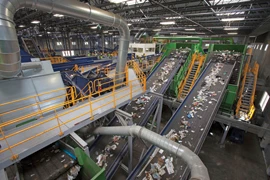
The second waste category consists of paper of all kinds (office paper, newsprint, magazine stock, corrugated cardboard) constitutes about 27%, over a quarter of municipal solid waste. This category includes a wide variety of material types and a wide diversity of shapes, sizes, and density. Depending on market demand, this material can be reused directly as pelletized fuel, indirectly as shredded packing and shipping material, or completely restored for reuse in its original form. The types of machines used for separating out paper products from the wastestream are as varied as the types of paper materials. Old corrugated cardboard (OCC) can be removed by disc screeners (a floor covered with rotating discs of different sizes and shapes that carry large light objects like OCC to the top of the wastestream for easy removal), while lighter papers can be extracted by air separators and the more precise air knives (blowers that use parallel sheets of high-pressure air blasts to minimize swirling and remixing of waste materials).
The third category, commercial plastics (HDPE, PVC, PET, etc.), makes up approximately one-eighth of the wastestream, or 12.5%. Plastic can be separated by type and ground down by a granulator for reuse as feedstock or scrim. And since it is made from fossil fuels, plastic also has a high BTU value, making it potentially useful as fuel.
The fourth category, ferrous and nonferrous metals, represents one of the waste materials more easily removed with one of the highest market values. Representing about 9% of a typical wastestream, ferrous metals can be extracted by magnets, while nonferrous metals can be removed by eddy-current separators.
The fifth category, glass of all colors (clear, amber, brown, green), including ceramics, makes up about 5% of the wastestream. Glass and ceramics can be recycled by color sorters, thanks to the technology of light spectrophotometry (LSP). LSP can distinguish between values colors of commercial glass (clear, amber, brown, or green) as well as cullet and ceramics. A near-infrared sensor determines what the color is and triggers a puff of air from a blower that pushes the material into the appropriate sorting bin.
The sixth and last category is a mish-mash of miscellaneous materials (“other”) and clothing, including rubber, leather, and textiles, making up about 12% of household waste. This material tends to be difficult to recycle and consists of materials with marginal market value. So it usually constitutes the bulk of the residue remaining after an efficient recycling process and is usually sent to the landfill for final disposal.
Latest from Waste Today
- Vermeer announces plan to build new facility in Des Moines metro area
- Buffalo Biodiesel shares updates on Part 360 application to DEC, Tonawanda facility progress
- Capstar Disposal expands roll off dumpster rental services
- Supreme Court strikes down IEEPA tariffs
- Casella details facility closures, expansion efforts
- Zero harm: Building a SIF prevention program for waste and recycling operations
- Casella posts a loss in Q4 2025
- McNeilus names Haaker Equipment first Dealer Partner of the Year