With severe weather events increasing solid waste amounts at landfills as well as increases in typical waste streams, achieving greater air space and attaining more efficiencies has become more critical.
Newly-emerging technologies are helping landfill operators rise to the task. Some are ground-based technologies that help operators gain more insight than in the past and others—such as unmanned aerial vehicles (UAV), also known as drones—are offering a bird’s-eye view of landfills.
“Drones make it easier and faster to collect data at landfills,” notes Lauren Elmore, president of Firmatek, a provider of drone solutions. “This means landfills can get data on density and remaining airspace more frequently, which ultimately helps the operators make better and more timely decisions.
“With better and more frequent data, operators can make adjustments to how and where they are using equipment for compaction, get the most out of a cell, and ultimately extend the life of the landfill.”
Given that it is new technology to the landfill sector, Firmatek staff teaches end users to fly drones in a time frame from a few hours to a half day of training, Elmore says.
“Depending on the size of the landfill, the client might fly a DJI Phantom 4 Pro or a senseFly eBee,” she says, adding that the company sets up the drone kit and conducts the training, which includes how to upload the data to a client portal.
“Since we do the data analysis and give the client actionable insights like density and remaining airspace, they only need to learn how to capture the data,” she adds.
Elmore says the feedback she gets from end-users is that as the technology is designed for ease of use, “People tend to like using it and enjoy having more frequent data analysis performed.”
Additionally, no changes have to be made to accommodate the new technology, she says.
“With drones, you don’t have to disrupt or change things happening on the ground in order to adopt the technology,” says Elmore.
Trimble also is using unmanned aircraft system (UAS) technology as a complementary tool on landfills, notes Jim Greenberg, product manager in civil engineering and construction for Trimble. He specializes in UAS technologies and landfill operations.
“If you think about the machine and achieving optimum density, when new material comes in it’s put on top of old material and that old material is slowly sinking,” he says. “But since we’re calculating volume and density from the machines on a daily basis, we don’t actually see that sinking per se because, throughout the day, you can assume everything is stable. Over a month or so, an entire landfill can settle quite a bit.
“The machine system monitors daily operations and what you’re achieving and the UAV monitors over time how a landfill is behaving relative to the application of this technology.”
Trimble has been flying UAVs over landfills on a quarterly basis in some cases, but it could be a valuable practice to do it more often, Greenberg notes.
“You can see if you’ve achieved optimum compaction, if the landfill is continuing to settle, and how much it is settling,” he adds. “We’re calculating remaining air space, but that’s just in the active area. The other areas are settling, so you’re getting more air space.
Data being collected on the ground also is providing more details for landfill operators.
Trimble offers a Compaction Control System which is used on four-drum compactors and features a screen on which the operator can view what’s going on in the landfill, notes Greenberg.
The system also includes a GPS receiver on the roof of the compactor and angle sensors to determine the pitch roll of the machine, he says, adding that it keeps track of the compactor’s location on the landfill and the elevation of its wheels and maps as the compactor travels over the solid waste.
Jules Muir, a segment manager at Trimble Planning Solutions, says a key benefit of the Compaction Control System is its ability to calculate density.
“Most landfills only calculate the density a few times a year,” he says. “The system can calculate the density daily so the back office can see what’s going on and start analyzing trends earlier. Compaction machines represent a huge investment.”
Trimble’s VisionLink Landfill calculates compaction densities using compaction information from Trimble or Caterpillar compaction systems and scale weights entered by the operator.
Fleet information can be accessed on mobile devices as well as desktop devices.
When coupled with landfill compactors that have 3D/GPS Trimble CCS900 Compaction Control Systems or Cat AccuGrade Compaction Control Systems from Caterpillar or Trimble, VisionLink Landfill tracks the compaction and fill process onsite.
It tracks the compaction efforts and calculates the waste volumes placed and the compaction densities achieved in active cells.
Technology is augmenting the work of compactor machines that are becoming more sophisticated.
To assist landfill operators in improving efficiency and maximizing air space, Caterpillar offers Cat COMPACT for landfill compactors.
Caron’s Double Crown teeth
“This technology puts mass mapping in the cab so operators can achieve proper coverage and avoid thick lifts. It can also utilize the Cat Compaction Algorithm that gives operators positive feedback on the level of compaction they are achieving,” notes Dann Rawls, development manager, Caterpillar.
“All of this data can be sent off-board to VisionLink where managers can monitor the coverage and compaction, enabling them to make changes to the operation if necessary,” he adds. “This technology is available factory-installed on Cat compactors and for a contractor’s local SITECH dealer for non-Cat compactors.”
The two-part training first introduces an operator to the use and functionality of the mapping display, a process taking about two hours, says Rawls.
“Second, if the contractor chooses to allow the data to be sent to the back office, the office personnel is introduced to the use and functionality of the office software, which takes about two hours as well. A complete system can be training on in half of a day.”
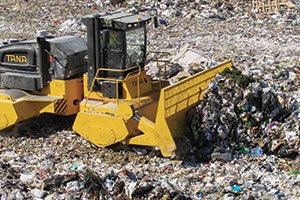
The TANA Compactor, offered through Humdinger, features a full-width twin-drum construction, rigid frame construction, and crushing teeth.
It is designed to offer more coverage per pass, notes Austin Phares, regional sales manager for Humdinger, adding that this means operators are compacting more waste with every pass.
“It also means less blowout,” he says, referring to waste that is dug back up during the compacting process on some equipment, which the full-width drum is designed to mitigate.
There is a constant 35-inch ground clearance, Phares points out of the TANA.
The TANA also is designed with smaller wheels and the ability to make more teeth strikes, he says. The machine has two joysticks: one for operating the ride and one for operating the blade.
One of the biggest factors in the TANA learning curve is getting accustomed to the cab positioning, says Phares.
The TANA compactor, like most, has two sections: a front with the blade and a back section that is typically where the engine is located.
“Traditionally, the driver always sits in the back section. Ours is in the front section,” says Phares. That was purposely designed to balance the weight better and enable the driver to look over the blade, he adds.
The TANA compactor comes in five different sizes—from the E260, which is a 60,000-pound machine, to the E520, which is nearly 120,000 pounds, says Phares.
Phares says operators have indicated that when they use the machine, “They enjoy their job more and can work longer hours without it affecting them. The rigid frame means it doesn’t oscillate side to side. The full-width drum offers a more comfortable and smoother ride and the operator is not getting thrown around in the machine, which makes a difference in an eight-hour day.”
Another option on the market comes from BOMAG. Its 57,300-pound BC473RB-4 Refuse Compactor is designed with features found on the larger 120,000-pound landfill compactor.
The Pakall polygonal wheel design puts the entire machine’s weight on a single tooth for maximum material shredding and compaction. Front and rear individual row wheel cleaners are designed to minimize debris buildup on the wheels and ensure maximum tooth penetration so the machine compacts more material in the same amount of space.
The bolt-on articulated joint delivers +/- 15-degree oscillation to keep the wheels in constant contact with the trash. Providing full-width two-pass coverage, the BC473RB-4 hydrostatic drive is designed to reduce fuel consumption and increase pushing power and tractive effort. Two wire cutters per wheel are designed to prevent wire and cable wrap and subsequent damage to seals and drive components.
The BC473RB-4 compactor is constructed with a sealed tub design to eliminate the need for belly pans to keep the engine bay free of trash and reducing fire hazard. The engine air intake is drawn from above the hood for clean air quality, allowing the 281 hp Tier 4 Final diesel engine to run cool.
The sound suppressed operator’s cabin is vibration-isolated to reduce operator fatigue. A vertical grid design on the 11.8-feet-wide dozer blade is designed to enhance operator visibility of the trash pile. The blade has reversible and interchangeable bolt-on cutting edges to extend service life.
A landfill in Cortez, CO, realized increased densities after switching from baling to the 57,000-pound BOMAG BC 473 RB-4.
Shak Powers, manager of the Montezuma County Landfill, notes that “in the landfill business, we are selling air space, so we need to be able to utilize as much of that air space as possible.”
The landfill—which opened in 1996 as a baling facility—takes in a daily average of 100 tons of MSW from the city of Cortez, Montezuma and Dolores Counties, and portions of southeast Utah, northwest Mexico, and northeast Arizona.
Montezuma County Landfill managers and county commissioners had expressed concern that the two-ram baler wasn’t achieving optimum densities—while the bales themselves were achieving expected densities, overall compaction densities were not where they needed to be when factoring in loose fill that could not be baled.
“We were getting between 1,150 to 1,300 pounds per cubic yard densities with our bales,” says Powers. “But we also took in heavy construction debris, metal, concrete, and other material that cannot be baled. About 30 to 35% of our waste stream could not be baled and was buried in loose-fill cells. Overall compaction densities ranged from 900 to 950 pounds per cubic yard.”
There also were concerns that the baling facility was labor-intensive and inefficient. Since the bales required a certain amount of moisture to be densified, workers had to co-mingle dry and moist waste prior to loading it onto the baler’s conveyor.
That required two workers to run the baler, load the bales onto a trailer, and clean up debris, with another worker driving the bales to the cell to be stacked.
Powers notes the operation was handling the waste stream three times with five workers.
County officials also sought to increase the types and percentages of material recycled. With the baler tied up to handle the waste stream, Powers’ crew could only recycle paper and some plastics.
“Envisioning a plan to switch over to compacting the waste stream with a landfill compactor, the commissioners set an ultimate goal of a 30% diversion rate for recyclable materials,” he says, adding that the plan included recycling cardboard, metal, mixed paper, and #1 and #2 plastics.
In their search for a landfill compactor, county landfill officials sought to choose a compactor to maximize the landfill space of 56 acres, which was designed with a 40-year life and in considering all factors, chose the BOMAG BC 473 RB-4.
The wheel design—with twice as many teeth as other compactors considered and the wheels being offset front to rear—was one factor in the choice, says Powers.
“We went from handling it three times with our baling process to handling it only one time with the landfill compactor,” he says. “Our workforce requirement for landfilling went from five to two people, which allowed us to use our workers more efficiently by shifting these workers to the recycling circuit and maintaining the site.”
The landfill compactor is kept in the waste stream because the teeth penetrate the clay base where the waste is dumped, making it difficult for some of the smaller truck traffic to dump material. The dozer doesn’t penetrate the ground, so it is used in the area where the traffic dumps the waste, notes Keith Hensel, sales representative for Power Equipment.
The compactor is designed to deliver high pushing power, allowing the operator to easily spread mounds of material with the dozer blade into more manageable, level lifts and reach desired compaction density in a few passes.
“The tooth design provides a crushing and kneading effect, where each tooth penetrates and compacts the entire lift to avoid bridging of material,” says Bill Stalzer, BOMAG territory manager for the Rocky Mountain State. Powers adds that the material bridging leads to air voids, which lowers density and shortens the life of the landfill.
A cell survey conducted just after the BC 473 RB-4 compactor was put to work showed an overall compaction density of 1,200 pounds per cubic yard, with density having increased to approximately 1,300 pounds per cubic yard.
“We are getting 44% higher compaction with the BOMAG machine compared to baling, and this has added 5.4 years to the life of our landfill,” says Powers.
It’s important to consider using resilient components such as tips or teeth, blades, and parts that mitigate wire wrap problems, industry experts point out.
In choosing the correct product, landfill operators should consider how many hours they expect to get from a machine, how long they expect to keep the machine, and the environment in which the compactor is typically operating, including waste streams and soil types, notes Dale Mills, marketing sales manager for Macpactor.
Diamond tips are among the compaction technologies offered by Macpactor.
The company’s M-Trax Diamond tips are designed for maximum demolition, elimination of side slippage when working across the face, improved surface finish, and high abrasion resistance as well as better compaction and better density. They are available in 7-, 8- and 10-inch height options.
The product is manufactured for Caterpillar, Mills notes.
A diamond tip weighs 82 pounds and that weight helps to provide more traction at a faster rate, thus using less fuel, he adds.
Wire-wrapping is another situation to consider in compaction technology, notes Mills.
That has become especially evident in recent months with the aftermath of the several hurricane hits in the US and its territories that has created a significant amount of construction and demolition debris.
For example, with mattresses and similar types of solid waste being discarded after flooding or wind damage, the wires and other materials have a tendency to get pinched by the tip on the inside row and when it gets pinched, it wraps around the axles, notes Mills.
That can result in expensive damage repairs to the compaction machine, says Mills, adding that Macpactor manufactures a cleat guard to help mitigate that problem.
While there isn’t a learning curve in the use of diamond tips, they necessitate a different approach to maintenance, notes Mills.
“That material is so hard, you do not want to be welding on it as some people do to keep building up older, less expensive tips,” he says. “This product is so hard, you would actually do damage to the tip.”
Macpactor’s tips are designed to work with natural slopes. “As the wheel goes into and comes back out of the ground, it has less tendency to fluff the material,” he says.
There are sites in Mississippi, for example, where the “gooey clay” material can get stuck in the pockets of the cleat, build up on the wheel, and slow down compaction because the tips are penetrating the waste, says Mills.
Allen Annett, supervisor for the Carson City, NV, landfill says an end of the year volume analysis, in the first year of using the Macpactor diamond cleats in conjunction with a new compactor on the solid waste, proved a “significant improvement” since there was a 5% increase in waste across the scale but the airspace consumed was 36% less than the previous year’s volume using Cat Plus cleats.
“The density of MSW for the fiscal year 2012–13 was calculated to be approximately 2,180 pounds per cubic yard, which is above the expected minimum,” he adds.
The Caron Compactor Company’s new Double Crown teeth for its largest units are designed to provide more demolition qualities and enhanced airspace with its aggressive and taller 8.5-inch design than previous products, notes James O. Caron, company president.
Providing wheels with two types of teeth, taller and more per wheel, is designed to improve results by breaking down material faster and into smaller sizes, thus providing increased density capabilities, more traction, and higher wear life, he adds.
For example, Caron’s product can be used on Caterpillar 836K, 826K, and 816K landfill compactors. Its pin-on teeth include the 7-inch SDP II and the 7-inch DuraMega 816K, designed to excel in high abrasive conditions.
The Double Semi-U (DSU) trash blade, used on the 826K, is designed to funnel trash under the compaction wheels as it spreads solid waste to reduce the amount of loose material under the center of the machine. Its center splitter helps break up piles of waste left by compactor tracks and allows smaller compactors to strike loads head-on rather than from the side.
Also used on the 826K is the Semi-U (SU) trash blade configuration, which is designed with a wider profile and angled external wings confining either solid waste or soil to the blade path.
Teeth options include 7-inch SDP II and 7- and 8-inch DuraMega for Cat cleaner bar applications and 8-inch SuperMega for high abrasive conditions.
An 836K can be equipped with a DSU trash blade and wheels manufactured with 8-inch DuraMega teeth for Cat cleaner bar application. The SU—in conjunction with 8-inch SuperMega teeth—can also be used.
Caron recently introduced to the 836K market an 8.5-inch Double Crown tooth that, in addition to the 8-inch SuperMega teeth, is designed to add demolition qualities and wear life for abrasive conditions.
The new Double Crown also incorporates Caron’s ShedEdge surface technology, designed to better aid with keeping wheels clean in wet, cohesive materials.
The company also provides alternating tooth patterns, an optional wire safeguard for use in intermittent and continuous configuration, and a seal protection group developed in conjunction with the Cat axle guarding as a way to reduce or eliminate wire and debris wrapping on the axle between the inside of the wheel and the machine’s frame.
Latest from Waste Today
- Vecoplan to present modular solutions at IFAT 2026
- Terex Ecotec appoints Bradley Equipment as Texas distributor
- My Green Michigan expands depackaging capacity
- Washington selects Circular Action Alliance as PRO
- Ten-8 Industrial opens new central Florida service center
- Triumvirate Environmental acquires Environmental Waste Minimization
- Official NYC Bin availability expands ahead of deadline
- US Food Waste Pact’s 2025 Impact Report shows decrease in food waste