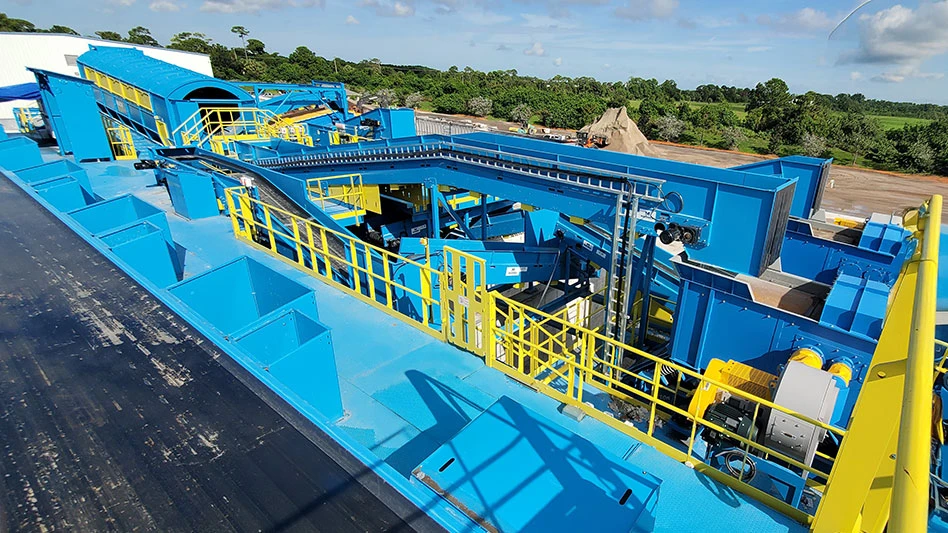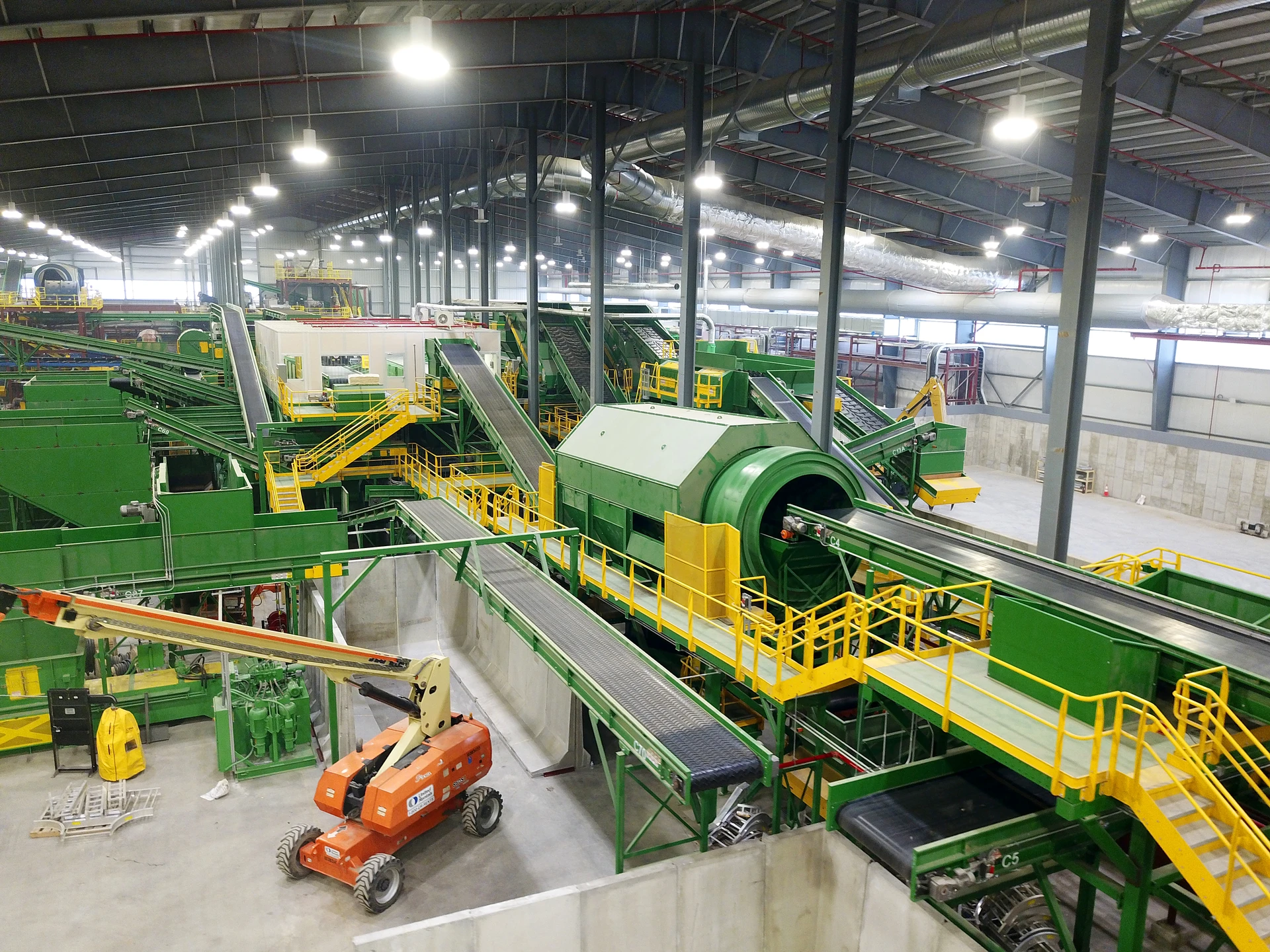
The main goal for recycling operations is to be sustainable and look out for the safety of the employees, points out Cal-Waste plant manager Jose Casillas.
To that end, Cal-Waste recently became the first MRF to partner with CP Manufacturing in placing an auger screen before the pre-sort that essentially fractions material off.
MRF equipment industry experts say 2020 may be the best year to date for innovations.
A significant influence is the Chinese National Sword. Enacted in 2017 and regarded as the “second green fence,” it has imposed the country’s strictest regulation on solid waste raw material imports. China’s policy change is a major consideration in the design or retrofit for MRFs throughout North America.
“This is when we really start to see the effects of the innovations in the market that have the potential to dramatically affect the industry,” says Mat Everhart, CEO, Stadler America.
Everhart says that 2020 “is going to be a huge year for innovation in sensor sorting technology in different combinations of sensor types used in both optical sorters and robots—the ability to use artificial intelligence to be able to have machines communicating between each other on the Internet and in a plant to predictively modify their parameters or modify their performance within a preset limit of high and low parameters.”
Everhart concurs that “necessity is the mother of invention.”
That’s especially the case in the North American market, which “for a long time has been able to coast on only a nominal amount of technological innovation,” he adds.
Since its inception in 1927, Cal-Waste, a full-service collection company serving California’s Central Valley region, has positioned itself to be a pioneer in its region to introduce new services and technologies.
The company also has a MRF. In 2013, Cal-Waste managers reached out to CP Manufacturing for helping to build its first line.
“We saw the need to grow with the expanding recycling market with some contracts that came up around us,” says Casey Vaccarezza, director of operations. “We reached out to CP a second time to rebuild our second version.”
“It's a new concept that CP put together,” says Vaccarezza. “We’re happy with the results. It’s something new in the industry.”
The setup helps Cal-Waste with challenges in material recovery and labor, notes Casillas.
“You don’t have people on the pre-sort tearing bags or grabbing heavy stuff,” says Vaccarezza. “It separates that material right out the gate before it gets to a sorter’s hands where they have to handle something bulky in a bag and not know what’s in that bag.”
Casillas points out that while Cal-Waste prides itself on producing top-shelf, quality materials against the backdrop of the China National Sword’s stringent requirements, there lies a challenge in that “the price is not what it used to be in the past.
“Before 2017, you would get up to $90 a ton of mixed paper and nowadays, we’re very fortunate if we get $20 or $27 for what they call premium paper. It has had quite an impact on the business.”
Still, says Vaccarezza, the innovations Cal-Waste has instituted have set the facility apart.
“The main idea behind the way we run our MRF is that we run a processing facility and we make a product,” he says. “We’ve always taken a lot of pride in creating that quality product out the back end of our MRF. While we’ve always had some struggle with the China Sword, we've always had top quality, so it didn't hurt us as hard as it hurt others."
“The recycling industry in America is going through a bit of a transformational era,” notes Nick Davis, product design engineer for CP Manufacturing. “The material doesn’t stop coming. Where does the material go? A large factor in that is the cost of producing the material. When we look at a MRF, we look at the labor pool within a MRF.”
CP Manufacturing focuses on the pre-sort area with its MSS CIRRUS FiberMax optical sorter, focused on high-speed paper sorting to maximize fiber quality to meet more stringent standards with fewer people, notes Davis.
Safety, as well as efficiency, is a byproduct of the process, says Davis, adding that issues such as potential injuries from repetitive motions and hypodermic needle injuries are minimized from having a smaller labor pool.
Cal-Waste is CP Manufacturing’s first single-stream operation to incorporate an auger stream as a primary separator.
“What they saw is that to make the pre-sort more efficient and safer, you have to get the small material away from the big material before the pre-sort,” says Davis. “The pre-sorters should only be looking at big material. You don’t expect manual sorters to pick paper out of a mixed stream with everything. We concentrate the paper into more focused streams and sort that."
CP Manufacturing’s design principles do not lean toward the automation of the pre-sort, but the elimination of the pre-sort through use of more robust mechanical equipment, says Davis.
With the elimination of pre-sort, an operation can better address residue in the system and the increasingly difficult to recycle materials with fewer people doing easier, safer tasks, he adds.
That has generated high uptime as a result, says Davis, adding that sorters don’t have to constantly stop the system and risk jamming it.
In September 2019, the city of Bangor, ME, transitioned to a new arrangement in which residents will dispose of all of their recycling with their trash and leave the mixed waste to be picked up curbside every week.
Closing the local recycling station is part of the city’s switch to a new integrated waste conversion plant in Hampden developed by Coastal Resources of Maine using Fiberight technology.
SCS Engineers was hired to provide its technical expertise and experience in planning large municipal solid waste and biogas programs and facilities. The company provided an in-depth examination and analysis of the technologies, program sustainability, and potential economic impacts of the facility.
The new facility in Bangor includes a MRF, organics processing, plastics processing, anaerobic digestion, and wastewater treatment.
The integrated technology is designed for ease of customer use and is intended to increase recycling rates without necessitating extensive outreach programs.
Benefits cited by Coastal Resources of Maine include doubling recycling rates, addressing global climate and sustainability commitments, and creating value from otherwise wasted resources.
The advanced technologies have been undergoing final testing at the Hampden, ME, facility and are already in use at automated MRFs in the US and Europe.
The end product is designed to be cleaner and provide more diverse material types for reuse as new products.
The Hampden facility’s advanced MRF is designed to have a high degree of separation, recovery, and monetization of commodity products and then employs additional processes for generating clean cellulose, engineered fuels, and biogas from traditionally non-recyclable materials.
The facility will serve 116 municipalities and public entities represented by the Municipal Review Committee, a nonprofit organization currently managing waste disposal activities in eastern and northern Maine.
Bob Gardner, SCS Engineers senior vice president, points out that input and line capacity are the two prime factors of consideration in designing or retrofitting a MRF.
Coastal Resources of Maine has a design specification of 45 tons per hour, Gardner says. “That determines if you have one line. You have to consider the availability and downtime to determine how much the capacity of your plant is.”
The correct sizing of the tipping floor is another factor in design.
“It’s based on your surge,” he says, adding that 10 a.m. and 3 p.m. are typically the two most common times garbage is brought in to the MRF.
From there, each process is considered.
“As you come in from your original in-feed into your MRF, you then immediately begin separating materials,” he says. “Each conveyer from that point out is going to be sized in terms of speed configuration with what type of materials you're using for the belts. All of those things will change depending on how much material you anticipated to be separated in each phase of the process.”
Gardner says optical sorters and robotics are a prime focus of emerging technologies. Optical sorts play a key role in the segregation of mixed materials, he adds.
“When you have the #1, #2, #3, #4, #5, #6, or #7 plastics, you can begin to segregate with optical sorters. There are a lot of ways you can configure these things. It's kind of a ‘Wild West’ what they’re beginning to do—especially with mixed waste—to be able to get as much material as possible,” he says.
Whether it’s the driving factor of the China National Sword or a fuel product a solid waste operation is trying to sell locally, it comes down to the purity of the material being sold and the desire to generate the highest possible price for the material, says Gardner.
The China National Sword is causing people to innovate and consider putting in additional processes to produce a product that can go to market.
Gardner calls emerging MRF technology a “wild, wild West. Things are evolving daily in response to market conditions. It’s a very tough market. It’s scary in many respects because these facilities are capital-intensive. Investors have invested significant amounts of money based on assumptions. And there are good assumptions that were made from a financial perspective at the time.
“With the planning and cooperation of many, Fiberight’s providing a truly sustainable solution in Maine while solving several challenges when consumers separate their recyclable materials and eliminating contamination,” says Gardner.
“The facility is capable of reusing nearly 150,000 tons of what formerly went into a landfill, is processing more municipal solid waste into high-value commodities, and is helping local municipalities and private waste haulers offset the cost of recycling.”
Greg Gesell, P.E. project manager and senior solid waste engineer, HDR, says the China National Sword is creating more of a strain on MRF equipment and operations.
However, “recycling economics is driving the issues for facilities and National Sword is only a part of that,” he adds. “Would the severe price declines have occurred without National Sword? Maybe. We certainly needed to re-evaluate recycling practices in the US, improving quality or returning to high quality as opposed to focusing principally on quantity or landfill diversion.”
Dick Reeves, director of resource recovery for General Kinematics, agrees, saying the China National Sword has forced companies to look more closely at their process to see how they can improve the final products.
“In return, equipment designers have to look for more creative ways to optimize the process, increase cleanliness, and efficiency,” adds Reeves.
Reeves notes that the main factors that go into a MRF design focus on flexibility, durability, and adaptability.
“Equipment designed 20 years ago doesn’t translate well to today’s wastestreams,” he says. “We need to consider equipment that can process a wide variety of materials with varying compositions and with frequent out of spec contaminants.
“While the basic sorting premises are the same—to reduce volume by size, density, and composition—we need to incorporate more automation to help reduce costs.”
Rusty Angel, Eastern Territory sales manager at Machinex Technologies, notes that the main factors considered for MRF design are quality, capital investment, headcount reduction, and tonnage capacity—and all must be correctly balanced.
Angel says the China National Sword is “absolutely” having an impact on designs.
“The quality of fiber needed to compete in an extremely competitive marketplace due to increased domestic supply has spurred investment in technology,” he says. “Many MRF operators have slowed their lines back to the original system design parameters and/or added optical sorters or robots to help produce cleaner materials.”
Sorting efficiencies depend on how they are executed.
“Human positive sorting of materials in a MRF will nearly always result in higher purity than automation,” he says. “However, it is impossible to have all-human sorting and keep up with the tonnage demands found in a typical MRF.
“Automation affords significantly higher tonnage capacity with high recovery values, but some purity is sacrificed. Our designs continue to work on the balance between recovery and purity while remaining financially justifiable.”
“Generally speaking, the end user’s needs for a customized design is the first and foremost factor that goes into a MRF design,” notes Everhart.
“The first thing you have to do when you're designing or making changes to a system is understanding what’s driving it,” he says. “It’s getting a good handle on what the inbound material looks like and the processing goals. If it’s a retrofit of a facility, it’s understanding where they have existing problems because most likely in a retrofit, they already know their material stream.”
Another factor is understanding the best opportunities from a standpoint of cost avoidance or revenue generation for the MRF operation.
Independent of technology manufacturers, Stadler serves as an integrator of the individual elements of a MRF system such as the sorting equipment, conveyor belts, and screens. That gives the company the latitude to apply the best solution for the customer, says Everhart.
It also entails understanding synergies among a particular mix of vendors to solve challenges as well as leveraging employees’ skill sets to maintain an operation’s widely varying pieces of equipment, Everhart says.
“To create a system that is more efficient while not creating additional costs because of all of the specialty labor and tooling, it’s best to look at not only what problem do we need to solve, but who would be the best suppliers to bring in to integration so that the end-user leaves the project with a system that has a great deal of synergy,” he adds.
Gesell notes there are “numerous and notable alternatives” from which to choose, including “better sensor devices, more successful picking methods, safer and more user-friendly robots that can be right next to manual sorters, robots for construction and demolition (C&D) or e-waste materials, all for much lower prices.”
Speed has always been a limitation since systems are designed to grab one item at a time and can’t compete with optical sorters in high-volume applications, says Gesell.
“A robot might serve a QC role to complement an optical sorter, grab lower volume materials, or to recover missed items on a residue line,” he adds. “In these types of roles, the number of picks per hour may not be as important but the robot doesn’t get tired and can be trained to look for more than one type of material. Thus, they are showing up in innovative ways for all types of recycling operations—not just single-stream applications.”
Such technology “does a great job of recognizing many types of commodities, can be built to handle all sizes and weights of materials, but does need to improve the successful picking rate,” he adds. “This technology will be important to watch as improvements are made and costs come down to be competitive with sorters.”
Gesell points out that while optical sorters aren’t new—having started with high volume container capture such as polyethylene terephthalate (PET) water bottles—“they are still the high volume champion but now are used in a typical MRF in many high volume locations for all types of containers and paper (fiber) in lots of innovative labor-saving applications.
“What is new are the improved sensors—refined housing designs and arrangements that increase the accuracy and ability to maintain that accuracy, better air distribution, more jets, maintenance needs, and safety,” he adds.
Gesell notes that some early models are being upgraded to improve performance.
“Equipment suppliers are very creative using teams of optical sorters to capture multiple commodities and ultimately subdivide them into specific commodities,” he says. “Optical sorters can outperform manual fiber and container sorters in many applications not only because they can be faster, but also because if fitted with the right sensors, they can make judgment calls regarding material quality issues.”
Of the latest developments in sensor technology and optical sensing, Gesell points out that sensors are critical for the success of robotic and optical sorters.
“Improving the resolution and speed of sensing has resulted in better near-infrared (NIR) technology than many of the early offerings were capable of achieving,” he says. “Now NIR is used with color detection in wider spectrums and when needed, some suppliers can offer other technologies borrowed from food processing, mining, or other industries exploiting other properties.”
A few of the more common technologies include electromagnetic and induction, X-ray (transmission and fluorescence), infrared (heat dissipation or light absorption), specialized lasers, density, hardness, and other techniques to more clearly distinguish the desired materials from contaminants, says Gesell.
Although most MRFs don’t need these advanced technologies, a system designed to allow for future changes is very important, Gesell notes.
Examples include better color sorting; determining if a piece of paper is too wet, dirty, or has too much ink for the particular product; or if they can sort types of metal, compost, or e-waste, he says.
Local education and resident acceptance of quality standards are very important to position a facility so it can achieve the high-quality standards, says Gesell.
“Starting with better quality feedstock helps,” he says. “Today’s quality requirements require higher technology facilities for larger MRFs. Careful equipment selection and arrangement will allow for the highest commodity quality guarantees. Equipment performance should also consider the ability to maintain those performance levels for ongoing operations.”
Latest from Waste Today
- Vecoplan to present modular solutions at IFAT 2026
- Terex Ecotec appoints Bradley Equipment as Texas distributor
- My Green Michigan expands depackaging capacity
- Washington selects Circular Action Alliance as PRO
- Ten-8 Industrial opens new central Florida service center
- Triumvirate Environmental acquires Environmental Waste Minimization
- Official NYC Bin availability expands ahead of deadline
- US Food Waste Pact’s 2025 Impact Report shows decrease in food waste