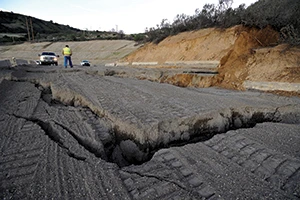
In March 1996 outside of Cincinnati, OH, the worst landslide in solid waste industry history occurred, resulting in a mass movement of more than 1 million cubic yards, a distance greater than 300 yards. Similarly, disastrous slides have occurred around the world: Hiriya, Israel, in the winter of 1997; the Payatas landfill in the Philippines (resulting in 250 deaths); the USA landfill in 2011; the Chirin and Big Run landfills in Kentucky, both in 2013 . . . and dozens, if not hundreds, of small slope movements and sliding cover displacements that occur each year. There are many causes for these landfill slope failures (over building of waste slopes, freeze/thaw conditions, weakened foundations, poorly installed geosynthetics, and so on), but in almost every case, running water and the erosion it causes played a part.
Soil erosion has special consequences for landfills that are far more serious than those found at conventional construction sites. There are many factors that make landfills unique, including the waste itself, the protracted nature of landfill activities, subsidence of the waste over time, and their post-closure care requirements. Given the disastrous consequences of a major waste slope failure, a landfill operator has to be wary of any structural weaknesses that could lead to instability.
Much of this can be addressed at the design stage. An experienced engineer will be able to lay out an operational and development plan for a landfill that meets regulatory requirements for safety. The site operator has to follow through on the engineer’s designs to ensure that waste placement operations and the movement of heavy equipment does not trigger a slope failure during the landfill’s mid-life operational stage. And while below-grade canyon fills buttressed on more than one side by natural terrain are less vulnerable, all landfills are susceptible to potentially disastrous slope failure.
The weight of the waste and soil creates a driving force that results in either a sliding motion along a defined surface (like a geomembrane liner used in the final cap and cover system), or a rotational mass block movement of a large section of the slope itself. It is the component of the mass weight that acts parallel with the potential failure surface that generates the driving forces that can cause a slope failure.
Friction forces resisting these movements of waste and soil are also created by the weight of the mass. The force component of the mass weight that acts perpendicular (normal) to a potential failure surface creates friction forces acting parallel to these surfaces in the opposite direction of the driving forces that can cause a slope failure. The combination of driving forces and resisting friction forces act in three potential failure conditions: sliding, rotational, and mass block.
Sliding failure is the movement of a layer of cover soil along a well-defined plane. This plane usually consists of a geosynthetic, and so sliding failure is a failure mode that occurs almost exclusively in final cap and cover systems.
Mass block failure also occurs along a well-defined plane, but in this case, the failure is at much greater depths along the bottom of a landfill and its liner and leachate management system. This failure plane extends down through the waste until it hits the bottom, travels along the bottom and up the side slopes of the landfill floor, until it exits ant the toe of an adjacent slope.
Rotational failure also extends down through the waste from the top of the slope, but instead it follows a curved path that takes it out near the toe of the failed slope without encountering a well-defined physical surface. This failure is effectively a rotational action of waste mass through the waste itself with a turning movement around some geometric point located above the waste slope.
Latest from Waste Today
- Vecoplan to present modular solutions at IFAT 2026
- Terex Ecotec appoints Bradley Equipment as Texas distributor
- My Green Michigan expands depackaging capacity
- Washington selects Circular Action Alliance as PRO
- Ten-8 Industrial opens new central Florida service center
- Triumvirate Environmental acquires Environmental Waste Minimization
- Official NYC Bin availability expands ahead of deadline
- US Food Waste Pact’s 2025 Impact Report shows decrease in food waste