The idea of converting waste into energy is not a new one. However, innovative companies are always developing new solutions or making tried-and-tested methods more effective. Generating electricity and heat from waste are two forms of waste-to-energy methods. Incineration is the most common process used to recover energy from waste materials. Other waste-to-energy (WTE) methods include anaerobic digestion and landfill gas recovery.
We spoke with various experts in the waste-to-energy business, including representatives from Bioenergy Devco, Waga Energy, Air Burners, and Archaea Energy, to learn more about what these companies are doing today to more efficiently transform waste into usable energy.
Anaerobic Digestion
Bioenergy Devco has been in the anaerobic digestion business for a while. It’s a natural, microbial process of taking organic material and feeding it to microbes that transform it into biogas. The biogas is mostly methane, and some CO2. The rest of it becomes a material called digestate—similar to compost. “It transforms organic material into methane that we can capture,” says Shawn Kreloff, CEO of Bioenergy Devco.
“If food waste goes into a landfill, methane can leak out. Landfills are probably one of the worst methane emitters we have,” he explained. “We’re kind of enabling sustainable farming. Instead of chemical fertilizer, this is a natural fertilizer. It’s much better to have microbes than chemicals in the soil.”
The technology has been proven in Europe; over the past six years, Bioenergy Devco has taken that technology to the U.S. The first project is operational and is being commissioned in Maryland. “We’re taking food waste and recycling it, instead of putting it in a landfill or incinerator,” Kreloff said. The resulting gas is put right back into Baltimore Gas and Electric’s pipeline, he noted.
“Our second project is going to be out in the Delmarva Peninsula, which is one of the capitals of the poultry industry in the U.S. Excess poultry litter and poultry sludges were being put on farmers’ land raw, or land-applied. A lot of that was ending up in the Chesapeake Bay after it rained, so they had nutrient management issues.”
Bioenergy Devco’s second plant will help to solve some of the region’s issues with water quality and soil quality. The company has about 25 projects in total that are currently under development in the U.S.
Bioenergy Devco has partnered with another company to transform its biogas into hydrogen. Most hydrogen in the U.S. comes from using steam to upgrade methane, Kreloff explained. “We’re also able to separate and trap CO2, and that can be made into food-grade CO2,” he said. This capability has the added benefit of keeping additional CO2 out of the atmosphere.
From a financial perspective, Bioenergy Devco’s anaerobic digestion facilities are competitive with other methods of dealing with organic waste, comparable to landfill tipping fees or using incinerators.
Another benefit of their solution is that they can often locate their facility fairly close to the source of the feedstock. This is because the footprint of one of the plants is five to six acres, explained Kreloff, whereas an incinerator could be 20 to 30 acres—and a landfill can take up hundreds of acres.
This also helps to keep transportation costs down, which is particularly useful for the municipal solid waste industry given the current climate of labor shortages and high energy costs.
Upgrading Landfill Gas to Renewable Natural Gas
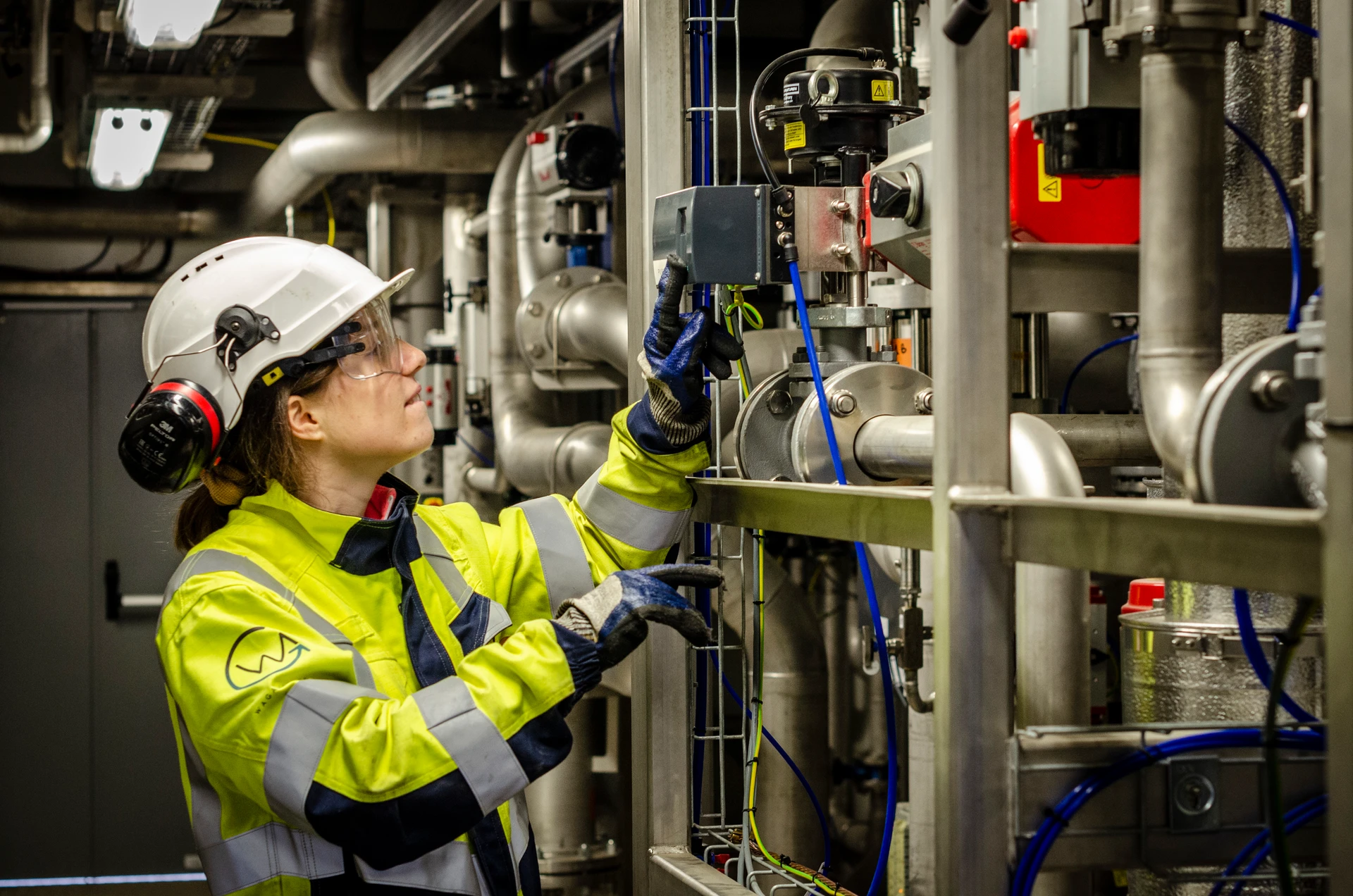
The company Waga Energy was founded in France in 2015. Waga Energy builds, owns, and operates landfill gas upgrading units, called the WAGABOX, which are proven, compact, and modular. The proprietary technology captures landfill gas and upgrades it into renewable natural gas (RNG).
According to Tanguy Largeau, Commercial VP, the WAGABOX units use membrane filtration to remove carbon dioxide, or CO2, from landfill gas. The system also uses low-pressure cryogenic distillation to separate the methane from the oxygen and nitrogen. “A major advantage of our technology is the ability to deal with high levels of nitrogen in landfill gas,” Largeau explained.
The company has commissioned 13 WAGABOX units over the last five years that are currently operational as beneficial-use projects. Waga Energy commissioned its first plant in 2017, and it has since been installed at a range of landfills. It is especially effective with small and medium-sized landfills, according to Largeau, and it works at sites with very low gas flow levels and with levels up to 3,000 scfm and higher. He added that they are currently in the process of commissioning 13 more units, including five in North America.
In September, Waga Energy announced its first RNG project in British Columbia which could begin operating in 2024. The project includes installation of a high-capacity WAGABOX at Hartland Landfill on Vancouver Island.
The WAGABOX solution does not require customer investment. A portion of revenue generated from selling the resulting RNG is actually shared with the customers, Largeau remarked. “It’s a risk-free approach,” he said. The technology generates significant revenue for both public and private landfills.
He added that these projects can help landfill operators to maintain good relationships with the residents in the community that live near the landfill. “If you are able to deal with a high level of nitrogen, you can pull more gas out of the landfill, reducing fugitive emissions and therefore addressing odor issues,” he stated. “You will have odor issues under better control. It’s a win-win.”
The team at Waga Energy is constantly working to improve upon the WAGABOX system. In 2021, each unit in operation achieved an uptime of at least 95%. The units produced 145 GWh of RNG last year, demonstrating a 26.7% increase compared with RNG produced in 2020.
Burning Wood Waste
Air Burners, a company that has been around for 25 years, offers solutions that process vegetative waste or wood waste into a nutrient-rich soil amendment called biochar. Air Burners has machines on every continent except Antarctica, according to Brian O’Connor, president of the company. “In the U.S., more than 50% of green waste is not recycled,” he said.
“Our air curtain burners, such as the FireBox system, are designed with thermo-ceramic walls,” O’Connor explained. The air curtain technology traps and re-burns smoke particles from burning wood waste to reduce the pollution from particulate matter, or smoke. Once the particles are small enough, they can escape through the air curtain. The smallest machine can burn 1-2 tons of waste material per hour, while the larger machines can burn 10 or more tons in an hour. They release almost no visible smoke, and it minimizes the environmental impact significantly.
The key difference between an air curtain burner and an incinerator is that the latter requires a secondary source to create heat; that isn’t necessary with a system like the FireBox. “We burn it faster and cleaner,” O’Connor said. “It’s essentially a pollution control device for open burning.”
Air Burners has recently developed a new system that converts biomass to energy for charging electric vehicles at a logging or land-clearing site. He explained that there isn’t currently another solution for transforming larger wood waste material into energy. Existing systems require that the wood is first broken down into smaller chips or mulch, then natural gas is added to burn the wood waste.
The PGFireBox system developed by Air Burners is portable and generates power from unprocessed biomass. The PGFireBox uses both air curtain pollution control technology and Organic Rankine Cycle power generation. It includes a power module and a cooling module.
The newest system designed by Air Burners, the name of which hasn’t been publicized yet, includes a new component—a battery storage module. This enables off-grid charging.
O’Connor mentioned that they have partnered with both Rolls Royce and Volvo in developing this solution to be fast and efficient. Rolls Royce is building the batteries, and Volvo is providing the charging technology.
“Right now, the system is designed so that during the day you get rid of all the waste—you don’t have to process it, you can just put it in the Firebox,” he shared. “It makes electricity, charging the battery all day long, then you can charge electric vehicles overnight.”
Landfill Gas to RNG
Archaea Energy develops RNG facilities and has 13 operating facilities across the U.S., 11 of which are based on landfills. Archaea also has 31 landfill gas to electric assets and nearly 90 projects in its development backlog. “We’re one of the only pure-play RNG companies out there,” said Megan Light, Vice President, Investor Relations at Archaea.
The company’s three current primary areas of focus are optimizing existing RNG plants, building greenfield RNG facilities, and building RNG plants onsite at locations that have landfill gas to electric plants. Archaea Energy went public via a merger with another company, Aria Energy, about a year ago, and Light remarked that some of the existing plants with Aria need to be optimized to meet the operating standards of Archaea’s new plants.
“When we bring in our projects and we build RNG to eliminate the need for landfill owners to flare their landfill gas, we are improving local air quality and improving social and environmental justice for local communities; displacing fossil fuels; and reducing carbon emissions across the chain,” she explained.
Archaea’s team is also exploring other longer-term projects that could take place over the next three to five years. These include things like carbon capture and sequestration as well as utilizing RNG to make low-carbon hydrogen.
For the almost 90 projects in Archaea’s backlog, they expect those to have about a four times build multiple in terms of financial returns, Light said. “In 2021, we had about $75 million in EBITDA, and produced 5.7 million MMBtu of RNG,” she explained. “Once all of our projects are built, we would expect to produce almost 50 million of MMBTU of RNG per year and we would expect our annual EBITDA to be about $600 million. We have a dramatic growth runway that we’ve locked in and are going to be executing on over the next five to six years.”
The average rate of return for Archaea’s projects is, on average, in the high 20% to low 30% range.
Light remarked that RNG is a very competitive space, and she thinks it will continue to be that way. One of the barriers to entry is the need to be able to build an RNG plant at a landfill without interrupting operations. “The most important thing is that we don’t interrupt their base operations,” she said.
The company believes that there are about 1,000 landfills in the U.S. that would be good candidates for development of an RNG plant. “It’s a really dynamic, growing industry,” she remarked, “and we’re really excited to be making a difference for multiple decades and multiple generations. Our projects make a difference to the overall climate improvement puzzle. It’s an honor to be able to have a purpose that really benefits future generations.”
Latest from Waste Today
- Vermeer announces plan to build new facility in Des Moines metro area
- Buffalo Biodiesel shares updates on Part 360 application to DEC, Tonawanda facility progress
- Capstar Disposal expands roll off dumpster rental services
- Supreme Court strikes down IEEPA tariffs
- Casella details facility closures, expansion efforts
- Zero harm: Building a SIF prevention program for waste and recycling operations
- Casella posts a loss in Q4 2025
- McNeilus names Haaker Equipment first Dealer Partner of the Year