Many factors go into consideration when landfill operators ponder the use of alternative daily cover (ADC).
Saving air space is one of many ADC advantages, experts note.
The use of ADC leads to significant reductions in labor and fuel costs while complying with government requirements for landfill cover, notes Mike Donley, FINN spokesperson.
That is achieved as it minimizes disease vectors, controls leachate and erosion, reduces fire hazard potential, minimizes wind-blown litter, reduces noxious odors, provides an aesthetic appearance, and allows accessibility regardless of weather, he adds
ADCs deploy faster than typical soil covers, allowing the landfill to increase its operational hours, says Brad Uthe, sales manager for JMI Covers. ADCs also prevent wind erosion that can occur with a soil cover, he adds.
Ease of application is another advantage, J.D. Mohr, who oversees business development for EPI Environmental Products, notes.
“It goes down very easily and quickly, even in adverse climatic conditions,” he says. “If there are a lot of winds, rain, snow, cold or hot temperatures, the film goes down just the same.”
“Landfills that use ADC will experience fewer leachate break-outs because it does not create an impermeable barrier like soil and dirt do, which results in costly repair, interruption in daily operations, and fines,” says Joel Lanz, president, LSC Environmental Products.
ADCs allow the end-user to tailor the product to their specific needs, such as short- or long-term cover, Uthe points out.
“To move soil is an expensive endeavor," Mohr points out. "You have to have soil available onsite and a way to move that soil to place it. You need articulated trucks and an excavator to load those trucks from wherever you're going to haul the soil and a bulldozer to spread the dirt.” That entails three operators, he adds.
Choices abound in the market, with many of them featuring recent improvements that focus on durability, ease of use, operational features, multiple applications, and ROI.
Atmos Technologies offers an aqueous foam that is a protein-based surfactant that expands 20:1 when applied on top of the trash from the company’s pneumatic foaming unit.
As the unit rides on top of the trash, it lays a blanket of foam behind it. The foam expands and seals to itself, sealing in the odors and vectors. Its adhesive properties keep the trash down.
“Birds won’t land in our product because of the texture. That is a big factor when deciding on an ADC for some sites,” notes Jared Watson, business manager, Atmos Technologies.
“It also helps with fire hazards on top of the trash, so it meets all requirements for Subtitle D. Then it dries out and breaks down. When it breaks down, it's back to trash and you're working right on top of it,” says Watson. “The next day, the landfill operator can work right on top of it. It uses zero airspace.”
While the Atmos product itself hasn’t changed over the years, the equipment that applies it has.
“We’ve upgraded the chassis of our equipment with the Morooka chassis. It drives faster and is more stable in the trash. It's a rubber track, so it can be used anywhere. Rubber tracks have proven to be great in the trash because it sheds trash so well in less than an hour,” says Watson.
The back of the chassis has been upgraded with a state-of-the-art hydraulics system and the Bulk Storage & Dilution System (BSD) features new electronics, he adds.
The foam product is deployed through the Morooka-based Pneumatic Foam Unit (PFU) 2500, a rubber-tracked vehicle designed for a working face’s rugged landscape. Foam bars spray the ADC bi-directionally as the operator drives over the trash.
For areas that cannot be driven over, a front monitor sprays foam out, applying it up to 75 feet away depending on wind and other conditions.
“It only takes one operator in a climate-controlled cab that's rollover protected,” says Watson.
“The other part of our system is what we call our bulk storage and dilution unit. It’s a shed next to a chemical tank. The operator goes into the shed, types on a touch panel inside for the volume he wants in the unit, and hits ‘start’,” he adds. “That unit takes the foam and water from whatever the water supply is and puts it into our unit and then the operator goes back to work to cover the working face.”
The system is provided on a user agreement, with the end-user purchasing product only.
“It’s difficult for a single landfill to get capital funds to purchase these,” says Watson. “We provide and service all of the equipment necessary to operate our system. We do ask for a power supply or water. In most cases, if we can't get water, we will supply the water tank and the generator.”
With the material going a long way, the airspace savings is significant in contrast to what it takes to haul soil to a site, says Watson.
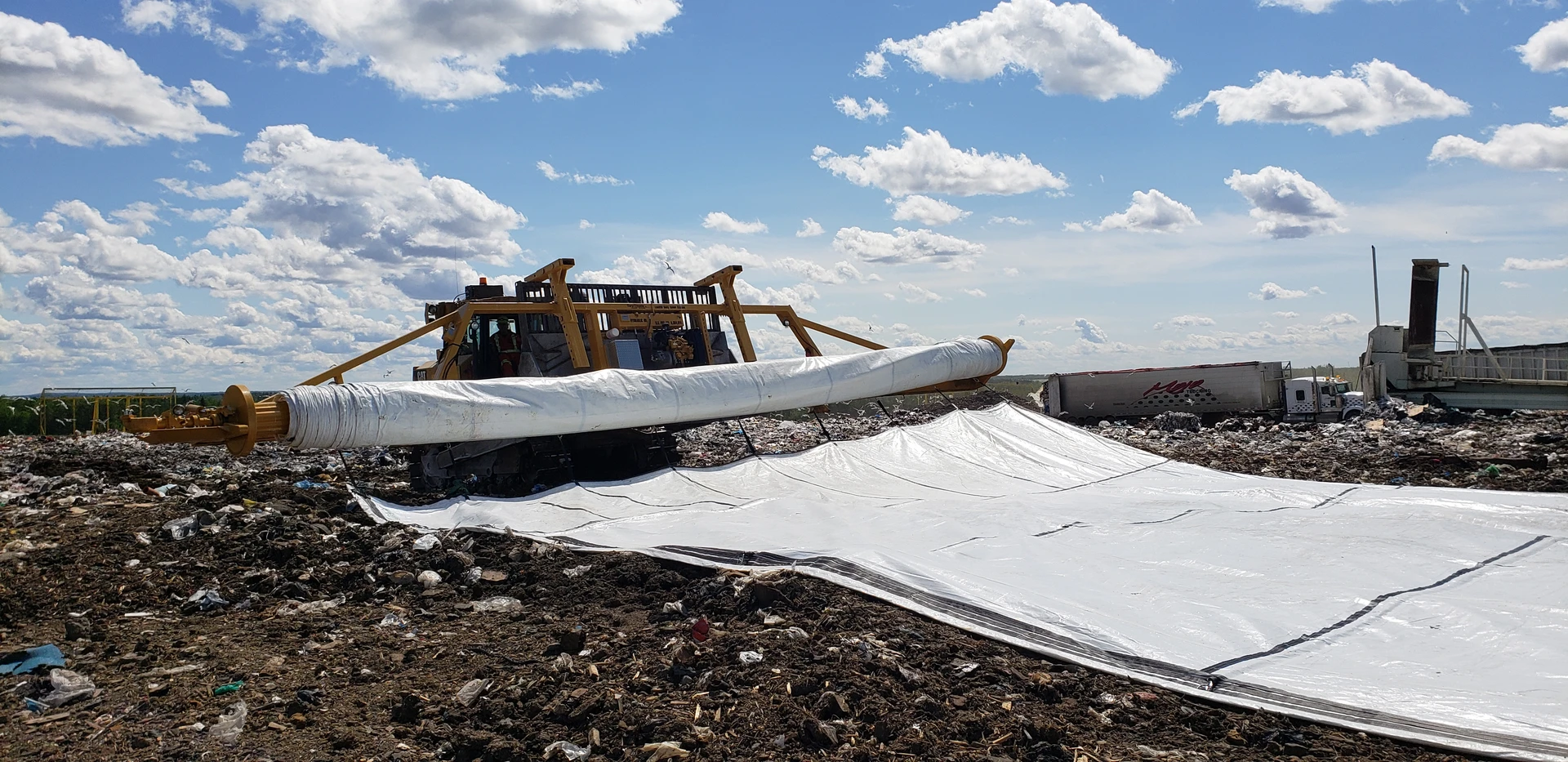
EPI’s Enviro Cover system is a non-reusable geosynthetic film designed to stretch over the uneven surface of the working face. It does not require removal and provides continuous coverage until the landfill operation begins the following day, notes Mohr.
Its impermeable nature is designed to control odor emissions, shed rainwater and minimize water infiltration into the landfill. The company has refined its equipment for ease of use, lower maintenance costs and durability, says Mohr.
“Enviro Cover goes down in the evening and then the next morning, the next day's waste just comes in on top of the film so you don't have to retrieve that film. You don’t have to peel it back,” says Mohr.
“Many times, when landfills try to achieve the benefits of ADC, they'll push the soil off and open it back up. With Enviro Cover, you don't have to. The trucks come in, you open the gates, the trucks dump right on top of the film and keep going, so you save a lot of time in the morning when you're opening up.”
While temporary tarps are another example of an ADC, the advantage of the Enviro Cover film system is that it does not have to be retrieved, but is left in place.
“That creates another operational advantage because you don't retrieve the film such as with a tarp or soil so the film stays in place, providing continuous containment so you don't get any kind of a gas release with a tarp,” Mohr says.
“Once you pull the tarp off, everything that collected under the tarp—all of the gas and odors—gets released into the air. Enviro Cover stays in place and provides continuous containment.”
With Enviro Cover, it is possible to just use one person to deploy the film, though two are recommended: an operator and someone on the ground, says Mohr.
Mohr notes many landfills struggle with odor issues.
“What separates our ADC from the soil or spray-on application is the impermeability of the film,” he says. “It’s less permeable than soil or a spray-type cover. Gases and odors get trapped. It contains all of that into the landfill rather than it finding its way out of the material.”
The FINN Waste Cover ADC is manufactured from recycled paper and wood and it also contains polymers, an enzyme complex, and other proprietary ingredients.
When mixed with water in a FINN landfill machine, the spray-on slurry is then applied to the open face, forming a cement-like crust. Waste Cover also helps to alleviate odors and breaks down landfill waste more quickly, says Donley.
“Birds don’t like this cover,” says Donley. “There are far fewer usage hours for dump trucks, excavators, and dozers. It takes 1.5 total hours for daily cover application.”
JMI Covers’ design is updated in response to landfill sector operations’ personnel feedback, says Uthe.
“Because ADCs have the flexibility to be designed for each site, they can be changed regularly to meet each site's specific demands,” he says. “This includes material and manufacturing techniques.”
LSC Environmental Product’s Posi-Shell is designed for the entire cover operation to take place with one or two operators in about 1 to 1.5 hours.
“Fuel consumption and maintenance on a Posi-Shell Applicator is minimal compared to the heavy equipment required to move soil,” says Lanz. “Soil cover also can create issues in the landfill itself by creating impermeable layers that prevent leachate and landfill gas from flowing effectively to their respective collection systems.”
When that happens, the leachate travels horizontally, causing breakouts on the landfill’s side slopes, allowing the leachate to co-mingle with clean stormwater and resulting in violations, says Lanz.
“Posi-Shell does not have this issue because it easily crumbles with the placement of the next day’s trash,” he notes, adding those operations using Posi-Shell as ADC and intermediate cover also recognize improved landfill gas collection, swale lining, and long-term dust and erosion control.
LSC is designing its products using environmentally-friendly natural materials and recycled products for use at a landfill, remediation site, reclamation project, or containing runoff at a wildfire location, Lanz says.
Latest innovations include bulk delivery formats, equipment upgrades, pelletized products and products targeting natural soil amendments, and the creation of short-term and long-term versions of landfill cover products.
New Waste Concepts offers the ProGuard line of ADCs, providing coverage from overnight up to 18 months and priced accordingly. The company’s CAPS K Series 900 is used to cover working faces up to 23,000 to 25,000 square feet, notes CEO Milton F. ‘Tony’ Knight.
Technology in wireless camera systems to improve vision and wireless remote-control reliability has enabled vast improvements in safety and efficiency, notes Shannon Harrop, marketing director for tarpArmor.
The 2020 release of the tarpARMOR XS-series of tarp deployers was designed to bring enhanced efficiency and safety features to the alternative daily cover process, he adds.
“What normally took multiple personnel to operate various methods of alternative daily cover applicators has been reduced to one operator remaining in the cab to accomplish the complete cover task with the XS machines,” he points out.
“These improvements to tarp deployers come on 30-foot and 40-foot models. The advancements were released at a time when they were desperately needed due to mandated furloughs, worker shortages, and a need to remain in a safer working environment with the early concerns about COVID-19 transmissibility.”
Harrop says while all ADC will offer some improvement to the soil, “covering with reusable geotextile tarps managed with a properly-equipped tarp deployment system will provide the most economical cover solution in nearly all situations.”
“The cost savings of the lost airspace can easily be determined as the lost opportunity cost of foregoing disposal fees at a national average of around $50 per ton,” says Harrop. “This quickly adds up to hundreds of thousands of dollars annually in lost revenue for the landfill. “Even if the substantial lost revenue is not considered, the return on investment for a well-equipped tarp deployment system is often less than six months based simply on the reduction of equipment hours and operator labor required to scrape, load, haul and spread the soil for daily cover.”
The XS-series of tarp deployers exchange multiple spools or cartridges of tarps for unlimited coverage by fully automated wireless control from within the dozer cab by one operator, he adds.
The newest tarpARMOR XS tarp deployers are highly automated and user-friendly, “enabling even inexperienced operators the ability to quickly take on the daily cover tasks and finish the day on schedule,” says Harrop.
"Robust design, materials, and manufacturing processes have improved reliability and reduced equipment downtime," he adds.
The latest advancement is the HiLIFT feature—designed to mitigate a long-standing issue of tarping machines not having enough clearance to overcome irregular terrain, intersecting slopes, or the host machine sinking in wet weather, says Harrop.
“An MSW landfill that is required to use daily cover will see multiple advantages by using any type of alternate daily cover,” notes Marlon Yarborough, sales and marketing manager for Tarpomatic.
Tarpomatic's new Gen lV model includes a push-button remote start, hydraulic top spool locking jaws, and a camera-assisted alignment system. The company also offers an engine enclosure, odor control system, drive motor hood cover, and machine lift system.
Tarpomatic has added safety features designed to allow the operator to control every function of the machine from inside the host cab without spotters needed on the ground.
“The main advantage is not filling up the landfill with a fill material such as dirt or sand that is not generating revenue,” notes Yarborough. “A landfill’s airspace is its moneymaker.
“If you are applying any type of fill to the working face, you are reducing the amount of money that can be made off that costly cell. Even a low profit-generating product such as contaminated soil, sludge or auto fluff will cheat your company out of its maximum profit capability.”
Most operations start seeing an ROI on an ADC investment within months and up to five years, depending on the efficient utilization of equipment and its depreciation, how much product is used, and the working face size.
“The ROI begins the day that the landfill stops using soil cover and starts using ADC because it will start day one in fuel savings by running one piece of machinery along with one of the applicators, which uses less fuel than heavy machinery,” says Lanz.
“The maintenance component on the equipment also will see a decrease over time. The ROI on airspace—which is important—comes when it is time to close and cap the landfill.”
Working face size is another factor, says Watson.
“Weather changes a lot. Hard-driving, windy rain is the enemy of any ADC,” he adds. “The big return on investment would be that a landfill operator doesn’t have to make a big capital investment. The return is seen immediately; they don’t need to use all machines every day. They’re able to use that machinery for other projects. The projects they may have paid an outside contractor to do previously, now they can do.”
Saving space increases revenue, Donley notes.
Case in point: since the East Baton Rouge Parish Landfill in Louisiana has used FINN Waste Cover, the operation has realized $3.7 million savings in space per year, he says.
That saving includes 20,000 gallons of diesel fuel and $60,000 in labor hours annually. Additionally, about 250,000 pounds of recycled paper are now being used as daily cover each year.
Latest from Waste Today
- Vermeer announces plan to build new facility in Des Moines metro area
- Buffalo Biodiesel shares updates on Part 360 application to DEC, Tonawanda facility progress
- Capstar Disposal expands roll off dumpster rental services
- Supreme Court strikes down IEEPA tariffs
- Casella details facility closures, expansion efforts
- Zero harm: Building a SIF prevention program for waste and recycling operations
- Casella posts a loss in Q4 2025
- McNeilus names Haaker Equipment first Dealer Partner of the Year