Water passing through the waste mass of a landfill absorbs contaminants and becomes what is now called leachate. The water comes primarily from rain or other precipitation. But it may also originate from fluids such as wet waste or waste degradation contained in the landfill. Sites in humid areas generate more leachate while those in the arid western United States generate less.
Leachate management is a costly expense facing owners and managers. Overall, the MSW industry continues to work collaboratively on better, cost-effective solutions. But there is some anxiety surrounding possible situations where there may be fewer nearby wastewater treatment facilities agreeing to accept and treat leachate at a reasonable cost.
“Leachate can become problematic if the leachate quality changes over time to the point where it becomes unacceptable to wastewater treatment plants,” explains Herwig Goldemund, Ph.D., with Geosyntec Consultants. “Such plants face increased scrutiny through more stringent discharge permits issued by state regulatory agencies through the National Pollutant Discharge Elimination System (NPDES) permitting process.
“In rare cases, leachate can become an environmental problem if it leaks into the groundwater below landfills—this is mostly limited to old, unlined landfills. Leakage rates through minor defects in liner systems of modern landfills are minimal and not leading to widespread environmental issues or groundwater contamination requiring active groundwater remediation.”
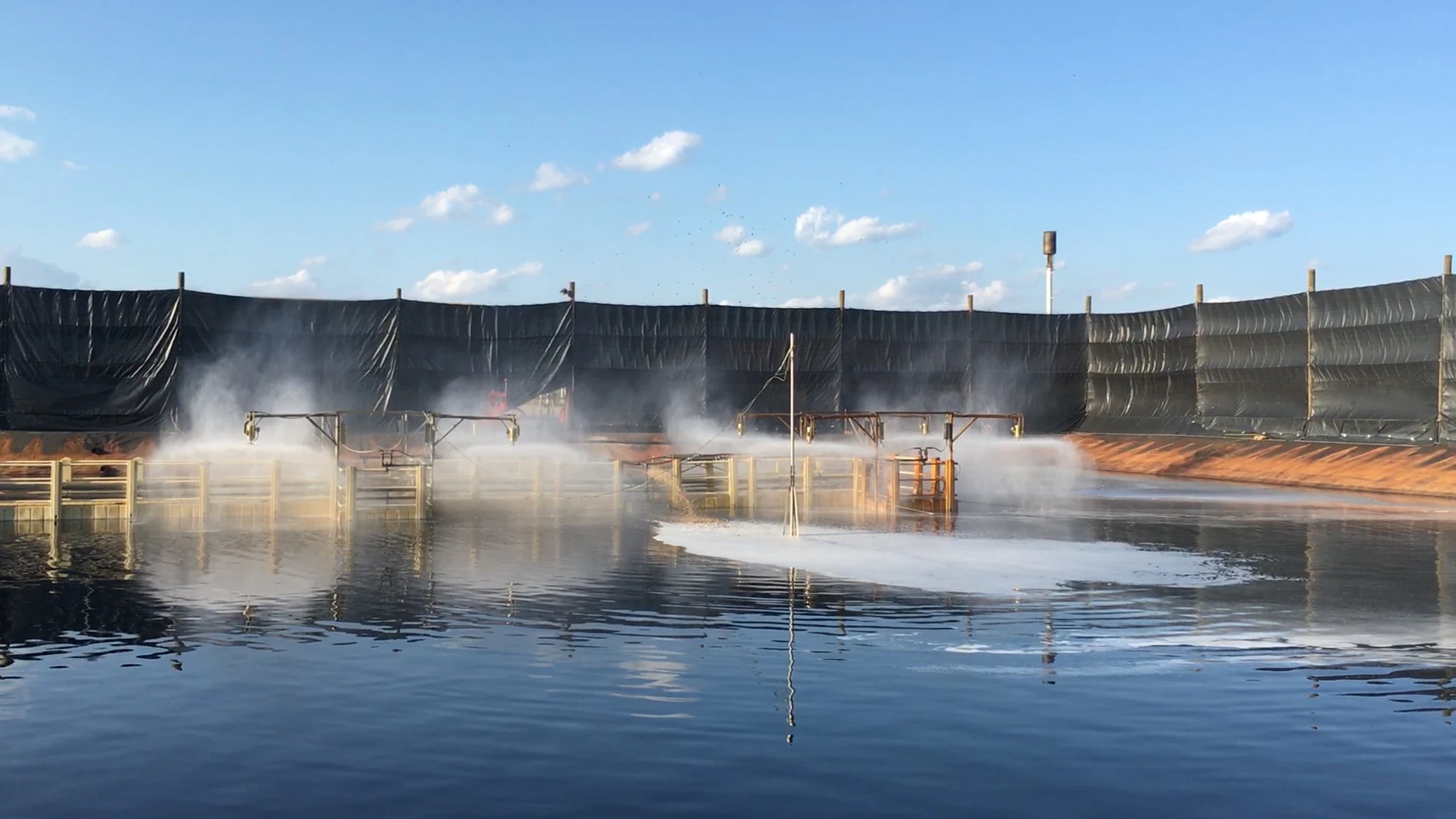
Leachate collected through a landfill’s leachate collection system typically gets stored in onsite leachate storage tanks or lined leachate storage ponds. From there, it either gets discharged to a public sewer system for subsequent treatment and disposal in a wastewater treatment plant, or it gets hauled to a treatment plant using tanker trucks, typically, in 5,000-gallon increments.
Some landfills have onsite treatment systems to pretreat the leachate to make it acceptable to a wastewater treatment plant. They might also employ more sophisticated treatment systems onsite, capable of treating leachate to stringent surface water standards. In these cases, a landfill may have its own NPDES permit that allows the discharge of treated leachate to a receiving stream.
More recently, some landfills have started to employ thermal evaporation systems evaporating the water while generating residuals of materials that cannot be evaporated such as salts, nutrients, and metals. Some 90–95% of the leachate volume can be evaporated while 5–10% of the volume gets landfilled as residuals.
“Leachate nowadays requires more advanced treatment compared to years past,” says Goldemund. “Wastewater treatment technologies have likewise evolved over the last 20 years or so, and membrane-based treatment systems, such as reverse osmosis, are capable of treating leachate to very stringent standards. However, they are energy—and capital—intensive, generating a wastestream termed 'reject' or 'concentrate,' which is difficult and expensive to manage.
“Traditional biological treatment technologies such as activated sludge systems, sequencing batch reactors (SBR), or membrane bioreactors (MBR) are all applicable technologies for leachate treatment, but may not address problematic issues such as interferences with UV disinfectant systems, removal of emerging contaminants such as PFAS and pharmaceuticals, or removal of salinity. Similarly, semi-passive systems such as constructed wetlands are applicable treatment approaches, but they also cannot address UV interference or removal of emerging contaminants and salinity (such as chloride, boron, or total dissolved solids [TDS]).”
The costs of leachate management or treatment vary widely. They are dependent on site-specific factors, existing infrastructure such as connections to public sewers, leachate volumes and chemistries, and regulatory environments, among others. Discharge to a public sewer system—where still acceptable—is the most cost-effective strategy and may be as little as $0.01 per gallon.
“But this increases if the receiving wastewater treatment plant charges surcharges for excess organic loading (i.e., BOD) or nutrient content (mostly ammonia nitrogen). Offsite trucking and disposal generally cost between $0.05 and $0.20 per gallon, or even higher. These costs depend on transportation distances but are also contingent upon being accepted by a nearby wastewater treatment plant.
“Costs for onsite treatment with discharge through an NPDES permit likewise vary widely and can be as little as about $0.02 per gallon for constructed wetlands systems or $0.05 to $0.15 per gallon for more sophisticated systems such as SBR, MBR, or RO. Thermal evaporation may cost about $0.10 to $0.20 per gallon, depending on whether onsite or offsite disposal is required for the residuals.”
The topic of leachate management is among the timeliest for the MSW industry now, according to Paul Sgriccia, Director of Engineering with Rochem Americas. “Leachate management is one of the most important issues facing landfill operators today.” There are new chemicals and contaminants those in the industry are finding every day.
Rochem Americas, a leader in reverse osmosis (RO) leachate treatment, has several landfill leachate systems in operation in North America, some over 20 years old, with treatment capacities ranging from 15,000 gallons/day to over 200,000 gpd.
One broad group of many compounds collectively known as Polyfluoroalkyl Substances (PFAS) has been called a “forever chemical” due to their complicated chemical structures and difficulty with treatment.
Uses for PFAS compounds exist from airports and military bases—where it finds use in firefighting foam—to the home in stain guard on carpeting, non-stick cookware, and weather-proof clothing. These thousands of different compounds present a challenge. Treating them is difficult.
One wastewater treatment technology that does remove PFAS and other emerging contaminants of concern from landfill leachate is reverse osmosis. With typical treatment efficiency of up to 90%, the permeate, the clean discharge from the RO process, can be discharged to surface water with an NPDES permit or to sewer systems. The remaining 10%, or RO residual, is typically recirculated back into the landfill. Other RO residual disposal options include deep well disposal, evaporation, and stabilization/solidification.
For many landfills, managing water and gas on the landfill site is critical. Water, based on a regulation known as Subtitle D, cannot build up greater than 12 inches. Water levels must be pumped down; in addition, gas extraction wells also are involved in the generation of moisture.
"If you have a gas well, you're going to have to manage liquids," explains David Kaminski, senior vice president with QED Environmental Systems, Inc. “The rock backfill creates a permeable pocket around each of these gas wells. Vacuum from the gas collection system creates a zone of influence around the well, pulling the liquids toward the well and holding it there.”
Strictly speaking, gas collection is a function of managing liquid in a landfill. To get gas you have to manage liquids. Water's an operational factor. “These liquids must be addressed—some refer to them as leachate, others as condensate,” adds Kaminski. “Chemically it can be similar or different depending on a lot of different things at the landfill.”
Gas extraction at gas landfills has resulted in the need for dewatering. “You end up generating more collected leachate on the site. When gas is pulled out you are generating more leachate, and more volume of gas taken from a site can increase the volume of leachate on a landfill as well. Leachate pulled out of the gas wells can be different than the chemistry of leachate going underground to the drainage systems. The biggest difference is greatly elevated ammonia in the landfill from the gas wells.
“Leachate is considered by many landfills to be the number one operating expense,” says Kaminski. “The cost is even more than that of the big pieces of yellow equipment they have running around on the landfill site. It is a big issue. One of the biggest waste treatment companies in the country looked at us and said, 'We have nothing against your QED pumps—we just don't want to buy any more. Every time we put in another pump we have more leachate to take out'.”
According to Kaminski, an industry survey showed that the top three gas wellfield management issues identified are controlling odors and surface emissions (96%), maintaining steady gas flow to the energy plant (86%), and dealing with liquids in gas wells (72%).
“Because treatment plants don't want the leachate, one question arising is whether evaporation ponds or leachate evaporators may be used,” explains Kaminski. “The process of concentrating the leachate by driving off the water can be powered by the landfill gas itself. Thus an older technology—from some 30 to 40 years ago—has found renewed usage.”
Landfills may end up generating anywhere from 100,000 to 120,000 gallons of water per day. “Where does that go?” asks Tony Knight, New Waste Concepts CEO. "Up until 10 years ago, the cost of treating the leachate was covered by sending it to the water treatment facility, to a marsh, and letting nature do the treatment.
“This biological treatment settled out suspended solids, dealt with ammonia or nitrates with the goal of nitrogen eventually being dumped. Long before Subtitle D, the nitrogen was released into the ground, and passed—possibly—into your drinking water."
All those things have been changed, according to Knight. “What has come to the forefront is growing awareness of the negative impact of leachate ammonia and other compounds on the health of our water system, aquatic life, fishing, and water sports.
The issue of ever-higher volumes of leachate water produced remains. One solution to this problem may be to simply decrease the quantity of incoming stormwater. “In terms of new products, there are ways to minimize the amount of stormwater intrusion,” explains Knight.
“Our Hydroguard product mixes with the soil, creates a surface shedding the rainwater. That covers one of the issues involved. The other option could be treating the water before reaching the wastewater treatment plant, a challenge as effluent management works in this country need a lot of new investment.
“Areas of the country have plants containing outdated technology so the volume of treatment depends on the amount of oxygen that they can put into the water. More oxygen can biologically support a lot more bugs, ones able to digest the organic matter.”
Such plants were designed for more solids and human waste, employing blowers and bubblers. These same facilities do not do well with higher amounts of ammonia; for every pound of ammonia, 4 pounds of oxygen are required to completely treat it. The main problem remains how the ammonia is treated before sending it to the wastewater treatment plant. The goal is to reach so-called gray water levels for the water exiting the plant, according to Knight.
Trucking leachate offsite can be a very significant cost, according to Jeremy O'Brien, director of Applied Research at SWANA. 10,000 gallons transported 20 miles to a treatment plant is a significant expense. A better option may be piping the leachate, letting gravity do the work.
“Trucking is a big question for landfill managers,” says O'Brien. “Transporting leachate can be a very expensive proposition. Lots of conventional technology exists, with costs varying widely—from one cent to 80 cents per gallon.
“But the ultimate goal should be to simply minimize the production of leachate in the first place by keeping water from entering the landfill. This lowers the volume of the leachate that has to be treated.”
O'Brien developed a leachate treatment course. His organization of solid waste professionals contains over 10,000 members representing people involved with solid waste across the US and Canada. With training and certification programs for different solid waste disciplines, membership benefits include technical divisions that people can join. All this proactive work toward solving the tremendous problems involved with leachate is a good thing.
Landfills have a working face where they push the refuse. This should be covered each day. But rainwater may still enter the landfill. "The debates on PFAS and public health risks continue," says O'Brien. "But parts per trillion in a person's body is still a very small amount.
“There may be a link to certain negative health outcomes but the question is, how strong is that linkage? Perhaps that depends at least to some degree on all the other health issues we face every day. A clear challenge remains that all 2,000 different types of PFAS found must eventually be studied and addressed.”
Before the 1990s, linerless sites were built. Leachate drained right into the groundwater. Adding liners was a big improvement over the past 30 years. Leachate can be 10 times the strength of the wastewater generated by our households. Thus, laws came about to collect and treat this liquid before placing it back out into the environment. In most cases, what landfill managers do is send the water to the local wastewater treatment plant.
“The leachate itself changes over time,” adds O'Brien. “It's something of a moving target that you are trying to hit. When you develop a leachate treatment system, it may be analogous to treating a person for health issues throughout their life. You do not do the same things for a younger person as you do for someone in their 60s or 70s.”
But the issue of PFAS remains something that has been a growing concern in recent years, especially since the technology to detect its levels in the environment has improved. The industry is just beginning to address this issue, according to O'Brien. “It is a really important issue. There is uncertainty as to whether water will ultimately have to be treated at the landfill, what standards will be required. All of that is up in the air right now.”
Earl Jones, Heartland Water Technology CEO, points out that landfill operations are highly orchestrated, and intensely safety-conscious, with significant monitoring and control technology to ensure high standards for environmental stewardship.
“I would not characterize landfill fluids as a problem; rather, they are waste fluids that need managing in the same way wastewater from any manufacturing process would require management. It is inaccurate to characterize landfill fluids as a problem. These fluids are professionally managed.”
Latest from Waste Today
- Vermeer announces plan to build new facility in Des Moines metro area
- Buffalo Biodiesel shares updates on Part 360 application to DEC, Tonawanda facility progress
- Capstar Disposal expands roll off dumpster rental services
- Supreme Court strikes down IEEPA tariffs
- Casella details facility closures, expansion efforts
- Zero harm: Building a SIF prevention program for waste and recycling operations
- Casella posts a loss in Q4 2025
- McNeilus names Haaker Equipment first Dealer Partner of the Year