Harnessing the power of waste

Waga Energy co-founders leverage more than a decade of experience in renewable energy to develop a landfill gas conversion system capable of producing pipeline-quality renewable natural gas.

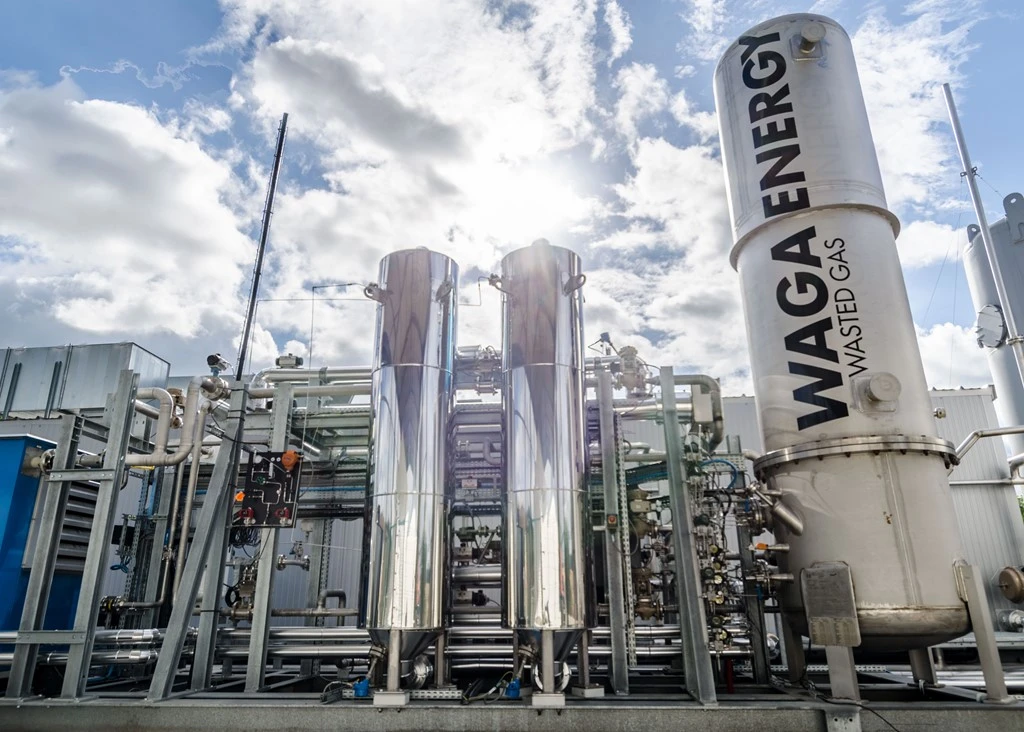
Waga Energy facility

Photo courtesy of Waga Energy

Founded in 2015 by Mathieu Lefebvre, Nicolas Paget and Guénaël Prince— former engineers at French gas supplier Air Liquide—Waga Energy was created with the goal of reducing dependence on fossil fuels through biomethane development.

Drawing on several years of experience in the industrial gas markets, the soon-to-be co-founders began developing a new form of waste conversion technology in 2007 to address challenges commonly associated with landfill gas (LFG) recovery.

“I spent 12 years with Air Liquide developing renewable energy [initiatives],” says Lefebvre, who is CEO of Waga Energy, Meylan, France.

During his time with the multinational company, Lefebvre gained expertise in the biogas industry, helping to build one of the first anaerobic digestion plants in France.

“We come from the energy side, having identified that we need to substitute fossil fuels with renewable energies—[renewable natural gas (RNG)] being a key pillar [of] the energy transition,” he says. “We’ve [caught up] with the West in discovering that landfill gas is a potential source [of energy], which is really interesting because it’s the most cost-effective, short-term resource that we can [depend] on.”

With the goal of producing large volumes of competitively priced biomethane, the Waga Energy co-founders created a new LFG recovery system called WagaBox and completed construction of their first unit in 2017.

The technology, which is the result of more than a decade of research and development, produces RNG pure enough to be injected directly into the gas grid.

“The main difficulties [with] landfill gas is it’s not … well-characterized,” Lefebvre says. “So, we started by really characterizing landfill gas, meaning working directly with [landfills] on not only having some samples of landfill gas but also monitoring real-time data to find the quantity and quality of the gas.

“Once we had characterized the properties of landfill gas, we discovered there is a lot of content that is very valuable. At the time, it was … difficult to remove nitrogen and oxygen from landfill gas, so there were good reasons why this gas was not as valued before.”

The process

To produce grid-compliant biomethane from LFG, the methane has to be separated from other components to reach at least 97 percent purity. To remove unwanted components, the WagaBox combines membrane filtration and cryogenic distillation to convert landfill gas into RNG.

The two-step process starts with raw gas being filtered through membranes to extract carbon dioxide and other impurities. Then, it is distilled at a cryogenic temperature to separate the methane from the nitrogen and oxygen. At the end of the treatment, the high-quality RNG meets gas grid standards for purity.

This process differs from standard LFG collection systems, which consist of a blower plugged into a network of wells installed within the waste mass. These wells transport the gas to a flare or energy recovery unit; however, given that such networks are never completely airtight, they also can draw in air.

“With the WagaBox, we are able to capture almost 100 percent of the gas collected from the landfill because we do not care about the gas quality. Whatever the gas quality is, we will be able to produce pure RNG with high efficiency. That is a breakthrough in the market,” Lefebvre says. “We expect the [WagaBox] to [help incentivize] the switch to RNG to solve methane emission problems.”

The first WagaBox unit was commissioned in Saint-Florentin, France, just south of Paris, in February 2017. Today, the company operates 13 units in France, primarily for industrial waste management companies such as Suez and Veolia, which are based in Paris, as well as municipal firms such as Lorient Agglomération. The 13 units service roughly 59,500 households, preventing 54,000 tons of carbon dioxide equivalent from being emitted into the atmosphere.

The largest WagaBox unit is located at a Veolia landfill in Claye-Souilly, also near Paris. It can treat up to 1,860 standard cubic feet per minute (scfm) of raw gas, which is five times more than previously installed units.

The system is capable of producing 410,000 million British thermal units (MMBtu) of RNG each year—the average gas consumption of 25,000 households.

“It is one of the largest project[s] of green gas injection in France and Europe,” says Paget, co-founder and chief technology officer of Waga Energy.

In addition to its current footprint, the company has 15 more WagaBox units under construction, including four in Canada, one in Spain and one in the U.S.

A growing reach

Waga Energy entered the North American market in April 2021 with the announcement of its LFG-to-RNG project at the Saint-Étienne-des-Grès landfill, operated by the Mauricie Residual Materials Management Board (RGMRM), in Quebec.

Prior to its installation of the WagaBox, gas generated at the RGMRM landfill was captured and burned via a flare. With the addition of Waga Energy’s technology, biomethane produced on-site is injected into the gas grid of Montreal-based Énergir, the largest natural gas distribution company in the province.

While France was the starting point for the deployment of the WagaBox, Lefebvre says the company always had plans to offer it globally.

“The key issue regarding climate change is not in France; it’s the rest of the world. France only contributes 2 percent of the [world’s total] methane emissions, so, when we started Waga, we … [wanted] to deploy this solution worldwide as fast as possible,” he says.

In January, Waga Energy signed a contract with Steuben County, New York, to build the first WagaBox in the U.S., located at the Bath Landfill. The unit will be commissioned by 2023 and is expected to purify 1,000 scfm of LFG to deliver 207,000 MMBtu of RNG. Waga Energy will fund, build, operate and maintain the WagaBox unit under a 20-year LFG supply contract with Steuben County.

 
Photo courtesy of Waga Energy
Waga Energy has 13 WagaBox units in operation with 15 more under construction for use in the U.S., Canada, Spain and France.

“The first subsidiary we formed was in Canada, and this was done in 2019, so [it was] quite early in the [company’s] development,” Lefebvre says. “Renewable natural gas is a local gas, so you have to be local.”

By using a decentralized approach, Lefebvre says Waga Energy can more intimately address the needs of customers in the different markets it serves. To manage its international portfolio of LFG systems, Waga Energy has more than 130 employees across its branch offices in the Canada, U.S. and Spain, in addition to its French workforce.

The company subcontracts manufacturing of its WagaBox units to industrial partners in France and Canada, except for the cryogenic distillation modules, which are manufactured only in France.

According to the company, the units are fully automated and supervised by Waga Energy’s head office in Meylan. Each unit is designed to accommodate a specific landfill’s gas flow rate, as well as other characteristics, to meet pipeline quality standards. The company also handles installation and precommissioning compliance testing.

The author is associate editor of Waste Today and can be reached at hrischar@gie.net.

November December 2022
Explore the November December 2022 Issue

Check out more from this issue and find your next story to read.