Waste compaction is a cornerstone of landfill operations. A survey I once conducted indicated that waste compaction is one of the highest operational priorities for a landfill manager-No surprise there. But what is surprising is how limited-as an industry-our thinking is. Now to be sure, I’m not tossing every manager into this basket. There are many standouts-those who go far beyond simply putting a compactor in the budget…and then leaving it up to the crew to “compact the garbage.”
There are some basics that must be followed in order to achieve good waste compaction. These include having a landfill compactor and using it. And by following a few basic protocols, you’ll get good compaction. Nothing wrong with that, but if you want to achieve great compaction, you must do more.
But before we get into talking about what “more” is, let’s first set the perspective. Great compaction is relative. It will vary from one landfill to another. For example: A landfill where 80% of the wastestream is packer truck waste and the other 25% is sludge can achieve very high compaction density. So we aren’t going to measure great by the numbers. Great is relative-and, more accurately, defined by measuring how much effort goes into maximizing density at a given landfill.
Planning
From start to finish, the planning component of your landfill operation either creates a platform for achieving great compaction…or it doesn’t. We aren’t playing horseshoes here. If your design provides deep fills, adequate time between lifts for settlement to occur before closure, and strategic management of stockpiles (e.g., soil, greenwaste, rubble, etc.) to encourage surcharging…then your landfill has the potential for great compaction.
Material Management
Your landfill is constantly receiving and processing material, be it waste, soil, or recyclables. You may also be exporting certain materials. By handling those materials properly, you can increase the waste density at your landfill.
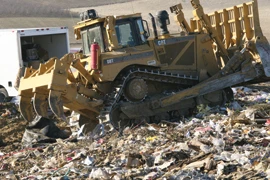
On a macro level, try to stockpile soil, greenwaste, woodwaste, rubble, and other material on areas that have the greatest potential for settlement. As an example, a 20-foot-high stockpile of soil can exert up to 14 psi on the underlying waste. This isn’t much pressure when talking about hydraulic systems, but in terms of sheer weight, it’s comparable to the ground pressure exerted by the tracks of a passing D9 dozer.
Surcharging will give the greatest results in areas that have been recently filled or where waste is deep.
On a micro level, material management comes down to placing the right type of waste in the right place-at the right time. Mix dry paper loads with wet loads, give the dry waste a few minutes to take on some moisture…and then compact it.
Compaction
Providing your crew with a compactor…without also providing good training, would be like giving someone a baseball bat and then sending them into a game without also giving them some basic batting practice. Good results require the right tools-and the know-how to use them.
So in addition to having the right size, model, and number of compactors, make sure your operators are doing things right. This includes working flat, making long runs with the compactor, placing the waste in thin layers, making multiple passes, and properly segregating the waste.
It goes without saying-almost-that proper machine maintenance is also critical. A compactor that won’t run is worthless. And a compactor with worn-out teeth is nothing more than a million dollar paperweight. To consistently achieve good compaction, give your number-one machine the highest priority in terms of maintenance.
Peripheral Contributors
No question about it, the compactor is the focal point when it comes to achieving great waste compaction. But there are other factors-things we might call peripheral contributors. So here are a few.
Spotter-Not all landfills use a spotter. At some landfills the on-the-ground spotter is replaced with signs, arrows…or a dozer operator that honks the horn and points. But the key is that you have some way of ensuring that certain loads are dumped in the right location. We’re back to that issue of mixing wet with dry-and isolating bulky, non-compactable material from the rest of the waste. In essence, we’re setting the stage for a well-compacted cell by managing how and when material flows into the cell.
Dozer-The dozer also plays a very key role, and it’s not limited only to pushing trash to the compactor. Well, let’s step back. In a traditional scenario, the dozer pushes trash from the tipping pad to the face, where it is spread for the compactor. And we typically think of this as the only role of the dozer. There is more.
The dozer is processing waste with every push across the face, and on a typical day there could be several hundred pushes. Why not further increase waste compaction by utilizing every (dozer) push? Along that line, consider the machine options that can help you do just that. For example, Caron Compactor Co. has developed grouser pads that are specifically designed to increase the demolition and compaction effect of the dozer.
By increasing these other factors, you can achieve waste densities well beyond what the compactor can provide alone.
Latest from Waste Today
- Interchange 360 to operate alternative collection program under Washington’s RRA
- Waste Pro files brief supporting pause of FMCSA CDL eligibility rule
- New Way Trucks expands US network with Joe Johnson Equipment
- Tire Industry Project publishes end-of-life tire management guide
- Vecoplan to present modular solutions at IFAT 2026
- Terex Ecotec appoints Bradley Equipment as Texas distributor
- My Green Michigan expands depackaging capacity
- Washington selects Circular Action Alliance as PRO