The waste industry is generally considered to operate in one of the harshest working environments, which takes its toll on operators and equipment alike. Machinery must live up to heavy-duty standards in order to endure in this rugged industry. That, however, may be changing ever so slightly.
“The waste industry changed 20 years ago,” states Aaron Murphy, vice president of corporate affairs and marketing for CMA, a subsidiary of Double Coin Tires in Monrovia, CA. Most waste trucks no longer go to landfills; they go only so far as a transfer station. That means they spend their days on city streets, easing concern about treacherous off-road hauls and landfill hazards.
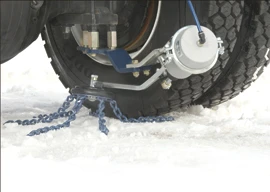
The automatic tire chain can be a lifesaver when facing adverse conditions.
Nevertheless, collection vehicles continue to endure the stresses of stop-and-start operation and tight-radius turns on urban routes. The scrubbing, turning, and twisting wear out the rubber with which trucks are shod. In addition, as Murphy points out, “The vehicles are heavy.” Trucks with 10,000-pound carrying capacity and heavy axles are hard on tires.
CMA offers 150 SKUs for truck and off-road tires. It’s important to match the tire to the application, Murphy says: the type of vehicle, the environment, the number of miles run, and the product the fleet manager likes-both brand and pattern. “Cost refers not always to acquisition, but lifetime expense.”
Murphy says refuse customers are looking for heavy-duty carrying capacity, performance, “retreadability,” durability, low cost per hour or mile, consistent pricing, and service. “Our tires are made to retread multiple times. Haulers tear tires up fast; they count life in hours.” The ability to retread casings is a valuable way to keep costs down. Retreadability and durability keep a hauler’s asset in the fleet longer.
Tires for transfer trucks don’t face the same severe environment, because most of their time is spent on the road or highway. Important features for them include durability, traction, and retreadability. Murphy adds that specific tire patterns can help steering axles.
Trailer tires are typically 15-inch tube, wide-base tires. Because they carry a large amount of weight, they must be durable and capable of surviving a severe environment.
Chain Gang
Whatever tires are on a refuse vehicle, there’s no longer a need to put chains on them when the weather is inclement, thanks to a product from Onspot Automatic Tire Chains. Six states in the west have chain control areas and there are plenty of other regions where chains are critical, says Pat Freyer, president. “[Our chains] do best in snowy, hilly conditions. West Virginia is the best state for us.”
DOT-approved, Onspot’s chain system provides the same performance and traction as a single chain, all without attaching to the tire. Instead, an air-operated arm swings down with the chains, which have a spring return. Capable of handling ice, packed snow, and up to 6 inches of loose snow, the system should not be used in deep snow or off-road. Haulers should use caution at landfills with mud or deep snow, Freyer advises.
All Waste, a customer in CT, put two sets on 8-10 years ago, just to try them. “They typically missed 40 percent of their stops on snowy and icy days,” Freyer says. “Now they have about 80 sets on 100 trash trucks and they
make 100% of their stops.”
In addition to improving productivity on the route, the chain system saves time by not requiring a driver to take them off and put them on. They also reduce tow bills because trucks aren’t getting stuck, a measure of safety is added through increased stopping ability. “A big, heavy trash truck can’t stop on hills,” Freyer points out.
Stopping ability isn’t the only safety aspect improved by the chain system. Every year for the past 24 years someone has been killed in a chain-control area while putting on chains, Freyer says. “Never get out of the vehicle if you don’t have to.” The shift-on-the-fly system can be turned on from the cab while the vehicle is traveling at speeds of 2 to 25 mph.
An added benefit of the system is that it doesn’t tear up the road or wear out the chains and tires, because it’s never running on dry road.
“New since 1977,” the system is originally from Sweden, but is now produced in Stratford, CT, and sold to dealers and OEMs. “It’s a factory option at 200-plus OEMs,” Freyer notes. Although “95% of the time, the Onspot dealer does the installation,” the “average guy” can install them on the rear drive axle in seven hours.
The system costs roughly $2,400, lasts the life of the vehicle, and requires minimum maintenance-just a little grease during routine oil changes and occasional replacement of bearings and bushings.
Tire Tools
Low tire pressure is responsible for wasting an estimated 5.4 million gallons of fuel a day (over 2 billion per year), according to the Department of Transportation. An additional 80,000 accidents are attributed to low tire pressure annually.
Proper inflation prevents irregular tread wear, averting dangerous conditions that can lead to accidents. To ensure that tires are properly inflated, it’s necessary to check pressures-a task that often goes undone despite its importance. The job is made easier by an external tire pressure monitoring system from L&S Safety Solutions as the distributor of the Pressure Pro TPMS.
“The refuse industry wants more information,” states Phil Zaroor, president and CEO of Pressure Pro. “Information is the name of the game; that’s the new trend. It leads to better fleet management. There’s no hiding from maintenance.”
Information is readily at hand with TPMS, which has become one of the hottest market segments as a result of the high cost of fuel, tires, insurance, downtime, repairs, and vehicles. This technology contributes to better stability, handling, braking, safety, savings, and environmental advantages by helping operators maintain proper tire inflation.
Tires are vulnerable, particularly in the waste industry, says Zaroor, who estimates a 6,000-mile life for refuse truck tires. “They wear fast because of tight-radius turns, all the stop-and-go, and the severe environment.”
Properly inflated tires last longer: Tread life is extended by as much as 20% to 30%, due to less wear, Zaroor explains. In addition to saving money, tires that wear longer save valuable resources used to produce new tires and keep used tires out of landfills longer.
Additional financial benefits come from fuel savings when tires are properly inflated. Properly inflated and maintained tires also eliminate expensive roadside repairs and downtime. If a tire blows, it can damage the vehicle-or other vehicles-triggering pricey repairs and increased insurance rates.
Safety is increased when tires are properly inflated. Tires with low air pressure skid and hydroplane more easily. Proper inflation protects and saves the tire casing, reducing the chance of blowouts and zipper rips.
To avoid all these problems, the Harrisonville, MO-based manufacturer’s new battery-operated Asset Tracker records tire pressures. With a sensor on every tire and a monitor on every truck with a gateway to the office, the information goes to both the operator and the office. “They can analyze the information,” Zaroor says. “They can see the type of tires and condition, so they know what needs to be done. When a truck comes in, they can generate a printout on performance and condition, so they know which tire is low.” He estimates that predictive analysis for cost management and maintenance scheduling cuts time and labor by 80%.
Suitable for trucks from almost all major providers, the Asset Tracker constantly monitors tire pressure, while moving or parked, warning the operator about any dangerous situations with both a visual and audible alert. It is easily installed in minutes with no tools.
At a cost of $1,700, fleets could see payback in six months or less, Zaroor says. “If you spend $1 million, you’ll make your money back in the first year. If you’ve got millions of dollars of inventory, you want to protect it.”
Sometimes the issue is with the wheel, not the tire. Wheel-offs are dangerous and expensive, and can be the result of improperly torqued wheel nuts.
The easiest thing to check is nuts, says Mitch Kopacz, sales/branch manager for Eastern Pneumatics & Hydraulics in Dorval, QC. But how often should it be done? “There are no studies, no recommendations. What is the life of a nut? How many times can you put a nut on before it weakens?”
He suggests checking them during wheel changes, but cautions that frequency isn’t enough. “People still had wheel-offs even if their nuts were torqued.” Using the analogy of an over-stretched rubber band, Kopacz says over-torqueing can create a dangerous situation. “Tension is an issue now that people are torqueing.”
Torque is merely a method of attaining tension, he explains. The nut and stud create clamping force on the wheel; if the clamping force is not correct, the nuts come loose. “When you take the nut off, you don’t know if it will maintain tension-if it will hold at the same tension level.” Measuring bolt tension can be complicated. At trade show demonstrations, Kopacz has shown attendees that even with no torque on a bolt, there is tension.
On dual wheels, clacking-when two wheels are together and one holds under braking, causing slipping-can occur. “Torque is there, but tension isn’t,” Kopacz says simply. If the wheels aren’t evenly tensioned, they can become loose, wobble, and start clacking. It causes stud wear and elongation of the hole; the studs shear, leading to wheel-offs.
Eastern Pneumatics’ exclusive Wheel Master is a pneumatic torque tool that measures bolt tension on wheel nuts, providing a simple go/no-go indication. The tool simulates attaching and then measures torque to 500 foot-pounds as well as tension.
Based on a tool used in the steel erection industry for bridges and wind turbines, the bolt tension calibrator has been used in this industry for two years. Eastern Pneumatics also offers a stud cleaner and nut rack because they need to be cleaned and tested. “It requires more force to torque dirty parts,” Kopacz indicates.
For easier removal of wheel studs, Tire Service Equipment Manufacturing Co. Inc. offers the 1-PPK PakPress portable wheel stud remover and installer. It allows removal and installation of studs without removing the hub, saving time and reducing risk of damage to wheels, the studs themselves, hubs, or seals, explains Randy Kindel, advertising. “It installs the studs correctly so there is no chance of them being installed crooked or not completely seated.” It also eliminates the risk of injury common when hammering studs in or out, making for a safer work environment.
Studs can wear or become weak from heat, frequent starting and stopping, and even improper installation, Kindel says. “The problem seems to be most prevalent in the disposal industry, probably because of the stress on the studs from constant starts and stops. Judging by the number of units we sell, I feel it must be quite prevalent.”
Manufactured in the US, the PakPress is easily operated by one person with the aid of the cart and works on any truck or trailer wheel studs that have 22.5-inch to 24.5-inch wheels.
Decreasing the time spent removing and installing studs manually, as well as lowering the cost of potential damage done to the hub, seals and studs contribute to a rapid payback period.
Uplifting Experience
Underbody work is often easier to perform if the vehicle is raised for better access. Mohawk Lifts, based in Amsterdam, NY, manufactures environmentally safe aboveground service lifts with capacities ranging from 6,000 to 240,000 pounds. The five basic styles are two-post, four-post, mobile, parallelogram, and in-ground.
While all the lifts by Mohawk improve productivity, profitability, safety, and convenience, Steve Perlstein, sales and marketing manager, indicates that different models suit diverse shop layouts, needs and budgets. Start by assessing the number of bays and available space, he suggests.
“For the best under-vehicle access, a four-post lift is the best choice,” Perlstein advises. The 48-inch four-post lift runs around $75,000 to $80,000.
If the shop bay is only as wide as the vehicle, choose a parallelogram lift. Measuring 44 inches inside, it costs $90,000 and features track lighting. Mohawk’s in-ground lift uses minimal shop space and is half the cost of some other brands, he says: around $120,000 installed.
The mobile column lifts cost only $35,000-$40,000 and can be used with multiple stands. “It’s more productive,” Perlstein explains, “because you can have three vehicles up in the air at once.” Its advantage is its flexibility. The four-post, mobile and parallelogram lifts are fixed-position, requiring a dedicated bay. The disadvantage, however, is that there is no quick work because each axle must be positioned to the lift.
Putting on the Brakes
“This is the hardest industry on brakes,” says Daniel Judson, technical director for Brake Sentry LLC. As a former maintenance manager in the waste industry, he should know. Uneven wear means even more brake work.
Brake-out-of-adjustment violations are the most frequently cited safety defect and carries a severity rating of 4 under the CSA-2010 BASIC safety scoring method, based on crash-related risk. Thus, it heavily impacts a fleet’s safety score.
Haulers typically require visual inspections as part of the daily walk-around check, but drivers can’t identify a brake out of adjustment by sight or by feel, only by measuring. “Between inspections, it’s anybody’s guess,” Judson says. “You cannot check without measuring.”
To help them measure, the Asheville, NC, manufacturer created the BrakeSentry kit, a brake stroke monitoring device that provides drivers and technicians with a quick and simple method to visually inspect and identify any brake-out-of-adjustment conditions. It eliminates the need to crawl under vehicles to mark and measure pushrod stroke at each airbrake chamber.
Designed for all climates, it works on any vehicle with airbrake chambers that have an exposed five-eighths-inch-diameter pushrod-all drive axles, trailer axles, and most steering axles, according to Judson. Displaying quarter-inch increments, it eliminates the inefficiency of automatic slack adjustors.
Other benefits include improved safety and reduced maintenance costs. “Heat from out-of-adjustment brakes can melt tire beads to the rims. In automatic trucks the brakes don’t get time to cool off,” Judson indicates, “causing progressive damage and cost.” He references a company in Florida that experienced this problem.
To avoid suffering the same fate, several well-known large fleets, such as FedEx Freight, Celadon, Waste Management and Republic, have been using the patented BrakeSentry kits since they were introduced to the waste industry in 2001.
Starting at $14.95 per axle and lasting two to five years, the kits provide a quick payback in addition to the security of federal compliance and safety. “BrakeSentry is easy to install, requires no maintenance, and eliminates many time-consuming procedures. The return on investment is the best I have seen,” says David Peck, corporate fleet manager for Waste Industries USA Inc.
Don’t Keep Me In Suspension
The Dynalastic suspension from Ridewell Corp. provides positive payback over its lifetime, claims Rick Rickman, who adds that it’s been the primary suspension for the waste industry for more than 20 years.
It’s all about acquisition budget versus maintenance budget, he explains. Although municipalities are known to have constraints on their budgets, the City of New York uses Dynalastic exclusively.
Tandem drives are more or less locked into mechanical suspension, and trailers typically use air ride suspensions because they’re predominantly in on-road highway situations, but trash trucks have more choices.
To achieve the best ride and durability requires a cost compromise, Rickman believes. “Air ride [suspension] is the best ride, but it’s not appropriate for collection trucks because it has no durability or stability and provides the least shock absorption. Solid mount is the most stable, but it has the roughest ride. That’s hard on the chassis and the driver. Rubber springs are the best compromise.”
A “rubber ride” can still provide a high degree of articulation for heavy-duty applications. It’s typically low maintenance. “We recognize the need for up time and tight budgets,” Rickman says.
Air is popular, agrees David McCleave, director of sales and marketing, truck vehicle commercial systems with Hendrickson in Canton, OH. One reason for its popularity is that it protects investments well by providing better road input absorption, which means it’s easier on the equipment.
“Waste Management prefers air ride,” McCleave says. “They won’t share information because they want to keep their advantage in the industry, but it saves them money and protects hydraulic lines. There’s also less maintenance.”
The trend for rolloffs, he goes on to say, is air ride because it always maintains ride height. “Mechanicals squat as the load increases,” he elaborates, “but with air, it’s stable when they’re dumping, and it’s a nice ride with no load: driver comfort.” Hendrickson’s lightweight Primaax Ex provides a superior ride and high roll stability.
Lift axles specific for the rolloff market are designed to stay out of the middle hydraulic cylinder. “There’s not a lot of room between the drive axles,” McCleave explains. “This provides proper ground clearance so they don’t get stuck.”
Steerable or nonsteerable, lift axles are lightweight, helping haulers remain compliant with bridge weight laws. There’s no scrubbing tires or lateral stress on the frame in turns. However, they do use more horsepower and fuel.
Camelback mechanical springs, which are standard on Mack, are the least expensive. However, McCleave cautions, leaf springs rust over time and don’t provide the same spring rate, so drivers feel road input more.
The Haulmaax, with its rubber springs, is popular for front-, rear-, and sideloaders because it produces a better ride than mechanical springs but is less expensive than air ride. It still provides roll stability and features a heavy load capacity. It also saves hundreds of pounds of weight. Explaining why those features are important, McCleave says, “A lot of fleets spec for weight targets, capacity, and roll stability.”
This brake-stroke monitoring device provides drivers and technicians with a quick and simple method to visually inspect and identify any brake-out-of-adjustment conditions.
Rubber springs, which pass salt spray tests, “the same as automotive guys,” McCleave maintains, work with sheer and compression force at the same time, for better performance in stop-and-go situations.
Decision factors for selecting the right suspension include roll stability, weight (allowing operators to haul more), maintenance, support (parts, technical information, and training), durability, and cost. Life cycle costs include maintenance, replacement components, and downtime. Because frontloaders use a specific style of cans, it can be difficult to cover routes during downtime-a factor that must be taken into consideration in calculating costs.
“Most trucks go to transfer stations on paved roads,” McCleave observes. They no longer go off-road at landfills. They do, however, experience increasing load throughout the day.
For trailers, Hendrickson offers Intraax, a vocational air-ride suspension. “We do only air ride for trailers,” McCleave notes. They spend a half-day empty, a half-day loaded. When not loaded, the trailer doesn’t “hop,” saving tires from wear. “Fifty-three-foot transfer trailers are expensive, with an aluminum or steel body; you want to protect that.”
Costs and savings are common themes. Observing that the new emissions regulations have hurt the industry by resulting in engines that are heavier and more expensive, McCleave says haulers have to cut back somewhere. “Where do you spend your maintenance budget-besides brakes and tires? Those hot buttons influence your decisions. If you’re worried about body damage, go air ride. If keeping drivers is an issue, choose air ride or rubber. If route management-the number of pickups-is a priority, get Haulmaax.”
Mod Squad
Route management is the realm of Fontaine Modification Co. as well. For more than 30 years, the Charlotte, NC-based company has been providing post-production truck modification services for dealers, fleets, and OEMs, with whom they have exclusive ship-thru agreements to minimize delivery costs.
Fontaine’s aftermarket stand-up drive is designed to make the truck work better for the operator
Latest from Waste Today
- Vecoplan to present modular solutions at IFAT 2026
- Terex Ecotec appoints Bradley Equipment as Texas distributor
- My Green Michigan expands depackaging capacity
- Washington selects Circular Action Alliance as PRO
- Ten-8 Industrial opens new central Florida service center
- Triumvirate Environmental acquires Environmental Waste Minimization
- Official NYC Bin availability expands ahead of deadline
- US Food Waste Pact’s 2025 Impact Report shows decrease in food waste