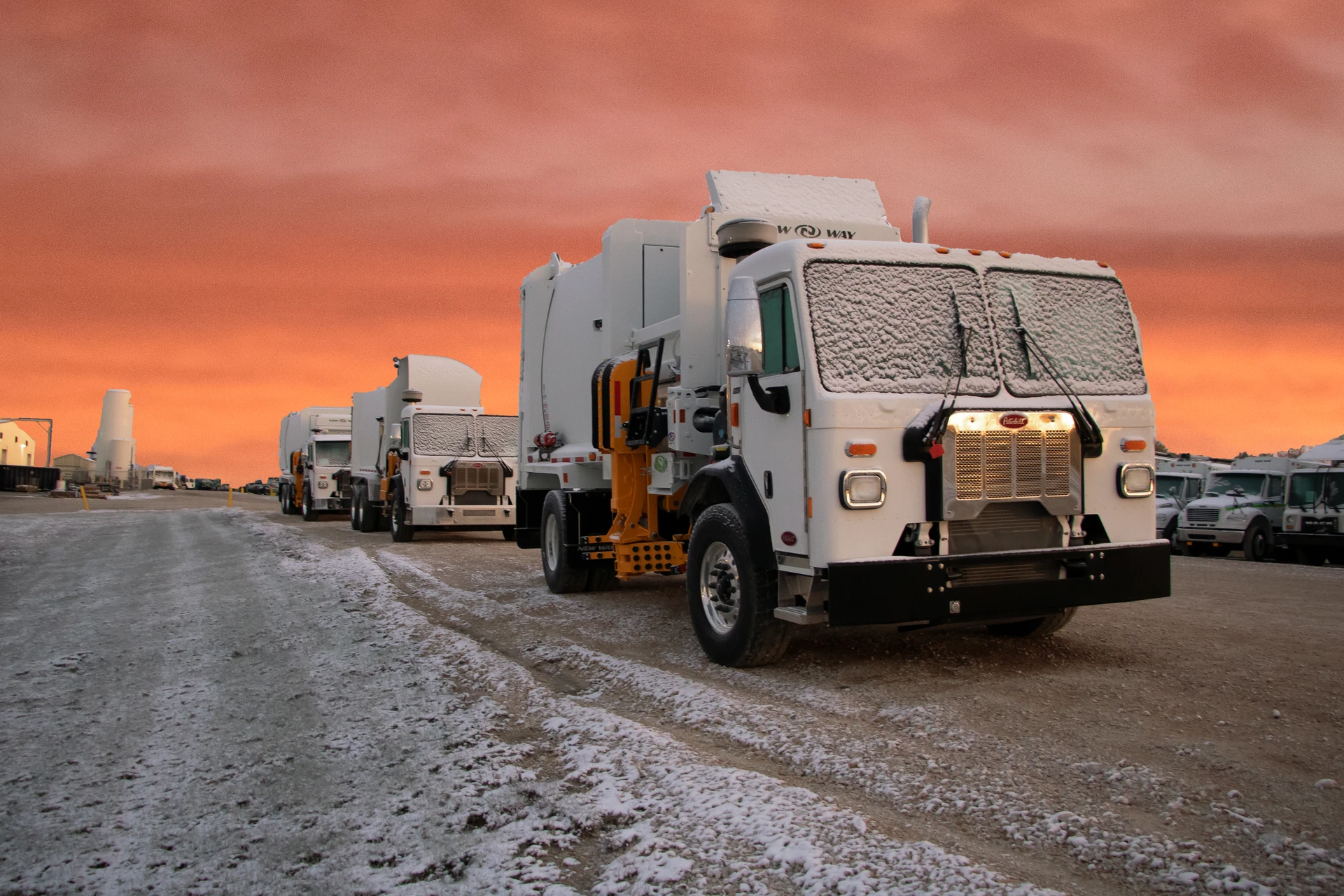
In many parts of North America, solid waste trucks are transitioning from warm to cold weather.
To ensure optimal performance and safety, solid waste operations should have a winterization plan that includes checking starting fluids, coolant, thermostats, batteries, oils, greases, tire pressure, hydraulic fluids, airflow, and fuel filters, among other factors.
Josh Seiferth, refuse product manager for Mack Trucks, notes that while the company’s trucks are designed and built to operate in a wide range of conditions—including cold winter weather—“to ensure proper operation, drivers and fleets should stay current on all regularly scheduled maintenance, including fluid and filter changes, and tire maintenance.”
Sticking with recommended maintenance schedules and following operation guidelines found in the operator’s manual is important no matter the weather, but especially in cold environments, Seiferth points out.
“It is absolutely critical to not use any type of starting fluid on the current engine,” he adds. “Today’s engines have pre-heaters, which can ignite starting fluid and cause severe damage, potentially blowing off intake pipes and sending small bits of material down the intake.”
Michael Thompson, inside service manager for Autocar, notes that among the many factors to keep front and center in winterizing fleets is “determining your coolant concentration for cold weather so you don't have coolant that's freezing when the temperatures drop,” he says.
“Most folks easily think of their antifreeze as winter approaches,” notes Dan Holdmeyer, industrial sector manager, Chevron Lubricants, North American region. “While this is good, it is a good idea to keep cooling systems in good condition year-round.”
To prepare for winter, one should check the coolant for the proper antifreeze concentration for freeze protection, he adds.
“Generally, 50% glycol and 50% water provide freeze protection down to -34°F (-37°C). For extremely cold conditions, 60% glycol and 40% water provide freeze protection down to -62°F (-52°C),” he adds.
Holdmeyer points out that the thermostat should be checked for proper operation and that hoses and connections should be checked for leaks, with issues corrected.
“Another important check is your battery for its power, which will be required to start the engine in extreme cold,” he adds. “Check to make sure the terminals are clean and the cables are in good condition.”
Fleet managers also should ensure they’re running the appropriate engine oil as recommended by manufacturers for the climates in which they are operating, says Thompson.
“When temperatures drop, you don't want to be on super-heavyweight engine oil that could cause strain and hard starting conditions,” he adds.
All of the oils on the equipment should be checked or changed out, says Holdmeyer.
“Certain systems tend to collect water that leads to corrosion and in the winter, it may freeze and prevent lubrication,” he adds.
Solid waste operations also should check oils and greases for low-temperature operation ranges, Holdmeyer points out.
“Lower viscosity oils, or synthetics, will help with faster starts and better fuel efficiency during the cold winter days,” he adds.
“Oil analysis is one of the best maintenance strategies to utilize to get collection trucks ready for winter,” points out Bernie Hall, general manager of Checkfluid. “It is a key component to maintaining engines and also transmissions and hydraulic components. With an oil analysis program, companies can be proactive by monitoring possible contamination and changing lubricant properties to ensure these systems are running smoothly for when the weather changes.”
The most important factor about oil analysis is the oil sample, Hall adds.
“You want to make sure you are getting the most representative sample from your equipment,” says Hall. “That means sampling while it is running. The best way to do that is to look at installing permanent sampling valves.”
Other factors include maintaining the fuel system by ensuring fuel filter replacements are done as outlined by the manufacturer's guidelines, says Thompson.
“Ensure the fuel supply itself—whether it comes from in-house storage tanks or an outside vendor—is treated properly for the area’s climate as well,” he adds.
Also, check tire pressure as the lower temperatures will result in lower tire pressure.
Holdmeyer says that some fleet operations have switched their hydraulic fluids to high viscosity index (VI) fluids that provide a wider operating temperature range similar to using multi-grade engine oil, adding that the high VI fluids allow faster operation at lower temperature and provide better protection at a higher temperature.
Thompson also encourages taking care of greaseable joints on trucks, a measure that should be undertaken no matter the weather.
“If not, you’re going to start having unneeded and early wear on those components that you wouldn't expect,” he adds.
Holdmeyer concurs.
“Besides the engine oil and coolant, which most people think of when preparing for winter, I find adjusting the grease is just as critical,” says Holdmeyer. “A greased system doesn’t have coolant running through it to warm it and so it is very exposed to the winter temperatures. It also has to fight corrosion due to the snow, sludge, and salt contamination.
“Therefore, it is important to use a grease that will function at the lower temperatures which usually means an NLGI grade lower, such as using an NLGI Grade number 1, or possibly even 0. Another good practice is to re-grease more frequently to remove those winter contaminants.”
To prepare a solid waste fleet for winter, Bud Corkins, inside field service technician at New Way Trucks, points out that maintenance should be done on the hydraulic system as such: “a new suction strainer, return filters, breather, and an ISO viscosity grade of 32 or 46 can be used depending on the ambient temperature the packer is operating in.”
Hydraulic tank heaters are a good option to have on a truck in extremely cold weather conditions, notes Corkins.
For those trucks that are not equipped with one, Corkins suggests warming up the truck before starting the route and running all functions of the body to ensure proper operation and to warm the hydraulic fluid.
Also, ensure that the air system is free of moisture, he adds.
Thompson agrees.
“No matter what the temperature is outside, draining air tanks after every shift keeps moisture from building up in the pneumatic system,” says Thompson. “Moisture—even during warm weather—can cause all kinds of havoc in a pneumatic system, but especially when it starts getting cold outside and temperatures drop below that freezing mark.
“That moisture can freeze in the pneumatic system and can cause all kinds of braking systems and other pneumatic systems not to work properly.”
In cold and snowy climates, the defroster is a major factor when running the truck, so it’s a good idea to ensure the HVAC system is working properly, Thompson notes.
“The last thing you want to do is have a driver get on the road and need that and it does not work,” he adds. “You want to prepare for that and ensure things are working before you get into those conditions so you don't cause a truck-down issue.”
Don’t forget airflow issues, Thompson says.
“If there’s an area around the door seals, the window seals, or around the fresh air vent where air may come in from the outside and enter into the cab if it’s 20 degrees outside and your heat's working, even as that's happening when you're traveling down the road, that cold air can come in and keep the cab uncomfortably cold. You may not defrost your frosty windshield as you should be,” he says.
“That’s one tip I like to give folks is take a look at your door seals, all of the ceiling points, the wiring and the pneumatic systems that come through the cab and out through the chassis. Make sure all of those are sealed well because that
Latest from Waste Today
- Vecoplan to present modular solutions at IFAT 2026
- Terex Ecotec appoints Bradley Equipment as Texas distributor
- My Green Michigan expands depackaging capacity
- Washington selects Circular Action Alliance as PRO
- Ten-8 Industrial opens new central Florida service center
- Triumvirate Environmental acquires Environmental Waste Minimization
- Official NYC Bin availability expands ahead of deadline
- US Food Waste Pact’s 2025 Impact Report shows decrease in food waste