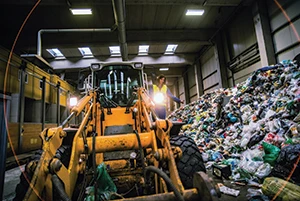
More than 116,000 sanitation workers collect 250 million tons of trash annually, according to a recent Mental Floss estimate. Statistics from the US Bureau of Labor Stats and Census in 2010 indicate that women comprised only 1% of that work force. Surveys conducted last year indicate that there’s been little progress in the five-year interim—about 99% of garbage collectors in this country are still men.
Reasons for the low percentage of females in the industry can only be speculated. It could be related to the fact that trash collecting routinely appears on lists of the most dangerous jobs in America, with approximately 30 fatalities per 100,000 workers annually.
It could stem, in part, from tradition. Historically, most dirty jobs outside of the home have been performed by men. Because even recent studies indicate that the trend continues, with 90% of dirty jobs being performed by men, Maria Klawe, president of Harvey Mudd College in Claremont, CA, compiled new research. She discovered that women don’t choose “dirty” careers because they don’t find them interesting. Additional reasons they don’t pursue such work include the belief that they wouldn’t be good at it, and their concerns about feeling comfortable working with their coworkers.
Some believe the lack of women in waste is a holdover from the days prior to automated trash trucks, when all cans had to be “manhandled” to empty them into the haulers, requiring strength and “grit.” More women have joined the ranks at the Phoenix Public Works Department since the municipality started using automatic trucks, admits Lorizelda Stoeller, operations manager, Solid Waste Field Services, where three of the 267 drivers are women. However, she adds, the Department requires everyone to run the bulk routes where manual pickup is standard operating procedure.
“It’s dirtier and dustier than curbside, but most [collections staff] start on bulk because it’s a two-man crew,” says Stoeller. “That way they get to know the city, the routes, and the operation before they can bid on contained sideload routes.”
Upper body strength is an outdated excuse in an age of gyms, better physical fitness, and automated equipment. “While some activities requiring extra strength may not be the best fit for some women,” observes Curtis Dorwart, Mack vocational products marketing manager, “you don’t have to have the brawn of yesteryear for many collection activities. Women can do as good a job all the way around as their male counterparts.”
Recruitment
So why aren’t there more women in waste? The short answer is that women aren’t choosing it as a career, but that raises the obvious follow-up question: why not?
“It’s little known,” postulates Stoeller, who confesses that she “stumbled into” her job as master’s level intern. “Never in a million years did I think I’d end up here, but I fell in love with it.”
Poor recruitment efforts may be blamed to an extent. Although Dorwart claims that women are being recruited and hired, efforts in some regions may not specifically target the female population. “All of the refuse haulers out there are looking for customer-oriented employees.”
The Memphis Public Works Division recruits along similar lines…when it needs an operator with a CDL. “It’s about equality,” says Kim Hardeman, area zone supervisor who began her career at the PWD in 1998 as a clerk. “We want an employee who can do the job.”
Other communities actively seek women. “Phoenix’s campaign to actively recruit women for non-traditional jobs spans many departments and occupations,” says Councilwoman Thelda Williams, a longtime supporter of campaigns and outreach planned by the city to encourage more women to consider applying for non-traditional jobs.
“We want to recruit more women,” adds Stoeller. “They take better care of the equipment. Those are $750,000 trucks—we are protective of them.” Women are typically less aggressive behind the wheel than men, and therefore would put less stress, wear, and tear on the trucks. Their different driving style may also include a safety bonus, especially in neighborhoods where young children play.
Women are meticulous when it comes to cleaning the trucks, Stoeller continues—perhaps because they’re commonly recognized as being more detail-oriented than men, or maybe just because they’re so accustomed to cleaning in the home.
Women also adapt quickly, Stoeller believes. Due to high turnover and a lot of vacancies, routes can change.
“We have 10 service areas, with each driver assigned to one,” she says. “If there’s an open route [due to illness or staff shortages], all the drivers work together to cover it after doing their own route.”
That sense of teamwork is prevalent. “We work together. We get out there and hump along with the men,” says Hardeman. “We grab disgusting carts with maggots, swing them into the truck and keep rolling because we have the motivation to provide a great service.”
That’s the purpose of having two to three on a packer, she explains. “We have to accomplish the same goal, so we do it together as a team.”
In fact, a 2009 study of behavior, practices, perception, and management of municipal solid waste in three districts presented at the International Conference of Waste Technology the same year demonstrated a clear link between women’s cooperation and the long-term success of any urban service project.
Having women on the team is beneficial. In addition to being team players, Hardeman views women as nurturers who provide support for a crew. “Women have a nurturing aspect. They motivate the men, but they also take care of them—make sure they take breaks and stay hydrated.” There’s a health component of these safety issues.
Because women contribute a vital component of success, Stoeller says Phoenix is exploring different ways to recruit them. One method is a new apprenticeship opportunity for 18 to 24 year olds who need a foot in the door. “A lot of drivers have no solid waste experience, so we help them get a CDL because the initial pool of CDL female drivers is low.”
Phoenix PWD also holds operator demos during which applicants drive a course to demonstrate their skills. “We used to get 200-plus, but last time we got only about 50,” laments Stoeller. Of those 50, they hired 14. Still, she considers these events and ridealongs in the trash trucks valuable because they “create awareness and drive interest.”
Nevertheless, evaluation of their recruitment efforts is ongoing. “It’s an internal challenge,” she clarifies. “This is an area of growth and opportunity where women can excel, but we need to promote it better and create awareness.”
Phoenix, AZ, is among the most proactive in recruiting women.
Breaking Through the Glass Ceiling…and Cleaning Up the Mess
The problem is that once they know about opportunities in solid waste, many women still aren’t interested. Research conducted by Penn Schoen and Berland reveals that 63% of teens have never considered a career in garbage and that even after learning of the personal economic benefits and the global impact of a job in solid waste, only 74% would consider it as a career.
“It can be intimidating for women because there are so few [of them],” speculates Stoeller. She says that “most men respect female drivers and their ability to operate a truck,” but she admits that “at the management level, we must earn the respect of the operators and develop relationships.” She has done so by riding along with the drivers to learn from them.
Hardeman concurs. “There is no resistance from the men. Everyone is welcome.”
In fact, women increase the potential driver pool, Dorwart points out. “Women can handle the same refuse equipment, routes, and customers just as well as men can.”
One of the big challenges is breaking down widely held stereotypes. According to a local publication, Verilyn Gallo was only the third woman to join the West New York City sanitation department in 1987. She is now one of 200 female trash collectors there. She laughs when people express disbelief upon seeing her drive the largest sanitation truck in the fleet. “I drive ‘the wrecker,'” she is reported as saying. “I have people in the truck who say, ‘you don’t drive that big truck,’ and I say, ‘oh yes, I do!'”
The general public often expresses surprise when they encounter a female trash hauler, although Memphis employs “quite a few drivers in solid waste and sanitation,” says Hardeman. They all do the same job as the men, whether it’s driving the truck, collecting debris, or administrative duties.
A good job and good working conditions help recruiting efforts.
In Memphis, that job involves collecting from 450,000 residential and commercial accounts. Crews of two to three ride rear loaders around the city on 86 routes a day, 43 recycling routes, and 43 curbside routes. “We provide a service,” says Hardeman. Most women love to provide service, she explains. “That’s our motivation.”
The job looks a little different in Phoenix, where residential accounts for 398,000 customers in the city are collected in automated side and rear loaders on Kubota tractors. In addition to the quarterly bulk collection, garbage, and recycling, Stoeller says the city has added a new service for green organics: lawn, grass, and tree trimmings.
“One-third of the waste we collect is green waste: palm fronds, shrubs, et cetera,” she says. They have 150,000 accounts signed up so far.
Most of the women are curbside drivers, Stoeller notes, but she explains that the city quickly promotes good workers: two women have become superintendents, and one is now a foreman. “One woman started 25 years ago as a bulk driver, and she now is a supervisor. Women are great workers. They know the operation. They want to promote and advance quickly.”
The Upside
Something must attract the more than 1,000 women who work in waste. Some are laid off from other jobs and grab this opportunity, Stoeller reports. It’s a job with prospects.
“It’s a great schedule, for one thing,” says Stoeller. Most sanitation jobs are Monday through Friday: no weekends and limited holidays. Workers are typically home by mid-afternoon. Such a schedule lends itself to family life. It pays well and provides a pension, she adds.
There are intangible benefits as well. Hardeman enjoys being outdoors all day. “I’m a garbage woman, and I love it,” she says. “And I don’t have to worry about the garbage can talking back to me.”
Hardeman believes women are successful in the industry because they have a “desire to make a difference in the community.” She says she considers her job as a trash collector a badge of honor. Women in waste love their jobs, she states. “Our attitude is the same [as men’s]…and we can do the same job.”
Generally, there is no difference between women’s and men’s skills, Williams agrees. She says the “handful of female solid waste drivers” have successfully demonstrated that they can do anything the male drivers can do.
“They take great pride in their jobs and in knowing they have a direct impact on their community. Our city is very diverse, and it’s important for our residents to see that reflected in our workforce. Our solid waste drivers have constant contact with our residents and are vital to our day-to-day function of keeping our city clean.”
Drivers are rock stars, Stoeller says. “They’re superheroes with the kids in the community.”
They’re pretty popular with the adults, too. The young management team in the department is primarily female and Stoeller believes they’re not only making “smart, strategic decisions,” but they’re also more cognizant of all the factors that go into those decisions. “Women consider the impact of our decisions.”
There simply is no downside to having women in the refuse industry, Dorwart says, despite the challenge it poses for Mack’s designers to find better “ergonomic sweet spots” for women or to design adjustability to suit a broader range of drivers.
“Most design decisions are made with the height of a 95th percentile male in mind, which can make control placement, visibility, and sight lines somewhat more challenging for women drivers,” he explains.
Maybe some manufacturers are taking physical differences into account, but in Memphis, Hardeman says no accommodations are made for women. “They have to be able to pick up 50 pounds, drive, and operate the equipment just like the men. All are equal in the eyes of the city.”
Whether women are equal to men in the waste industry, or whether their talents complement the skills of their male counterparts, it’s clear they’re here to stay.
Steps to a CDL
In order to drive a trash truck, an operator must obtain a commercial driver’s license (CDL) permit. According to the Commercial Motor Vehicle (CMV) Safety Act of 1986—which didn’t become law until 1992—operating a CMV (such as a collection vehicle) without a CDL can incur a civil penalty of up to $2,500 or, in some cases, criminal penalties up to $5,000 in fines or up to 90 days in prison. An employer is also subject to a penalty of up to $10,000 if they knowingly permit a driver to operate a commercial vehicle without a valid CDL.
Owing to the importance of proper licensing, if a potential hire doesn’t already possess a CDL, the Phoenix Public Works Department (PWD) will help the candidate obtain all the information they’ll need to get it.
Once a permit is obtained, the PWD staff gives the individual an overview of the equipment, along with a copy of the seven-step air brake test, which is needed for an endorsement on the license if they will be operating a truck with air brakes like those in the Phoenix fleet. The staff practices with the future operator until the person can perform the test to standard.
There are three classes of CDLs with endorsements for specialized qualifications for different types of vehicles. Each type and endorsement comes with a set of requirements.
Once the brake test is completed, explains Lorizelda Stoeller, operations manager, Solid Waste Field Services, Phoenix PWD, the person begins practicing driving with a trained staff person onboard.
Future drivers must possess a permit for at least 14 days before they’re allowed to take the skills test. Some states require successful completion of CDL training prior to testing, but even where it’s not required, it is advised.
In Phoenix, driver’s training is already part of the city’s 40-hour CDL course to obtain the license. People seeking a CDL in other regions can get training through a qualified program at a truck driving school, which charge an average of $3,000–$7,000 for classes that typically last three weeks. Topics covered include how to properly and safely operate a truck, map reading, trip planning, compliance with US Department of Transportation laws, backing up, turning, hooking up a trailer, and driving on the road. Some also include skid avoidance and recovery, as well as how to handle other emergency situations.
While the minimum requirements for acquiring a CDL vary from state to state, they must align with the Federal Highway Administration testing standards for licensing drivers. A written and practical test must be given by the State or an approved testing facility.
To obtain a CDL, an applicant must pass all three parts of the skills test: the vehicle inspection test, the basic controls test, and the road test. Each prospective driver must pass a written test on highway safety and a test about different parts of a truck. To pass the written test, student drivers must answer at least 80% of the questions correctly. To pass the driving skills test, the student driver must successfully perform a set of required driving maneuvers in the vehicle that the driver operates or expects to operate.
Some states issue the license immediately upon successful completion of the tests; others send the license by mail.
Latest from Waste Today
- The BDP compost system
- WM opens 2 new MRFs in Ontario
- Liberty Waste Solutions acquires AJ Disposal
- RecycleNation helps people find nearby recycling facilities
- Hoffman Sanitation Services acquires Lake Texoma Trash Service
- Ecowaste Solutions acquires Howie’s Enterprises
- Fornnax appoints new sales partner in Germany
- Super Bowl LX will implement reusable cup program, AI recycling systems