Photo courtesy of the Atlantic County Utilities Authority
The Atlantic County Board of County Commissioners passed an expansion of the county’s landfill in Egg Harbor Township, New Jersey.
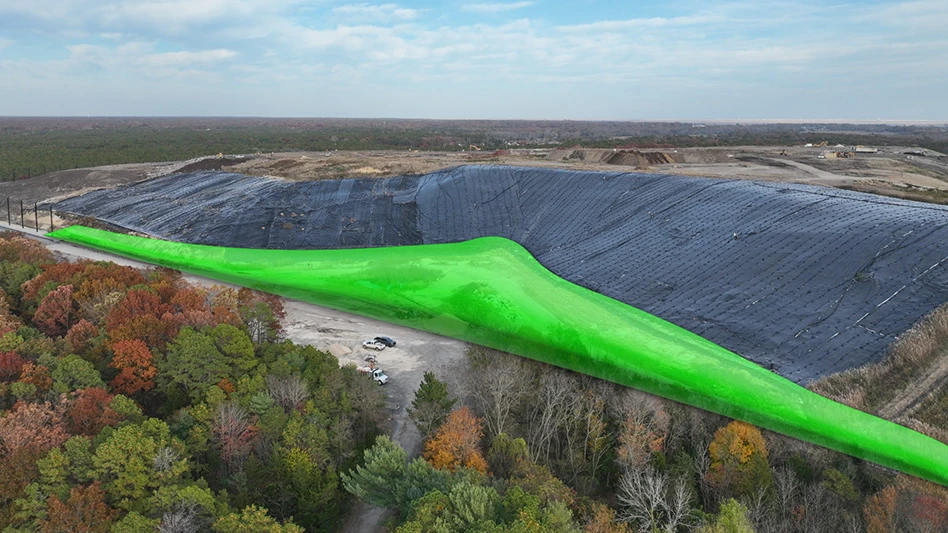
The site, operated by the Atlantic County Utilities Authority (ACUA), will receive an additional 5.74 acres of land and 40 ft. of airspace. According to the ACUA’s presentation, Atlantic County residents, municipalities and businesses will benefit from affordable and controlled rates for the next 15 years.
ACUA President Matthew DeNafo addressed the Atlantic County Board of County Commissioners on March 3 and outlined how capital costs for the expansion will be less than half of what historical project costs have been.
The expansion extends the landfill’s capacity from maxing out in 2029 to 2040. DeNafo says the 5.74 acres carved out for expansion is not currently in use.
“We’re just taking advantage of geometry,” DeNafo says. “There’s a corner there, we’re going to round it off. We’re not clearing wetlands or doing anything that’s environmentally irresponsible. The second part of that is the vertical expansion, 40 feet sounds like a lot, but it’s actually one of the lowest [in the state].”
DeNafo says without the expansion, the landfill will reach capacity in 2029 and would have burdened municipalities with more than $25 million in additional expenses each year. Transporting waste to another site would significantly increase rates, which according to the ACUA are among the lowest in New Jersey.
“There are 12 landfills in the state, 10 of them are going through the same process as we are,” DeNafo says. “We’re not unique, we’re not a unicorn. There are 10 other counties that are going through capacity. One is going for 55 acres. And New Jersey is dense, there are houses and communities in proximity to those landfills and they’re concerned, absolutely, but this is an essential need for the community, for economic development and for health and safety.”
DeNafo proactively addressed odor concerns in his presentation to the Atlantic County Board of County Commissioners. He says ACUA uses proven methods for minimizing odors and those will be installed in the expanded areas. ACUA says it has invested more than $22 million in its systems, including more than $8 million the past two years, adding that its efforts have led to a 98 percent decrease in odor complaints from 2023-26.
“It’s the way we manage it,” DeNafo says. “We have a new staff with new ideas and new partners. This has all helped us get to the point where we’re at today.”
ACUA added that maximizing the current landfill is better for the environment because the existing infrastructure has systems and technologies in place to protect the environment. DeNafo says the existing renewable natural gas (RNG) facility reduces methane being flared and prevents 340,000 metric tons of carbon dioxide emissions per year.
DeNafo says the RNG project was just opened in October and has reduced emissions and flare by 95 percent. He added that hauling waste creates additional emissions, but DeNafo says the same safeguards and innovations might not be available at other sites.
“This is what our organization has prided itself on,” DeNafo says. “Not being bad neighbors, but being integral in the community.”
Latest from Waste Today
- Worn Again Technologies unveils Accelerator plant to advance polycotton recycling
- Nashville Waste Services launches new digital route system
- Clean Energy announces multiple RNG deals with fleets nationwide
- Interchange 360 to operate alternative collection program under Washington’s RRA
- Waste Pro files brief supporting pause of FMCSA CDL eligibility rule
- New Way Trucks expands US network with Joe Johnson Equipment
- Tire Industry Project publishes end-of-life tire management guide
- Vecoplan to present modular solutions at IFAT 2026