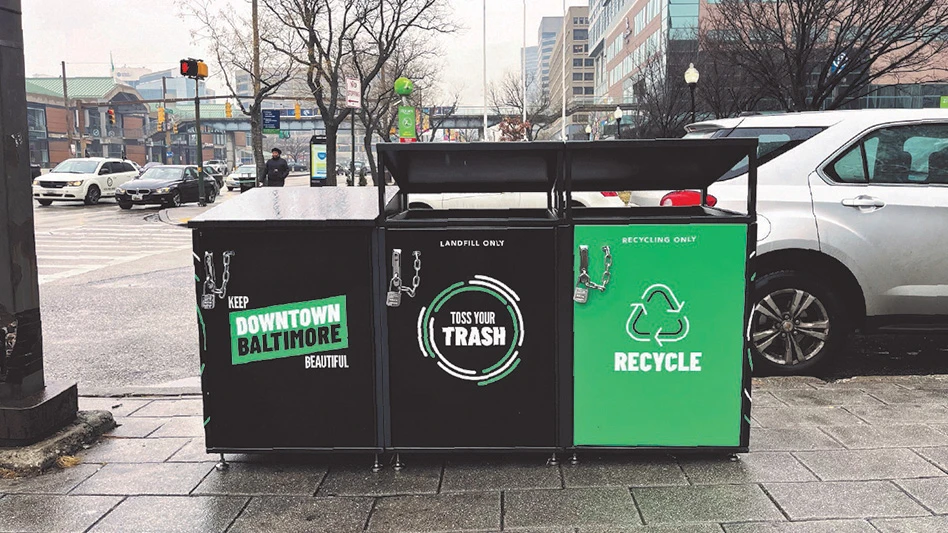
Photo courtesy of Citibin
The city of Baltimore recently completed its Citibin initiative, replacing all waste bins in its 106-block Downtown Management Authority (DMA) footprint with Citibin receptacles.
Citibin, a New York-based manufacturer of storage containers and receptacles for waste and recycling, as well as other materials, began the pilot project in Baltimore a little more than a year ago and since has installed its BasketPlus product at 195 locations in the city’s DMA area.
“These upgraded bins not only improve the appearance of our streets but also support a cleaner environment, making it more enjoyable for everyone who explores or lives in the area,” the Downtown Partnership of Baltimore says in a LinkedIn post announcing the initiative’s completion.
BasketPlus is a modular waste enclosure with additional storage for full bags of waste awaiting collection. When a litter basket reaches capacity, the bag can be removed from the receptacle and stored in BasketPlus’ additional compartment.
Citibin founder and CEO Liz Picarazzi says this extra storage capacity and the product’s modularity are what set BasketPlus apart from other waste sheds on the market.
“One thing that we noticed was that a lot of the litter baskets in public spaces that were collecting the trash were overflowing,” she says. “Instead of putting the trash bag leaning against the litter basket because it’s over capacity and they’re not getting picked up, in many cases, for many hours, … we created BasketPlus to be able to have the component of the litter basket, plus the storage.”
The product’s modularity allows for the separate collection of various materials, including recyclables like plastic and glass, apart from waste.
Citibin has installed BasketPlus in other cities, with 16 locations in Chicago and two in New York.
The Citibin story
What initially began as a residential waste solution for Brooklyn brownstone residents has grown to feature a varied portfolio of waste receptacles, from composting bins to litter baskets to an upcoming line of bear-resistant trash sheds.
Picarazzi has been at the helm of Citibin for 13 years. Up until recently, the company primarily focused on residential waste enclosures.
New York’s waste containerization initiative helped boost Citibin’s popularity with municipalities, expanding its reach to 30 of the city’s business improvement districts, including Times Square and Wall Street.
RELATED: The New York Department of Sanitation celebrates more than 800,000 bins ordered online
“With municipal, what we’re sort of focused on is just containerization of [black bags] that otherwise would be on the curb,” Picarazzi says. “So essentially, it’s sort of a holding pen or weigh station in between the collection point of a litter basket to being collected and taken, in most cases, to a landfill.”
Boston’s community composting program, Oscar, features Citibin containers at 30-40 locations. The bins, a distinct green, are locked and located in public spaces for residents to drop off food scraps.
Citibin containers are made of sheet aluminum, which Picarazzi says boasts pest resistance.
“It’s basically a huge aluminum cabinet, and rats can’t get into it,” she explains.
The containers are available in three sizes, small (32-44 gallons), medium (45-55 gallons) and large (65-95 gallons). The medium bins were designed to fit New York’s new waste containers.
Bins are available in three colors—coffee, charcoal and slate—and Picarazzi says municipalities often opt for a custom vinyl wrap clad with city branding.
Additionally, Citibin made the 2025 Inc. 5000 list of the country’s fastest growing private companies for the second year in a row. In an announcement posted to LinkedIn last week, the company says this recognition affirms its belief that “something as humble as a trash enclosure can be transformed through thoughtful design.”
“Making the Inc. 5000 is more than a milestone—it’s the result of years of studying and trying to improve trash enclosures,” the company’s post reads. “Every prototype, every user insight [and] every design challenge solved brought us here.”
Outside the waste space, Citibin also offers package lockers and planters.
Latest from Waste Today
- Fleetio launches AI capability to accelerate fleet maintenance approvals
- Recycle Ann Arbor extends drop-off station operating hours
- Sybilion seeks to help manufacturers confidently address volatility
- Ecowaste Solutions partners with city of Trinity, Texas
- Bristal Hauling acquires G&R Garbage Disposal
- Baltimore trash collection expected to slow as WTE facility closes for maintenance
- Landfill Insights | Connecting the dots: Policy to practice
- FCC Environmental Services awarded collection contract in Florida