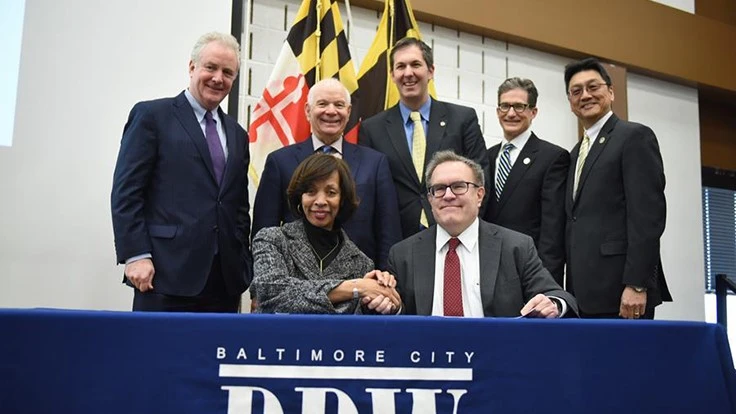
The U.S. Environmental Protection Agency (EPA) Acting Administrator Andrew Wheeler has announced a $202 million Water Infrastructure Finance and Innovation Act (WIFIA) loan to the City of Baltimore to help the city make system-wide upgrades to its aging wastewater infrastructure at the Back River Wastewater Treatment Plant.
“This WIFIA loan will help Baltimore modernize its wastewater infrastructure, protect human health and prevent sewage and polluted runoff from entering the Chesapeake Bay,” Wheeler says in a press release.
“Maryland appreciates the support of our federal partners in helping Baltimore City promote public health and ensuring that we continue making historic progress to restore our most precious natural asset, the Chesapeake Bay,” says Maryland Governor Larry Hogan.
Like many urban centers, Baltimore is facing the immediate challenges of aging wastewater infrastructure, the EPA says. With the WIFIA loan, Baltimore will complete 14 projects that will include a series of repairs and upgrades across its large wastewater conveyance system, make upgrades to the Back River Wastewater Treatment Plant and make improvements to its storm water management system. Together, these projects improve the reliability and performance of the city’s wastewater infrastructure, reduce polluted runoff and sewage from flowing into the Inner Harbor, and safeguard the significant investments that have been made toward restoring the Chesapeake Bay.
“Our water and wastewater customers have been required to shoulder the burden of paying for these long overdue and essential improvements,” says Baltimore Mayor Catherine E. Pugh. “Making these critical investments is not only long overdue, but vital to Baltimore becoming a truly 21st century city. We are grateful to the EPA for this low-interest loan that will assist us in managing effectively the significant costs associated with our infrastructure improvement efforts.”
Baltimore’s project is estimated to cost $942 million. EPA’s WIFIA loan will help finance more than twenty percent of that amount—up to $202 million. Additionally, Maryland Department of the Environment (MDE) will finance approximately $280.5 million from its Water Quality Revolving Loan Fund and approximately $47.5 million from the Bay Restoration Grant Fund. The Maryland Water Quality Revolving Loan Fund receives an annual grant from EPA, including nearly $39 million in 2018. Because both the WIFIA program and the MDE loan program offer low interest rates, the city is expected to realize significant cost savings, EPA says. The WIFIA loan alone will save the city up to $40 million.
Established by the Water Infrastructure Finance and Innovation Act of 2014, the WIFIA program is a federal loan and guarantee program at EPA that aims to accelerate investment in the nation’s water infrastructure by providing long-term, low-cost supplemental credit assistance for regionally and nationally significant projects.
To date, EPA has issued seven loans totaling nearly $2 billion in WIFIA credit assistance. Combined, these seven projects will create over 6,000 jobs.
Latest from Waste Today
- Vecoplan to present modular solutions at IFAT 2026
- Terex Ecotec appoints Bradley Equipment as Texas distributor
- My Green Michigan expands depackaging capacity
- Washington selects Circular Action Alliance as PRO
- Ten-8 Industrial opens new central Florida service center
- Triumvirate Environmental acquires Environmental Waste Minimization
- Official NYC Bin availability expands ahead of deadline
- US Food Waste Pact’s 2025 Impact Report shows decrease in food waste