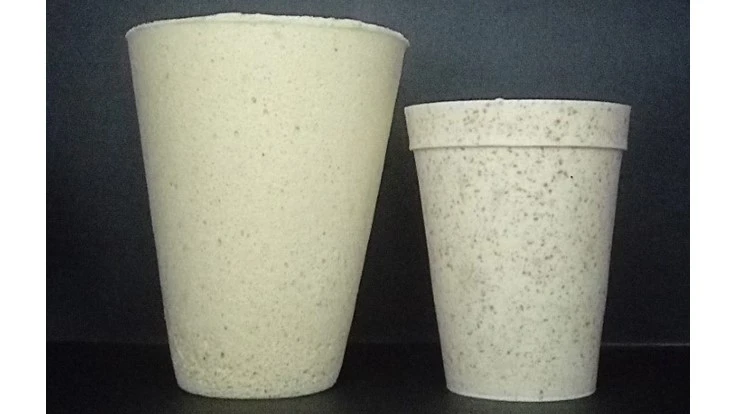
Houston-based BioCapital Holdings says it has designed a plastic-free to-go coffee cup that is compostable and can thus cut into the estimated total of some 600 billion “cups and containers that end up in landfills around the world each year.”
The company says it is “hoping to secure a grant funded by Starbucks and McDonald’s, among other industry leaders [to] create a prototype for the recently announced NextGen Cup Challenge.”
“I was very surprised to learn about the enormous number of cups going into landfills each year when I first researched this initiative,” says Charles Roe, a senior vice president at BioCapital Holdings. “As a coffee drinker myself, it never occurred to me the plastic liner in the fiber cups most companies use could present such a huge recycling hurdle.”
Roe says he learned that although such cups are fiber-based, they use a thin plastic liner tightly attached to the cup to help prevent leaks. This liner makes the cup very difficult to recycle and can cause it to “take about 20 years to decompose.”
Says Roe, “Our company already had developed an organic foam material that can be molded into a soft or hard BioFoam for mattresses and wood substitutes. I approached our chief scientist to find out if we could adapt this existing material to a cup that eliminated the need for a petroleum-based liner.”
He continues, “One week later, he created a prototype that effectively held hot liquids. Not only did we now have a prototype, but a few months later our research showed this natural-based cup, when crushed into pieces or composted, was great as a plant fertilizer supplement. He had created a natural cup to drink your beverage of choice and then use it for plant food in your garden.”
Roe and BioCapital contend the new cup can address both design and recoverability issues facing current cups. “Except for a handful of specialized facilities in a few major cities, existing recycling plants around the world are not equipped to consistently or cost-effectively separate the fiber from the plastic liner” in currently used cups, states BioCapital in a news release. “Thus, most of these cups end up as waste. Compounding the issue, the material that is recovered from fiber cups doesn't sell for much, so there is little financial incentive for the industry to recycle.”
The NextGen Cup Challenge will select the top 30 designs in December, and six finalists will be announced in February 2019. These six companies will have the opportunity to work with a wider pool of corporations to scale production of their cup ideas.
BioCapital Holdings describes itself as a bio-engineering start-up that strives to produce compounds and materials that are biodegradable and friendly to the environment, with applications in several industry sectors.
Latest from Waste Today
- Vermeer announces plan to build new facility in Des Moines metro area
- Buffalo Biodiesel shares updates on Part 360 application to DEC, Tonawanda facility progress
- Capstar Disposal expands roll off dumpster rental services
- Supreme Court strikes down IEEPA tariffs
- Casella details facility closures, expansion efforts
- Zero harm: Building a SIF prevention program for waste and recycling operations
- Casella posts a loss in Q4 2025
- McNeilus names Haaker Equipment first Dealer Partner of the Year