Photo courtesy Cal-Waste
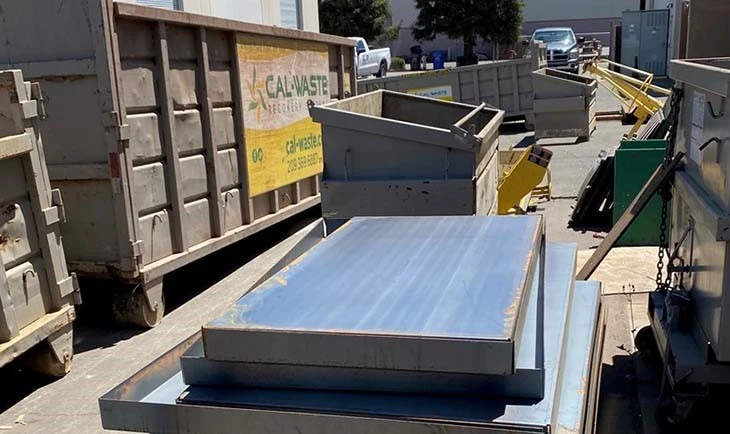
For as long as Casey Vaccarezza, director of operations at Cal-Waste Recovery Systems, and Ken Kimmel, the company’s maintenance shop director, can remember, the California-based waste and recycling provider has repaired its collection containers in-house.
For Cal-Waste, the effort is part of its mission to be a pure customer service company, fulfilling its customers’ needs whether they ask directly or not.
“From a marketing standpoint for us, every container, every box, every cart is a billboard out on the street,” Vaccarezza says. “Do you want a rusted box in front of your business or a freshly painted one? Clean equipment is more appealing to a new customer.”
The company manages about 4,000 front-load containers and 1,200 roll-off boxes. Jack Meotti, marketing communications director for Cal-Waste, says the company refurbishes 10 roll-off dumpsters and up to 30 other commercial containers at any given time. The typical cost of repairing and maintaining a container or box depends on the amount of work that needs to be done but typically is between $1,000 to $2,000 apiece.
The containers are repaired as needed, and repairs can take up to three days, depending on the scope of the repair. Some of the most common repairs that need to be done include replacing the bottom of the container, replacing the lids, repairing holes, applying decals and repairing the pockets.
The repair process at Cal-Waste begins in the field, with customers or drivers examining the container to determine if it needs to be taken in for maintenance. The primary sign a container needs to be repaired is liquid leaking from the bottom of the container, which sees the most wear because of the acidity of the material and from being picked up and put down regularly.
Other signs that customers and drivers look for include damaged wheels and lock bars or sharp edges. They also look for cosmetic damage, such as chipped or faded paint and damaged decals.
When the company gets the container into the shop, it gets steam washed and examined before any repairs are made. Metal repairs are made before the container is sandblasted to remove the paint completely. Workers then apply a fresh coat of paint to the container and reapply decals.
For Cal-Waste, the primary benefits of repairing the container in-house include quality control and lower costs. Vaccarezza says if Cal-Waste sent in the containers for repair at a fabrication company, there would be a 15 percent to 20 percent mark up in price because of parts, material and labor.
By handling the container repairs in-house, Cal-Waste also can manage the quality of the labor and materials, including higher quality paint and better welding. The company also finds benefits in customizing the containers for the businesses that use them. This includes installing specialty lids, splitting containers and bear-proofing boxes and containers for the company's foothill region customers.
Kimmel says another benefit of repairing the containers in-house is that Cal-Waste can prioritize what needs to be done.
“If we've got 30 containers of different types and sizes sitting at somebody else's shop, unless we're calling them telling them which one to do next, it will take a while to get what we need,” Kimmel says. “Because we're doing it ourselves, we're right there and we can prioritize what we need and when.”
The biggest benefit, however, is that the repair program allows the company to work on its own time and not the time of another company, which optimizes its speed and efficiency.
Latest from Waste Today
- My Green Michigan expands depackaging capacity
- Washington selects Circular Action Alliance as PRO
- Ten-8 Industrial opens new central Florida service center
- Triumvirate Environmental acquires Environmental Waste Minimization
- Official NYC Bin availability expands ahead of deadline
- US Food Waste Pact’s 2025 Impact Report shows decrease in food waste
- Coastal Waste & Recycling expands recycling operations with Machinex
- Reconomy acquires German-based GfAW