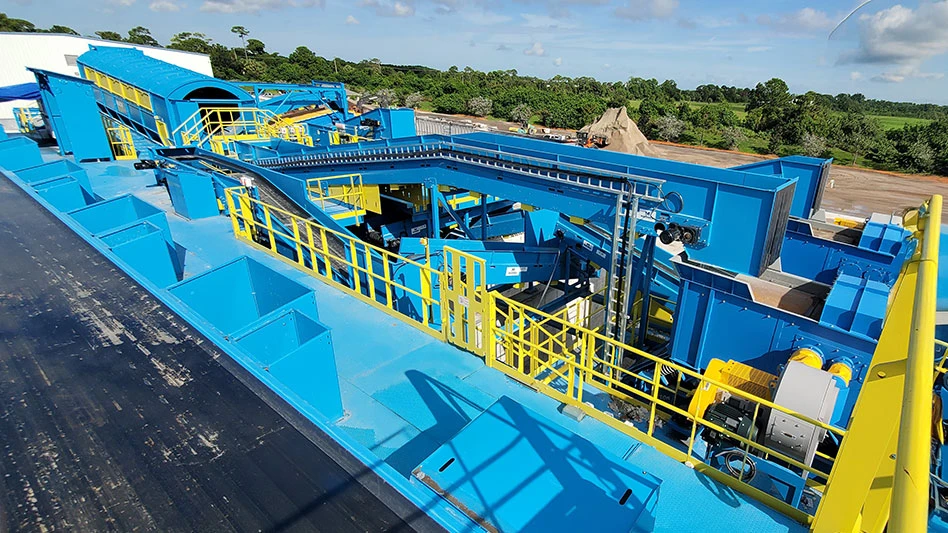
Photo courtesy of CarbonZero.Eco
CarbonZero.Eco, a climate technology startup based in Silicon Valley, California, has completed its first commercial biochar production facility in Colusa County, California.
Since 2024, the company has secured partnership agreements with hundreds of almond farms across Colusa and Yolo counties, aiming to mitigate up to 1.5 million tons of CO₂ emissions from agricultural waste.
The new plant marks CarbonZero.Eco’s first large-scale production site. The facility is located adjacent to almond shell stockpiles, aiming to minimize operational emissions by ensuring that no feedstock transportation is required. The biochar produced on-site will be blended into compost used directly by partnering farms.
According to CarbonZero.Eco, almond shells typically decompose within 24 months and turning them into biochar enables long-lasting carbon storage. Currently, the company estimates that half a million tons of shells are being burned or left to decompose in California’s Central Valley. CarbonZero.Eco says its technology reduces this number to zero.
Additionally, there are 500 watersheds in the California aquifers which are being drained each year. The company says its biochar will prevent sink spots by requiring less water usage requirements by farmers, with biochar soil retaining 20 percent more water to stop depleting the reservoirs.
The company also announced its first commercial agreement with Climeworks, a global carbon removal company headquartered in Switzerland, for the purchase of CarbonZero.Eco’s carbon removal credits.
“This facility represents a major step toward making carbon-negative agriculture both practical and profitable,” CarbonZero.Eco founder and CEO Harper Moss says. “By placing our first plant directly where agricultural waste is generated, we’re creating a closed-loop system that benefits farmers, the environment and the climate. Our mission is to empower American farmers to enhance soil health, improve crop yields and unlock new revenue streams—while removing atmospheric CO₂ at scale through next-generation biochar production.”
Latest from Waste Today
- Interchange 360 to operate alternative collection program under Washington’s RRA
- Waste Pro files brief supporting pause of FMCSA CDL eligibility rule
- New Way Trucks expands US network with Joe Johnson Equipment
- Tire Industry Project publishes end-of-life tire management guide
- Vecoplan to present modular solutions at IFAT 2026
- Terex Ecotec appoints Bradley Equipment as Texas distributor
- My Green Michigan expands depackaging capacity
- Washington selects Circular Action Alliance as PRO