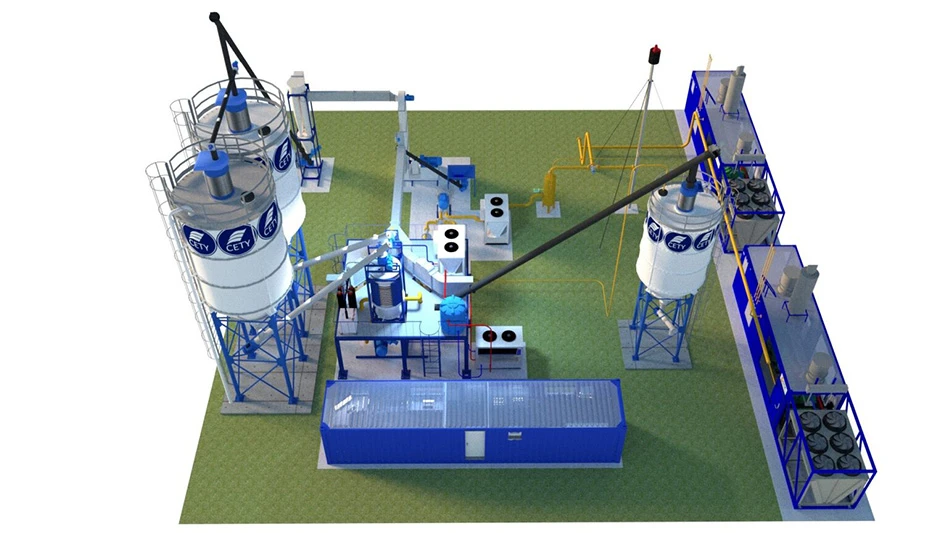
Photo courtesy of CETY
Clean Energy Technologies Inc. (CETY), headquartered in Irving, California, has launched a dedicated High Temperature Ablative Pyrolysis (HTAP) platform for integration with existing and planned anaerobic digestion and renewable natural gas (RNG) facilities.
According to CETY, the platform will allow anaerobic digestion operators to convert hard-to-digest biomass and digestate into additional renewable energy and biochar.
HTAP technology thermochemically converts forestry residues, agricultural waste and other nonfood biomass inputs into syngas, supporting up to 1.3-1.6 megawatts of onsite power or up to 8 million British thermal units per hour of supplementary RNG and into biochar. This biochar can then be tested and certified for agricultural or industrial applications.
When paired with anaerobic or catalytic methanation systems, the syngas can be upgraded to pipeline-quality RNG, the company says. A single HTAP unit producing 1,500 normal cubic meters per hour of syngas can support production equivalent to approximately 13 MMBtu per hour of additional RNG. CETY says this places one HTAP system between a medium- and large-scale anaerobic digestion facility in terms of its incremental output.
The company estimates that the combined HTAP platform could generate more than $3 million per year in incremental RNG value from a single commercial installation. This depends on feedstock, design scale, regional markets and regulatory approvals before account for biochar value and avoided digestate management costs.
“Anaerobic digestion is a proven pathway for renewable gas, but digestibility limits and digestate handling costs restrict its full potential,” CETY Director of Technology Alexander Skorokhodov says. “HTAP unlocks the remaining energy in hard-to-digest biomass and converts digestate into clean energy and biochar. This enables anaerobic digestion operators to potentially expand RNG output while improving environmental and economic performance.”
Latest from Waste Today
- Fleetio launches AI capability to accelerate fleet maintenance approvals
- Recycle Ann Arbor extends drop-off station operating hours
- Sybilion seeks to help manufacturers confidently address volatility
- Ecowaste Solutions partners with city of Trinity, Texas
- Bristal Hauling acquires G&R Garbage Disposal
- Baltimore trash collection expected to slow as WTE facility closes for maintenance
- Landfill Insights | Connecting the dots: Policy to practice
- FCC Environmental Services awarded collection contract in Florida