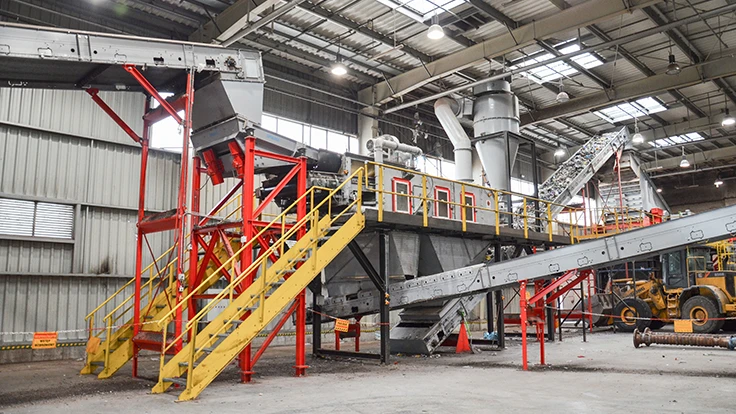
 EkoPaliwa, a waste recycling company in Chelm, Poland, commissioned Weima, Fort Mill, South Carolina, to introduce two Powerline 3000 single-shaft shredders with hydraulic drive used in secondary shredding in its plant to produce alternative fuels.
The main buyer of the refused derived fuel (RDF) is Cemex, with US headquarters in Houston, and produces cement in the building adjacent to EkoPaliwa.
The globally active construction supply company wants to ensure it is self-sufficient in terms of fuel supply at all times. The environment benefits from the use of RDF, since significantly less fossil coal is needed for the generation of energy, includes a decrease in CO2 emissions. In addition, less waste is dumped on municipal unloading places, so the latest regulations of the European Union in relation to the reduction of landfill waste are met.
In order to meet the demands of the project, one Weima PowerLine 3000 single-shaft shredder, including sorting and separation systems, was initially commissioned. The demand for RDF, however, grew and exceeded the quantities produced at the plant, the company says. Not more than a year passed before EkoPaliwa doubled its capacities and purchased another Weima PowerLine 3000 shredder with 350 kilowatt drive capacity. Today, 16 workers in a two-shift operation are employed in Chelm. The waste recycling plant is monitored by four teams around the clock.
All the input material comes from Poland. Around 18,000 tons are delivered on the premises every month. The main suppliers are local waste disposal companies and private companies. Once foreign objects such as glass, hard metals and stones have been separated from the flow of waste, the high-caloric municipal waste is fed into the Weima secondary shredder, where it is reduced to around 40 millimeters. With a working width of 3,000 millimeters, each and the universal PowerLine rotor (190 revolutions per minute), that is equipped with 144 cutting knives and Vautid wear protection, a total material throughput of 30 tons per hour is attained.
With the Weima hydraulic drive, stop, start and reverse is possible at all times. Its structure and response time is designed to make it almost completely insensitive to interfering materials. In addition, overload protection can be achieved by way of a pressure relief valve and a reversal of direction. Speed and torque can be adjusted with the control pump, without current peaks occurring or a frequency converter having to be used, the company says.
An advantage of the RDF system of EkoPaliwa is its closeness to the Cemex cement plant. Over a system of conveyor belts, the shredded material is brought to the neighboring silo, from where it is transported, as needed, directly to the furnaces of the cement production system. Hence loading on trucks or other logistical resources are no longer required.
During the subsequent combustion process for heating the raw meal, temperatures of up to 3,632 degrees Farenheit are reached, and clinker emerges in the process, the company says.
With this method, the waste being used is designed to be able to remain for much longer in the rotary furnace and does not leave production-related organic residues, which have to be disposed of later. All kinds of materials are recycled and salvaged in terms of energy.