U.S. PIRG Education Fund.
Americans discard millions of tons of compostable material each year, primarily food scraps and yard trimmings, which are then incinerated or sent to landfill, contributing to global greenhouse gas emissions. The latest data shows Americans landfilled or incinerated 50 million tons of compostable scrap in 2015.
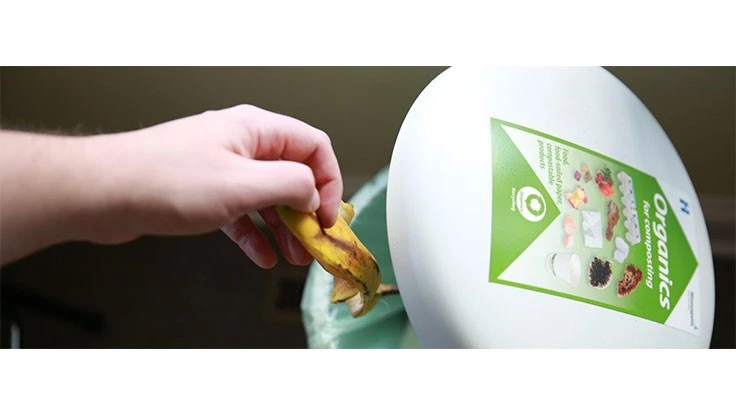
According to Composting in America, a new report released in summer 2019 by U.S. PIRG Education Fund, Environment America Research and Policy Center and Frontier Group, composting could reduce the amount of material sent to landfills and incinerators by 30 percent; however, only 326 towns-- less than 2 percent of American communities--offer curbside food scrap collections.
“Imagine if our organic waste--food scraps, paper towels, yard trimmings--could help us instead of hurt us,” says Alex Truelove, zero waste director for U.S. PIRG Education Fund. “With composting, we can make that a reality.”
The number of cities, towns and states offering organics waste management solutions, including curbside collection programs, community-wide composting programs and laws requiring commercial businesses to properly manage food scrap through authorized recycling facilities, is growing.
"Composting programs can work in every community, from small towns to big cities," says Abigail Bradford, policy analyst at Frontier Group and co-author of the report. "What communities may lack is know-how. This report shares experience and tips from communities that have taken simple steps to create successful composting programs."
San Francisco has reduced the amount of waste it sends to landfills by 80 percent and composts 255,500 tons of organic material each year. As part of Vermont’s Universal Recycling Law, passed in 2012, the state will ban recyclables, yard trimmings, food scraps and other organics from landfills by 2020.
Prince William County, Virginia, is also partnering with Freestate Farms to upgrade technology and add capacity at its local composting facility. By 2020, the facility will have capacity to compost more than 80,000 tons or organic waste per year, doubling its capacity, the report notes.
Currently, waste haulers are using a combination of curbside pickup and drop-off locations to collect organic material for composting. San Francisco has encouraged residents to participate in composting programs by making the bins for organics larger than waste bins. In addition, Portland, Oregon, provides organics collections more frequently than waste and recyclables, the report notes.
Municipalities and haulers are also partnering with nonprofits and volunteers to educate residents about composting to reduce contamination. “Peer-to-peer” education is a widely used tool in the industry, the report says. In Minnesota, “block captains” are appointed by a local nonprofit to “educate neighbors about the mechanics and value of composting.” San Francisco also educates residents through volunteers who teach composting classes, the report says.
Although drop-off programs and windrow composting sites have been the most traditional methods of composting in the last decades, an increasing number of businesses, institutions and municipalities are using anaerobic digestion to process food scrap. Several anaerobic digestion facilities are being constructed in Vermont and in other states, including Chicago.
In order to pave a path “toward universal composting” the report also makes policy recommendations to make organics collections “cheaper” than waste disposal. Programs, including Save Money and Reduce Trash (SMART), charge residents and businesses less if they throw out less waste. The report also supports legislation that requires commercial businesses to divert food scrap and organics from landfill to composting facilities. New York is the latest state to pass commercial organics requirements in 2019.
For the full report, click here.
Latest from Waste Today
- Vecoplan to present modular solutions at IFAT 2026
- Terex Ecotec appoints Bradley Equipment as Texas distributor
- My Green Michigan expands depackaging capacity
- Washington selects Circular Action Alliance as PRO
- Ten-8 Industrial opens new central Florida service center
- Triumvirate Environmental acquires Environmental Waste Minimization
- Official NYC Bin availability expands ahead of deadline
- US Food Waste Pact’s 2025 Impact Report shows decrease in food waste