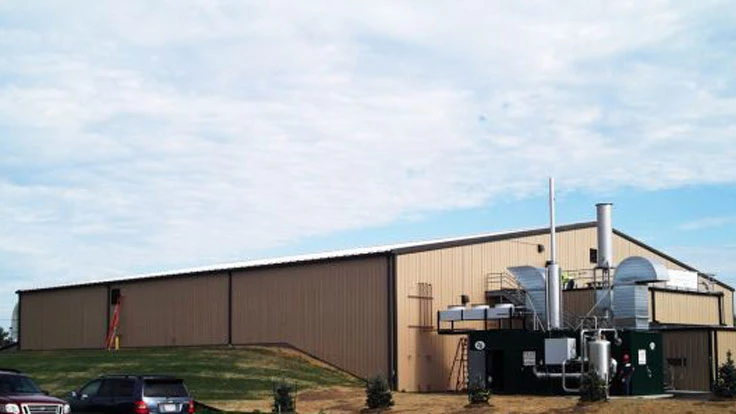
The dry fermentation anaerobic digester by Madison, Wisconsin-based Bioferm at the University of Wisconsin Oshkosh (UWO), dubbed “Biodigester I,” is the first industrial-scale dry fermentation anaerobic digestion plant in the Americas, the company says. The facility serves as a living, learning laboratory for students and faculty and furthers the university’s goals to create a sustainable campus with a net zero impact on the climate and environment.
The facility can handle up to 8,000 tons of organics at a time including campus and nearby food waste, yard waste and crop residue, produces 2,320,000 kilowatt hours on average a year and supplies as much as 15 percent of UWO’s electrical needs.
The total footprint of the facility is 19,000 square feet, with a storage area of 2,000 square feet and a mixing area of 7,800 square feet. There are four fermentation vessels, each 70 feet by 23 feet by 16.7 feet. Each cycle is 28 days long, with 13 maximum material exchanges per year–around 150 tons of fresh material per exchange.
The methane produced and used is equivalent to the avoided release of 9,641 metric tons of carbon dioxide (CO2) equivalent. Electricity generation from these renewable sources is equivalent to reducing 2,339 metric tons CO2 per year from a conventional bituminous coal facility or 1,372 metric tons CO2 per year produced from a natural gas facility.
The facility can handle up to 8,000 tons of organics at a time including campus and nearby food waste, yard waste and crop residue, produces 2,320,000 kilowatt hours on average a year and supplies as much as 15 percent of UWO’s electrical needs.
The total footprint of the facility is 19,000 square feet, with a storage area of 2,000 square feet and a mixing area of 7,800 square feet. There are four fermentation vessels, each 70 feet by 23 feet by 16.7 feet. Each cycle is 28 days long, with 13 maximum material exchanges per year–around 150 tons of fresh material per exchange.
The methane produced and used is equivalent to the avoided release of 9,641 metric tons of carbon dioxide (CO2) equivalent. Electricity generation from these renewable sources is equivalent to reducing 2,339 metric tons CO2 per year from a conventional bituminous coal facility or 1,372 metric tons CO2 per year produced from a natural gas facility.
Latest from Waste Today
- Worn Again Technologies unveils Accelerator plant to advance polycotton recycling
- Nashville Waste Services launches new digital route system
- ACUA landfill expansion project unanimously approved
- Clean Energy announces multiple RNG deals with fleets nationwide
- Interchange 360 to operate alternative collection program under Washington’s RRA
- Waste Pro files brief supporting pause of FMCSA CDL eligibility rule
- New Way Trucks expands US network with Joe Johnson Equipment
- Tire Industry Project publishes end-of-life tire management guide