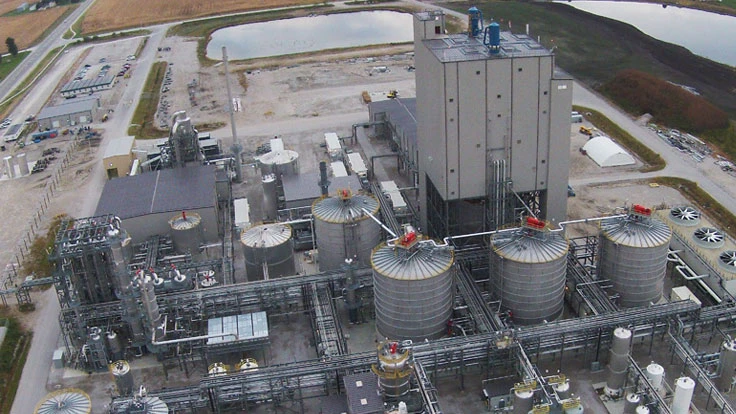
Wilmington, Delaware-based DuPont celebrated the opening of its cellulosic biofuel facility in Nevada, Iowa, with a ceremony including Iowa Governor Terry Brandstad and other dignitaries on Oct. 30.
DuPont says the biorefinery is the world’s largest cellulosic ethanol plant, with the capacity to produce 30 million gallons per year of fuel, offering a 90 percent reduction in greenhouse gas emissions compared with gasoline.
The raw material used to produce the ethanol is corn stover—the stalks, leaves and cobs left in a field after harvest. According to DuPont, the facility will demonstrate at commercial scale that nonfood feedstocks from agriculture can be the renewable raw material to power future energy demands. The company also says that cellulosic ethanol will further diversify the transportation fuel mix.
The biorefinery receives its feedstock from some 500 local farmers, who DuPont says will provide 375,000 tons of stover per year from within a 30-mile radius. In addition to providing a new revenue stream for these growers, the plant will create 85 full-time jobs and more than 150 seasonal local jobs in Iowa, DuPont says.
“Iowa has a rich history of innovation in agriculture,” said Iowa Governor Terry Branstad. “Today we celebrate the next chapter in that story, using agricultural residue as a feedstock for fuel, which brings both tremendous environmental benefits to society and economic benefits to the state. The opening of DuPont’s biorefinery represents a great example of the innovation that is possible when rural communities, their government and private industry work together toward a common goal.”
DuPont says that as a global company with operations in more than 90 countries, it is uniquely positioned to deploy its cellulosic technology for a global rollout in transportation fuel and other industries.
“Today, we fulfill our promise to the global biofuels industry with the dedication of our Iowa facility,” said William Feehery, president of DuPont Industrial Biosciences. “And perhaps more significantly, we fulfill our promise to society to bring scientific innovation to the market that positively impacts people’s lives. Cellulosic biofuel is joining ranks with wind and solar as true alternatives to fossil fuels, reducing damaging environmental impacts and increasing our energy security.”
In Asia, DuPont recently announced its first licensing agreement with New Tianlong Industry to build China’s largest cellulosic ethanol plant, and last fall a Memorandum of Understanding (MOU) was announced between DuPont, Ethanol Europe and the government of Macedonia to develop a second-generation biorefinery project. The company also is working with Procter & Gamble to use cellulosic ethanol in North American Tide laundry detergents.
DuPont says most of the fuel produced at the Nevada, Iowa, facility will be transported to California to fulfill the state’s Low Carbon Fuel Standard, a policy to reduce carbon intensity in transportation fuels. The plant also will serve as a commercial-scale demonstration of the cellulosic technology, DuPont says.
Latest from Waste Today
- Vermeer announces plan to build new facility in Des Moines metro area
- Buffalo Biodiesel shares updates on Part 360 application to DEC, Tonawanda facility progress
- Capstar Disposal expands roll off dumpster rental services
- Supreme Court strikes down IEEPA tariffs
- Casella details facility closures, expansion efforts
- Zero harm: Building a SIF prevention program for waste and recycling operations
- Casella posts a loss in Q4 2025
- McNeilus names Haaker Equipment first Dealer Partner of the Year