Image courtesy of the EPA.
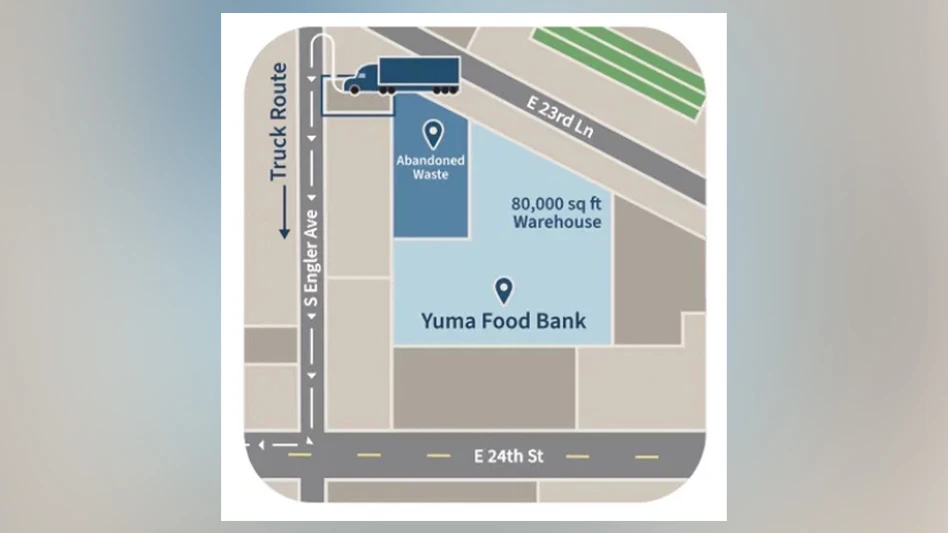
The Arizona Department of Environmental Quality (ADEQ) has requested the U.S. Environmental Protection Agency (EPA) lead a cleanup effort at a Yuma, Arizona, warehouse after the Yuma Community Food Bank was made aware of electronic waste housed in its facility.
The warehouse, located at 2404 E. 24th St. in Yuma, houses 3.92 million pounds of abandoned material, created from 2012-2015 by a glass recycling company, which the EPA names as Down Management LLC, also known as Attan Recycling Corp. (Dow/Attan), in a document.
The EPA has assured the city that the food bank will remain unaffected and will continue to serve the community throughout the cleanup project. The EPA also stated in a fact sheet about the project that “this material is sealed in boxes and held in an area of the warehouse separate from the food bank.”
The glass recycling company abandoned TV and computer screens with glass vacuum cathode ray tubes (CRTs). The EPA says the glass and parts from these devices hold hazardous material, mainly lead. The agency will properly dispose of the waste and debris in a certified landfill.
Atlas Technical Consultants LLC performed a Phase 1 environmental site assessment at the request of the food bank.
According to the site assessment document provided through the EPA’s administrative record, the area of the building was contaminated by Dow/Attan’s improper CRT destruction and materials management from 2012 through 2015. This area is separated from the food bank by a floor-to-ceiling “wall” constructed of chain-link fence covered with poly sheeting.
“Atlas estimates the amount of CRT hazardous waste to be 660 Gaylord totes located inside the warehouse and another 600 tons of wrapped CRT hazardous waste located outside in the northwest corner of the parking lot,” according to the document. “The total estimated amount of CRT hazardous waste is 1,960 tons or 3.92 million pounds.”
According to the document, Dow/Attan was investigated by the ADEQ between 2014 and 2017, at which time the company was out of business and the responsible parties had fled the country.
Following the assessment, ADEQ requested assistance from the EPA on May 8, 2025. The EPA requested consent to access the property shortly after May 27, 2025.
The on-scene coordinator for EPA Region 9 was granted funding approval Aug. 27, 2025.
“This funding is necessary to address the release of hazardous substances into the environment, specifically dust containing lead, cadmium, arsenic, barium and chromium,” the coordinator says in a memorandum that requested approval to spend up to $4 million in direct extramural costs to perform a time critical removal action and to request an exemption from the $2 million statutory limit.
The cleanup will be completed in two phases. The first will consist of set up and waste removal and the second will cover cleanup of the rest of the warehouse.
The EPA will begin the first phase by sealing the room housing the material using a layer of large plastic sheets with a vacuum seal, which will trap any debris or dust in the area.
The agency also will install air monitoring and sampling devices inside and outside the sealed work area and will then remove the material in covered boxes from the back entrance of the warehouse and truck to a landfill.
In the second phase, the EPA will wipe down all surfaces in the area, including the ceilings, take the vacuum-sealed plastic sheet out of the removal area and as an extra safety step, workers will wipe the rest of the warehouse’s surfaces and ceiling down, including the Yuma Community Food Bank area.
The first phase is expected to be completed within three weeks, and the second will be completed within the following five weeks. The EPA fact sheet lists the cleanup timeline as December 2025 through March 2026.
Latest from Waste Today
- A look inside WM’s new $90M south Florida MRF
- Waste to Resource Ontario announces new co-chairs
- WIH Resource Group adds senior associate
- Calgren builds public R-CNG fueling station in California
- Benlee calls 2025 record year
- Caterpillar to launch redesigned rental management experience
- SWANA, EREF sign MOU to advance waste and resource management education, research
- PaintCare Illinois program achieves early program milestone