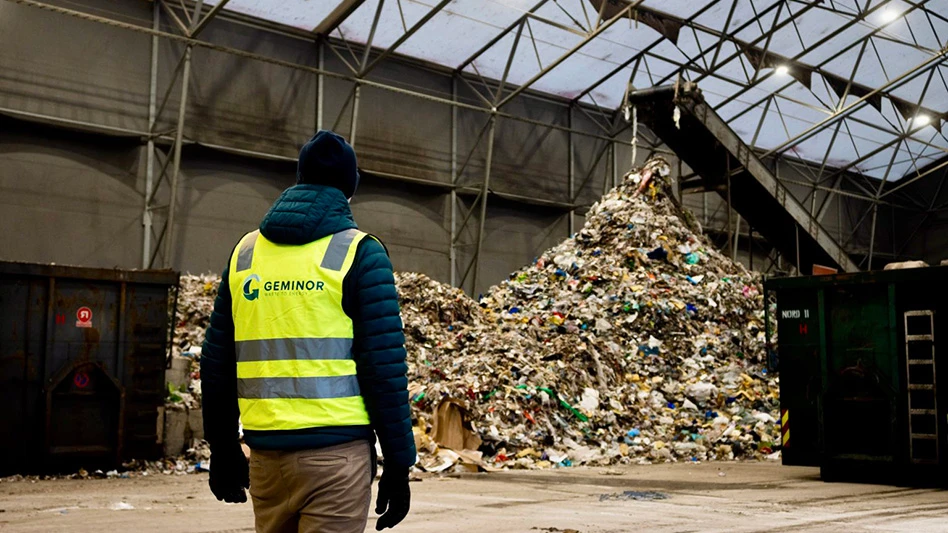
Photo courtesy of Geminor
Norway-based Geminor, which specializes in producing refuse-derived fuel (RDF), says it handled 1.82 million metric tons of waste feedstock in Europe last year, representing an increase of nearly 9 percent compared with 2021.
“This is a more modest growth than expected,” the company says, citing competition for material as a reason.
“The waste industry has experienced a turbulent 2022 and is adapting to a new reality in Europe,” Geminor CEO Kjetil Vikingstad adds.
Despite the competitive landscape, Geminor says its residual waste-for-energy recovery (to produce RDF and solid recovered fuel, or SRF) is growing by as much as 14 percent, accounting for more than two-thirds of the total volume handled by Geminor in Europe last year.
Scrap wood for material recycling and energy recovery, the second largest fraction handled by the firm, fell by 4.5 percent last year, while its cardboard and paper intake fell by 21 percent. “The handling and treatment of [scrap] plastics, which has been a focus area for Geminor and partner company Quantafuel, more than tripled in 2022 compared to the previous year,” the company adds.
“It is gratifying to see that we have managed to increase our volumes quite significantly from 2021,” Vikingstad says. “At the same time, we had expected a somewhat larger increase. A turbulent year caused by high energy prices, strong inflation, and lower business activity has led to a reduction in waste volumes and hence a new market situation.”
He continues, “The political and economic changes we saw in 2022—some of them triggered by the Russian attack on Ukraine—brought consequences for the recycling industry in all the countries where Geminor is present. We have had to adapt to a new reality in some of the markets in Europe. Countries such as Germany and Finland have gone from being exporting to becoming importing markets” for residual materials.
“In the United Kingdom, an increasing number of national industry players have taken a larger share of the waste volumes, leading to less export of waste resources,” adds Vikingstad. “We have increased our tonnage in the U.K. by securing more national offtake in 2022.”
He refers to Norway as Geminor’s largest market, adding, “We have handled roughly the same tonnage as in 2021. Last year we experienced a more stable but competitive Norwegian market. The international common denominator for 2022 is a substantial increase in the competition for waste volumes in the market.”
The company points to Southern Europe as a current bright spot, saying it has “increased shipments of waste resources from the surplus markets of Southern and Eastern Europe.” Those sources of supply have assisted in balancing and stabilizing the market, according to Geminor.
“In 2022, Italy has been an important export market and secured supplies of high-demand waste resources to players in both Central Europe and the Nordics,” Vikingstad says. “The market in Poland also continues to develop, and we have had several deliveries of RDF to Germany, among other countries. We have also had a good year in Denmark, where we managed to increase exports significantly within waste wood.”
The CEO concludes, “If 2022 has taught us anything, it is the importance of being present in several markets. Therefore, our ambition is to contribute to developing new surplus markets, such as France, so that we can secure the supply to European [RDF buyers] in the coming years.”
Latest from Waste Today
- Vermeer announces plan to build new facility in Des Moines metro area
- Buffalo Biodiesel shares updates on Part 360 application to DEC, Tonawanda facility progress
- Capstar Disposal expands roll off dumpster rental services
- Supreme Court strikes down IEEPA tariffs
- Casella details facility closures, expansion efforts
- Zero harm: Building a SIF prevention program for waste and recycling operations
- Casella posts a loss in Q4 2025
- McNeilus names Haaker Equipment first Dealer Partner of the Year