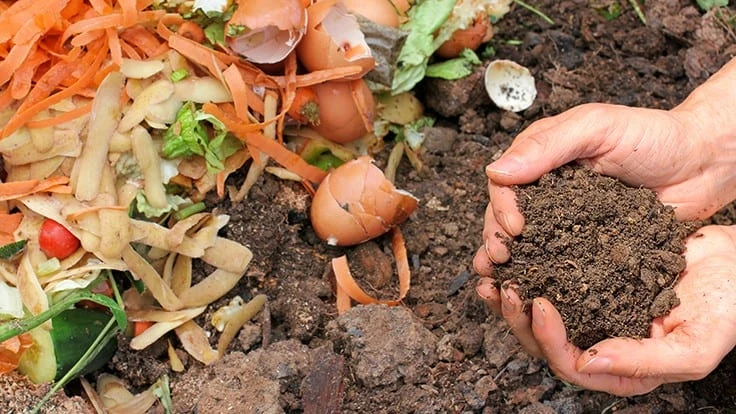
A prospective $10.5 million composting facility in the County of Hawaii is on hold after officials discovered they’re missing a critical ingredient—food waste.
As reported by West Hawaii Today, the county’s contract with Hawaiian Earth Recycling (HER), a compost producer with six locations across Hawaii, will now wait for a new administration to work out details about how a compost facility could fit into the county’s solid waste plans. The plan is currently on hold after the county and the contractor signed a six-month “act of god” abeyance because of the coronavirus pandemic.
“The county and HER jointly and together came to the conclusion to suspend phase 2, building the compost facility, until such time we can address the issue,” Environmental Management Director Bill Kucharski said.
But the shortage of food waste goes beyond the temporary stoppage of hotels, restaurants and schools that were slated to provide it. Hog farmers have been saying for more than a decade that they hold contracts for the food waste produced from those sources as an essential component of raising their product.
Kucharski told West Hawaii Today there is a shortage of another component in the compost mix, the green waste that’s brought to county disposal sites and is then ground up for mulch that’s offered for free or for a reduced loading cost to residents. He added that 100 percent of it is quickly scarfed up by residents on both sides of the island.
“This is not as simple and straightforward as it appears,” Kucharski said. “When the precursor material has a bigger demand than supply and we don’t have a critical ingredient, we have to ask is this the right way to do it.”
In addition to the cost of building the facility and leasing land at W.H. Shipman Business Park in Keaau to house it, the county is slated to pay $3.8 million annually to the contractor for processing the waste, while the contractor gets to sell the resulting compost. That figure, combined with personnel and trucking costs to move the green waste around, consumes 11 percent of the county’s solid waste budget and 60 percent of its recycling budget, Kucharski said.
Members of the Environmental Management Commission on Wednesday saw the halt of the contract as a way to reevaluate the compost plan, especially after hearing from constituents who say small local compost facilities would serve the whole island better than one large facility in East Hawaii. The commission plans to bring experts in for presentations at its meeting next month.
“Maybe it’s about re-imagining this composting facility,” said Commissioner Melissa Cardwell. “From the beginning, I thought that was a flawed plan.”
Meanwhile, Commission Chairman Justin Pequeno said the COVID-19 crisis does contain some silver linings.
“This gives us the opportunity to reflect and re-imagine what composting looks like,” Pequeno said. “We do have this opportunity to look at composting a different way.”
Latest from Waste Today
- Vermeer announces plan to build new facility in Des Moines metro area
- Buffalo Biodiesel shares updates on Part 360 application to DEC, Tonawanda facility progress
- Capstar Disposal expands roll off dumpster rental services
- Supreme Court strikes down IEEPA tariffs
- Casella details facility closures, expansion efforts
- Zero harm: Building a SIF prevention program for waste and recycling operations
- Casella posts a loss in Q4 2025
- McNeilus names Haaker Equipment first Dealer Partner of the Year