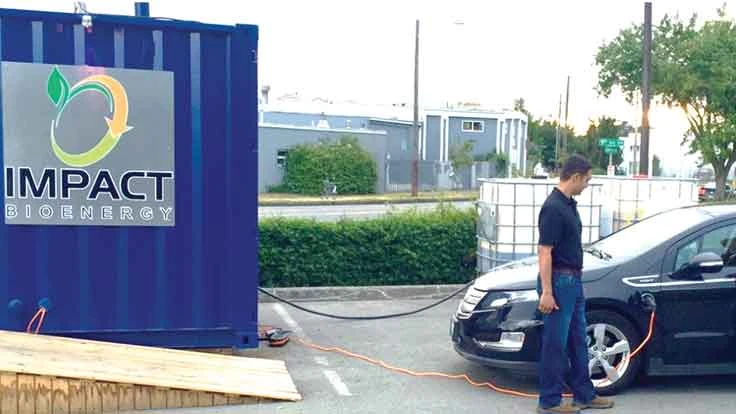
Seattle-based Impact Bioenergy is now demonstrating the performance of its portable microdigester, called the HORSE (High-solids Organic-waste Recycling System with Electrical Output), at Fremont Brewing Co., Seattle. The project is sponsored in part by Seattle Public Utilities. This marks the first of several HORSE projects underway near Seattle, the company reports.
The second machine will be located in Auburn, Washington, and negotiations are underway to site a third machine, on Bainbridge Island, sponsored by Puget Sound Energy, according to the company. The company has been awarded additional grant contracts from King County, Department of Natural Resources & Parks and is receiving research and development support from the Small Business Technical Assistance Program at the Pacific Northwest National Laboratory. With its partners, the team says it plans to accelerate to a “full gallop” in the coming months. Impact says it can produce several machines per month and is exploring scale-up partnerships with several complementary technology firms.
"The global interest has been a surprise for us," Jan Allen, CEO Impact Bioenergy, says. "We are considering how to best make strategic partnerships that are truly win-win. This approach will allow some level of quality control and operational excellence."
Charging electric vehicles and generating renewable CNG fuel are integrated into the business model.
Impact can deliver portable systems that convert 960 pounds to 35,000 pounds of organic waste per week into liquid fertilizer. The company has received requests for the HORSE from Albania to Zambia, it says. These machines upcycle organic waste materials into renewable natural gas and fertilizer. Energy can be in the form of building heat, hot water, radiant heat, light, electricity, vehicle fuel, cooking fuel, and prime motion. The digested food waste can be liquid soil amendment, liquid fertilizer, dried fertilizer, and compost. The liquid soil amendment from the HORSE has been approved by Washington State Department of Agriculture for use on their partner's certified organic farm, owned and operated by Seattle Urban Farm Co.
Impact clients can move the needle beyond zero waste by connecting the idea of distributed bioenergy to job creation, energy conservation, renewable energy production, carbon sequestration and local agriculture. The basic design is to build a resilient hyperlocal food ecosystem that provides access to healthy, affordable organic food by engaging farmers, food/beverage businesses, communities and governments. The HORSE can be used to build and store energy for off-grid emergency management and disaster response, according to the company.
Latest from Waste Today
- Vermeer announces plan to build new facility in Des Moines metro area
- Buffalo Biodiesel shares updates on Part 360 application to DEC, Tonawanda facility progress
- Capstar Disposal expands roll off dumpster rental services
- Supreme Court strikes down IEEPA tariffs
- Casella details facility closures, expansion efforts
- Zero harm: Building a SIF prevention program for waste and recycling operations
- Casella posts a loss in Q4 2025
- McNeilus names Haaker Equipment first Dealer Partner of the Year