Biojet fuels will be key to achieving the aviation industry’s pledge to cut carbon dioxide (CO2) emissions to 0.2 billion tons (gigatons) in 2050 – half the 2005 figure – as opposed to the staggering 2.1 gigatons projected by current growth rates, according to Lux Research, Boston.
Biojet fuel innovations, led globally by Honeywell UOP, Des Plaines, Illinois, and Boeing, Chicago, will account for 56 percent of the targeted CO2 emissions reductions, while a third of the cuts will come from new aircraft technology and optimization of operations and infrastructure.
“With lessons learned from the mishaps of road transportation and regulatory policies emerging from a single governing body, the International Civil Aviation Organization (ICAO), the aviation industry is well-positioned to meet emissions targets,” says Yuan-Sheng Yu, Lux research analyst and lead author of the report titled, “Biojet Fuel Technology Roadmap.”
“In the estimated $300 billion jet fuel market in 2050, Neste and Honeywell UOP will be winners over the short term, while renewable diesel producers UPM and Renewable Energy Group will be mid-term winners, and companies like Ensyn and Licella, will be long-term winners,” he adds.
Lux Research analysts studied the biojet fuel landscape against 2050 targets for CO2 emissions, and evaluated the main companies involved in the development of novel fuel types. Among their findings:
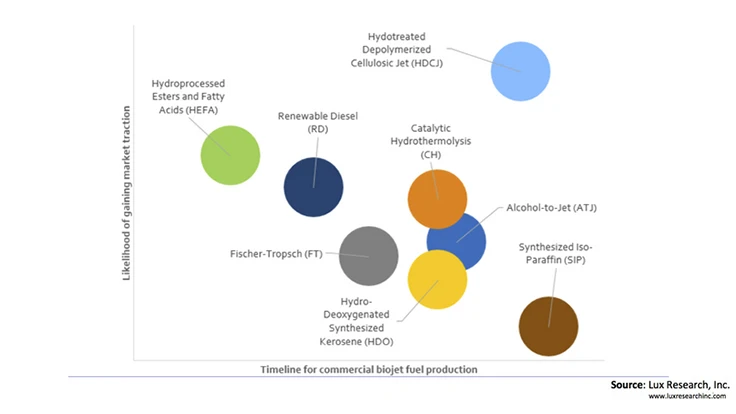
- Technology shifts over time. Of the four American Standard for Testing and Materials (ASTM)-certified pathways for biojet fuel and an additional four under review, hydroprocessed esters and fatty acids (HEFA) is the only viable short-term option while hydrotreated depolymerized cellulosic jet (HDCJ) will be the long-term winner.
- Honeywell UOP and Boeing are global flag-bearers. Honeywell UOP and Boeing are the undisputed global leaders since the Commercial Aviation Alternative Fuels Initiative (CAAFI) biojet initiative was launched in 2006. Honeywell has 333 unique relationships and 13 different initiatives, and with AltAir, operates the first commercial-scale biojet fuel plant. Boeing has established 279 unique ties and 20 initiatives, and has focus on Japan, United Arab Emirates and Mexico.
- Aircraft and other innovations matter. New aircraft models using lightweight materials have been instrumental in 1.5 percent annual fuel efficiency improvements since 2010. Other measures that will help the industry include lightweight cabin gear, seat design, taxiing on one engine, scheduling of flights in optimal conditions and improved air traffic controls.
The report, titled “Biojet Fuel Technology Roadmap,” is part of the Lux Research Alternative Fuels Intelligence service.
Latest from Waste Today
- Vecoplan to present modular solutions at IFAT 2026
- Terex Ecotec appoints Bradley Equipment as Texas distributor
- My Green Michigan expands depackaging capacity
- Washington selects Circular Action Alliance as PRO
- Ten-8 Industrial opens new central Florida service center
- Triumvirate Environmental acquires Environmental Waste Minimization
- Official NYC Bin availability expands ahead of deadline
- US Food Waste Pact’s 2025 Impact Report shows decrease in food waste