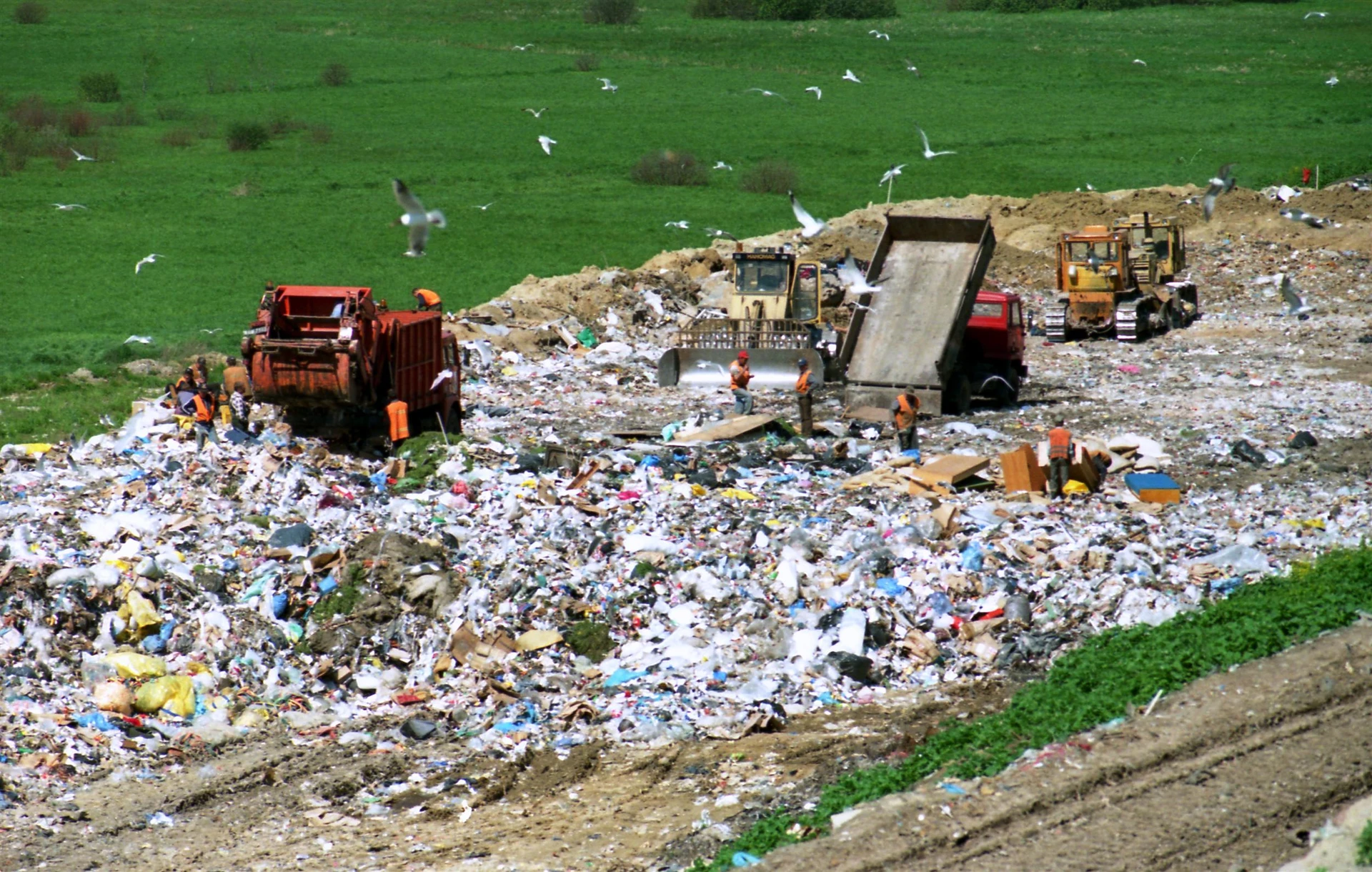
Dust and odor are two major concerns for landfill operators. Odor becomes an even bigger potential problem if residents live nearby a landfill or waste management facility. Dust at a landfill, and something called fugitive dust—small particulates that can be suspended in airstreams—can affect residents for miles.
At the Anne Arundel County landfill in central Maryland, odor and dust are managed by performing odor inspections twice every day. Most of the roadways located onsite are paved, which minimizes dust generation. The employees also use a water truck to control dust on all roadways, and there is litter fencing around the area where active disposal takes place, preventing windblown litter. And soil is applied over the garbage to help minimize odors.
The town of Ipswich in Queensland, Australia, has experienced some concerns about odor control at the New Chum Landfill. A representative from the company that operates the landfill commented that the residual odor had happened after significant rainfall in the region, which also affected other waste facilities nearby.
The landfill operator had installed multiple large-scale deodorizers and also shared that they used sodium hypochlorite to reduce the odor. Australia’s Department of Environment and Science, or DES, mandated that excess water at the landfill is disposed, and the department is overseeing the appropriate disposal of the wastewater. DES officers also started performing daily inspections on the landfill, including enhanced air monitoring and sampling.
As the rainfall declined in the region over the past week, the volume of wastewater at the landfill has also decreased. Lower levels of hydrogen sulfide are now being reported, and the operating company has started to build a trench that will intercept groundwater before reaching the body of wastewater.
In King County, Washington, the Solid Waste Division has announced plans to design and construct an updated transfer station, making recycling and waste disposal services more convenient for the region’s customers. Although it will not open until 2029, the Sold Waste Division is designing the transfer station to be fully enclosed, which will help to control odors. The transfer station will help to keep recyclable items out of the landfill.
The science of odors starts with a simple realization, according to David A. Hill, the CEO of GOC Technologies. “You don't smell apple pie. You smell the volatile gases leaving the pie. This is also true of wastes, leachate, whatever the source of the odor. And these gases are the target of our system," he explains. The company has developed a solution called QuikAir Vapor Technology that breaks down landfill odors. Two of the main causes of odor complaints are organic acids and sulfur compounds.
“Our job is to analyze your particular problem and create a blend that will render it neutral,” says Hill. The technology uses vapor as a deodorizer, and the vapor is made with a proprietary blend of amino acids, hydroxyls, some sugars, and 1% active hydrocarbons.
Latest from Waste Today
- Vecoplan to present modular solutions at IFAT 2026
- Terex Ecotec appoints Bradley Equipment as Texas distributor
- My Green Michigan expands depackaging capacity
- Washington selects Circular Action Alliance as PRO
- Ten-8 Industrial opens new central Florida service center
- Triumvirate Environmental acquires Environmental Waste Minimization
- Official NYC Bin availability expands ahead of deadline
- US Food Waste Pact’s 2025 Impact Report shows decrease in food waste