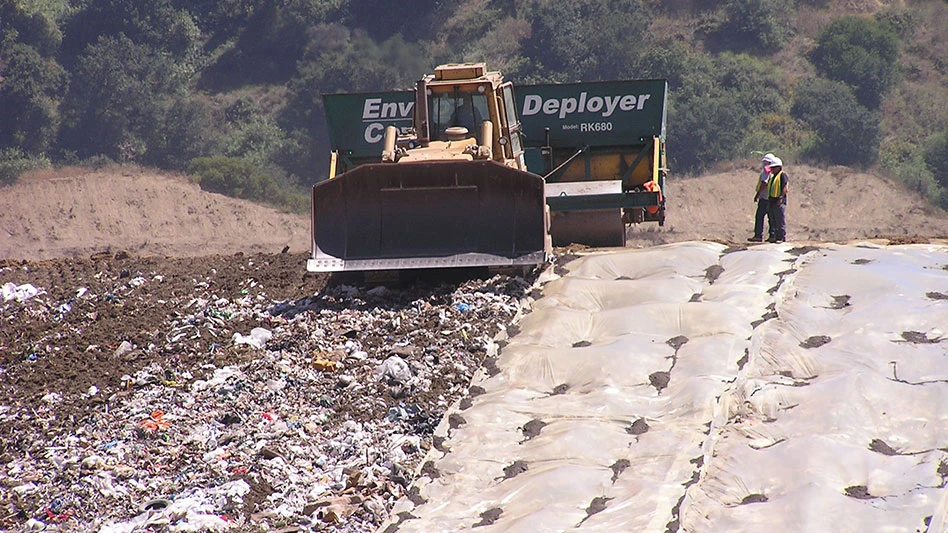
Photo by Neal Bolton
Many landfills manage their cover soil operation like teenagers at an all-you-can-eat buffet. They’ll have some of this, some of that and, before they leave, just one more piece of apple pie. Before you know it, despite their amazing metabolism, they’ve overdone it.
In a rush to get the waste covered and reduce overtime, many landfills will put an extra load of soil here, a couple loads there … and maybe just one more for dessert. Before you know it, despite their amazing inventory of airspace, they’ve overdone it.
For landfills that have plenty of soil, adding a few extra loads every day can make your regulators happy, keep your landfill in compliance and make things look clean and sanitary. All it takes is more soil.
But, oh, the price you’ll pay later when your appetite for soil finally catches up with you … and catch up it will.
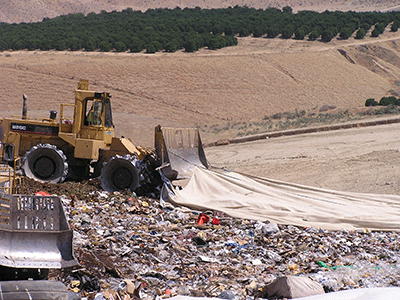
At most landfills where the current lined phase didn’t last as long as expected, or where the landfill ran out of soil, those problems can likely be traced back to an excessive use of cover soil.
That’s why alternative daily cover (ADC) has become a standard in the landfill industry. In a play off the old slogan: Works great … less filling.
There are many types of ADC, but they can be generally split into two main categories, those that are manufactured and others that are derived from some form of waste material.
Manufactured ADC products include tarps, film and spray-on materials.
Tarps are the most common type of ADC. They may be manually dragged into place with a tractor, pickup or, at smaller facilities, by workers. The drag-on, drag-off method requires no up-front capital cost, except of course for the tarps.
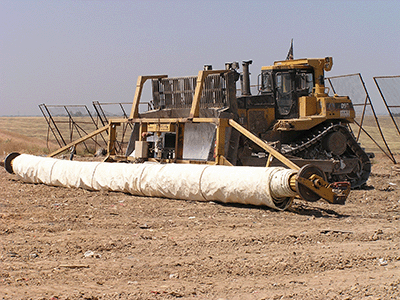
But, unfortunately, tarps don’t tend to last very long when they are dragged across trash. Even with great attention to finishing the waste cell and extra care while placing and removing the tarps, rips happen—and it’s rare for a dragged tarp to last more than six months or so. Ninety days would be more common.
Conversely, with a bit of care, mechanically placed tarps may last twice as long.
The life of any tarp can be extended if you’re willing to do a little mending along the way. Spending a few hundred dollars on a portable sewing machine definitely makes sense if it can extend the life of a $1,200 dollar tarp. At landfills working on tighter budgets, I often see ripped tarps that have been stitched back together with a handful of zip ties.
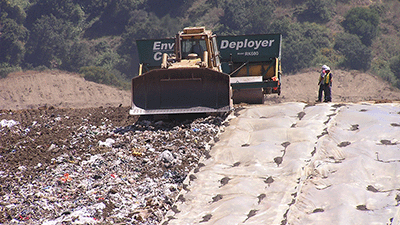
Other ADC systems use mechanical equipment to deploy a layer of film. Some of these units are towed behind a machine or lifted by a dozer blade or loader bucket. Others may be placed by a fully self-propelled film-deployment machine.
Depending on the system you choose, the capital costs can vary considerably. Like tarps, film deployment ADC systems consume almost no airspace, but you’ll spend money to purchase the film. However, there may be some savings on labor because compared with tarps, film only requires effort for placement, not for removal.
Spray-on units are the other category of ADC machines. Some of these are self-propelled and use proprietary foam material. Others utilize a towed unit, like a hydro-seeder, to apply various blends of material. Some landfills purchase material from the manufacturer. A common recipe includes paper pulp and a binding agent that, when mixed in water and sprayed on, sets up like lightweight gunite or paper mâché.
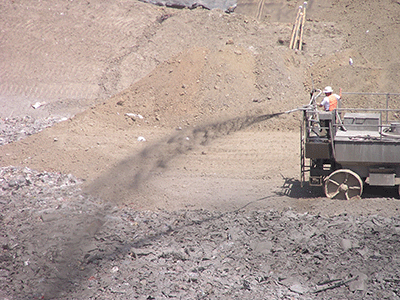
A number of creative landfill managers have come up with their own recipe that may include various waste materials like ash, recycled latex paint or shredded paper. The idea of using processed waste material as ADC takes advantage of the ‘use it or lose it’ concept. Those waste materials are destined for the landfill anyway, so why not utilize them in a beneficial way that saves money and airspace?
Many landfills have found creative ways to use various waste materials as ADC without the need to use a special machine to apply it. Some of the more common examples include the use of contaminated soil, auto-shredder fluff or residuals from an organics processing operation. This material is just dumped and spread across the trash. No special handling required.
Here’s something to think about. Many landfills have a side gig where they process organic material to create compost or a wood product for co-generation energy plants.
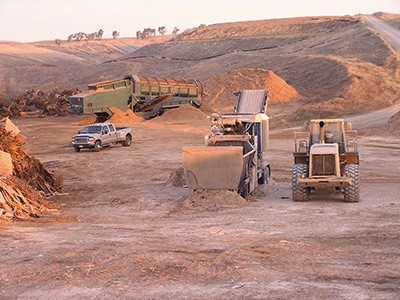
In the process of performing comprehensive operations reviews—something we refer to as CORE assessments—we regularly encounter landfills that are creating great organic products such as compost or wood chips but at a cost far above what they can sell them for.
One facility was grinding wood waste into wood chips for a local biomass facility. In the process, they touched the material 17 times from when it entered the landfill until it was delivered to the biomass plant. All that handling came at a whopping cost of $71 per ton. And in return for this premium biomass product, the landfill was paid only $15 per ton! They were losing $56 per ton—not what you’d call a sustainable business model.
This highlights the problem with most organics processing systems: excessive handling. Every touch point in the process takes time and costs money.
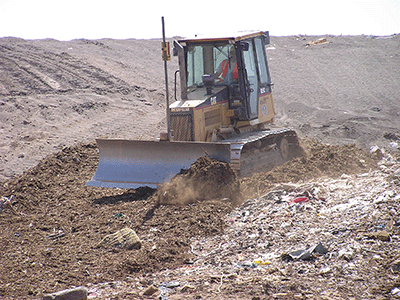
But if we think of organic material in terms of ADC, we find some good alternatives. If we dump the idea of creating compost or biomass fuel and simply grind wood and other organic material to use as ADC, there is less handling and lower cost. Yes, grinding for ADC is still a cost, but it’s a lower cost at somewhere around $10 per ton. So, the question for that landfill was, “Would you rather have spent $56 per ton, or $10?” Sometimes making money isn’t just about increasing your revenue but decreasing your operating costs.
Each type of ADC has its own collection of pros and cons. Some are more susceptible to fire. Others may help solve an operational problem.
At one landfill, wild hogs were creating serious environmental and compliance issues by rooting around in the trash. Soil cover was ineffective at stopping the hogs. So, too, was the use of tarps, foam or film.
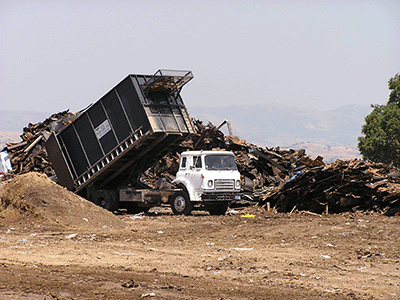
Then one day the landfill team discovered that a layer of broken shingles was very effective at stopping the hogs from digging. Likely, the broken shingles and shakes created a prickly barrier the hogs would not cross. So, after getting regulatory approval, the landfill staff began setting aside loads of shingles and using them at the end of the day as ADC.
Many landfills utilize more than one type of ADC. A common-sense approach is to use waste-derived ADC material whenever possible, then supplement with a manufactured product as needed.
Sometimes the selection of one or more types of ADC solves site-specific environmental or operational issues. For example, a landfill in a very wet climate may decide to use tarps to minimize infiltration, or a landfill that has odor issues may use film to help minimize surface emissions.
Yes, using the characteristics of a specific type of ADC to help mitigate your landfill’s issues is important. However, selection of a particular ADC also comes down to money. The good news is, the right ADC can minimize operational costs and conserve airspace.
Calculating the cost of various types of ADC is a straightforward process. It’s not quite as simple as just looking at the cost of a film deployment system or a batch of tarps, but neither does it require an MBA. Like many other decisions in this industry, common sense and basic math are all you need.
I’d like to start by establishing baseline costs for using soil as daily cover. We’ll assume the area to be covered is 100 feet by 200 feet, for a total surface area of 20,000 square feet. I’ve observed the average depth of daily cover soil for most landfills is 16 inches, so that’s what we’ll use.
16 in x 1 ft/per 12 in x 2,000 ft2 x 1 yd3/per 27 ft2 = 99 yd3
Thus, placing 16 inches of soil across 2,000 square feet works out to approximately 99 cubic yards.
We’ll assume you’re hauling that soil with a Caterpillar 623 scraper with a rated payload of 18 cubic yards. What’s more, we observed and found that it takes 12 minutes to make a full round-trip cycle.
99 yd3 x 1 load/18 yd3 x 12 minutes/per 1 load x 1 hour/60 minutes x $240/per 1 hour = $264
Thus, the scraper must run 1.1 hours at $240 per hour for a total cost of $264 (including the operator).
Additionally, the water truck ($115 per hour) and motor grader (at $185 per hour) each spend 15 minutes to maintain the scraper’s haul road. Here’s that cost.
($115 + $185)/per 1 hour x 15 minutes x 1 hour/per 60 minutes = $75
Next, a D6 Dozer, at $160 per hour, is used to spread the soil across the waste surface. This process takes approximately 30 minutes for an additional $80.
($160)/per 1 hour x 30 minutes x 1 hour/per 60 minutes = $80
At an estimated cost of $15 per cubic yard, the airspace consumed by 99 cubic yards of soil is worth another $1,485. Here’s that equation.
99 yd3 x $15/per 1 yd3 = $1,485
All in, this shows that the cost of placing cover soil across that 2,000 square foot cell costs $1,904 … or approximately 95.2 cents per square foot.
($264 + $75 + $80 + $1,485) = $1,904/ 2,000 ft2 = $.0952/ft2
This example shows a very typical cost for landfills that use soil as daily cover … usually around a dollar per square foot.
As an interesting alternative, perhaps you could find some cheap carpet on sale and use it as ADC. You might even choose from a dozen designer colors! All kidding aside, using soil for daily cover material is very costly—to the point that almost anything else would be preferable.
Calculating the cost for various types of ADC requires a similar approach, with some slight variation depending on the type of ADC you’re evaluating.
When calculating tarping costs, start by taking the cost of your tarps divided by their average life. For example, if a single tarp costs $1,200 and lasts 140 working days, then its cost is $8.57 per day. Further, if your tarp is 40 feet by 100 feet (4,000 square feet), then the daily purchase (i.e., capital) cost is $0.00214 per square foot … that’s less than ¼ penny per square foot. Far below the dollar per square foot for soil.
Of course, there are other costs associated with using tarps. Those may include the dozer and operator to drag the tarp on and off. Or they may include the capital and operating costs of the tarp machine while placing and removing tarps. Some managers like to express this as a cost per square foot, or as a daily cost. Don’t forget the cost of airspace, which in this tarp example is nil.
We’ve found that tarp costs can often be less than $0.10 per square foot, regardless of whether the tarps are placed manually or mechanically.
Run your own numbers to calculate cover soil and ADC costs.
I guarantee you’ll find ADC is consistently more economical than soil, primarily because it helps you avoid the loss of your most valuable commodity, airspace.
In the next article, we’ll discuss some ways to measure and track your airspace utilization factor (AUF), the most critical metric at your landfill.
Part 5 - Tracking Your landfill’s AUF
Bringing It all together to save airspace and money
Neal Bolton is President of Blue Ridge Services Montana Inc. He has been improving solid waste operations for more than 47 years. You can contact Neal at neal@blueridgeservices.com
Latest from Waste Today
- WeSort.AI recovers critical raw materials from recycling plants
- Collective Waste Solutions acquires Alcop Resource Recycling transfer station
- A blueprint for curbside composting
- Aemetis narrows net loss in 2025
- Fleetio launches AI capability to accelerate fleet maintenance approvals
- Recycle Ann Arbor extends drop-off station operating hours
- Sybilion seeks to help manufacturers confidently address volatility
- Ecowaste Solutions partners with city of Trinity, Texas