Photo by Neal Bolton
Bulldozers are the backbone of most landfill operations. They provide the first and most critical phase of processing inbound waste. As loads are dumped onto the tipping pad, it is the dozer that pushes that waste to the active face, spreads it and returns for the next load.
This is the typical procedure, though there are exceptions where waste might be pushed by a wheel loader or a compactor. Fortunately, the concepts used to maximize bulldozer productivity generally apply to any machine that pushes waste from the tipping pad to the active face.
A common thread is woven into this task, and if we surveyed dozer operators about their goals and challenges, this is what we’d hear: The main pressure operators feel is to keep the deck cleared to make room for the next truck to dump. This point often is accentuated by a line of impatient drivers who want only to dump their loads and get back to their routes or back to their yards to end their days.
Traditional assumptions
Adding to that urgency, bulldozer operators also work under several assumptions, some of which are outdated or inaccurate.
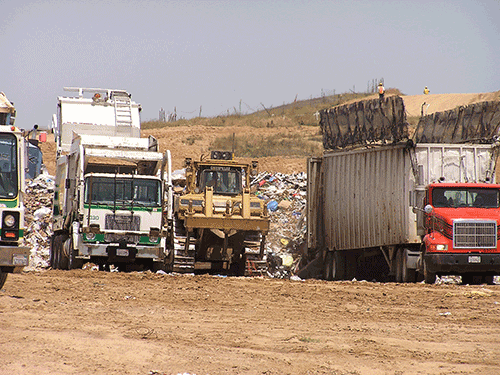
Assumption 1: Most landfills strive to maintain the smallest possible active face because that helps reduce litter, odors, vectors and other issues associated with exposed trash. But the main reason for keeping the face small is related to airspace conservation. Landfills are required to cover all exposed waste at the end of every operating day to comply with state and federal regulations. Historically, the use of soil as opposed to using alternative daily cover (ADC) represented the single biggest waste of airspace for most landfills. In reality, the 6-inches of soil required by regulation more likely is at least three times that much when we factor in the internal voids and the uneven surface of the waste. This has created an expectation that the best face is a small face.
Assumption 2: A small active face equates to a small tipping pad. If the face is 100 feet wide, so is the tipping pad. That secondary assumption results in a very crowded tipping pad, which leads to lots of pressure for the dozer operator to promptly push every load as soon as it is dumped. Unfortunately, this often leads to dozers working too close to other waste vehicles.
Assumption 3: Impatient drivers should always be allowed to take the next open tipping slot, regardless of where it is. This is a classic example of the tail wagging the dog. Landfill employees are responsible for orchestrating cell construction. That means they also are in charge of when and generally where specific loads should be dumped.
Assumption 4: To accommodate impatient drivers, bulldozer operators are compelled to push every load as soon as it is dumped. This results in lots of idling while waiting to see where the next push will be.
Assumption 5: The entire tipping pad should be kept clean and smooth at all times like a parking lot. However, if we think about it, we’d realize that trucks only need a clear slot to back into so they can dump their loads. That means the extra bulldozer time spent cleaning and back-blading the entire tipping pad is unnecessary effort. I’d call this nonvalue-added work.
Assumption 6: The bulldozer must be busy all the time. Many operators are informed about the high cost of the dozer and that it must be productive all day long. This results in operators keeping busy with incidental tasks, instead of focusing strictly on making production pushes and then parking the dozer when there’s no productive work to do. In my experience, this results in a bulldozer making 3-4 cleanup pushes for every production push. Much of that busy work is unnecessary, but it keeps the dozer moving, while providing an appearance of being productive.
By challenging these long-standing assumptions, it’s possible to come up with a better process, one that is less stressful and more efficient.
Efficient dozer operations
Widening the active face allows more room for spreading, grading and compacting. The compactor will be much more efficient when it has room to make long, consistent runs rather than working within the limitations of the smallest possible active face. Offset the drawback of using extra cover soil and wasting airspace by implementing a robust ADC program.
Similarly, widen the tipping pad to allow more room for trucks to dump and dozers to push while maintaining safe separation. I suggest a minimum safety buffer of 50 feet between heavy equipment and other vehicles.
Adopt a standardized right-to-left or left-to-right typewriter pattern that trucks can follow to dump in sequence. By establishing a predictable pattern, trucks know where to go next, and the pressure to fit into the next slot is eliminated. Bulldozers then follow that same pattern while maintaining a safe buffer.
A wider tipping pad with a predictable dumping pattern also allows the dozer to focus on making every push a production push. By pushing each load and avoiding the urge to make additional cleanup pushes and regularly sweeping the entire tipping pad, the bulldozer will spend much less time doing busy work and instead make every push a full-bladed production push.
The dozer should remain parked while the typewriter tipping pad is filling. As it nears capacity, the dozer should begin pushing waste, focusing on pushing only full production loads, without the normal series of cleanup pushes. Remember, the goal is to create a tipping slot for the next truck to back into, not a groomed parking lot.
With practice and by observing your landfill’s inbound tonnage, you’ll find opportunities for the dozer to park for 30-60 minutes while the tipping pad fills with loads. This allows the dozer operator to jump on the water truck, fill in for the compactor operator who is on a break or do some other productive task instead of just keeping the dozer busy.
Combating initial resistance
After working with hundreds of bulldozer operators, I can predict the challenges they will face when shifting to a typewriter operation. First is resisting the powerful temptation to push every load as soon as it’s dumped. This often requires a supervisor to restrict the dozer operator from pushing until the typewriter tipping pad is nearing capacity.
I consistently have found that by adjusting the bulldozer’s effort, focusing only on production pushes and eliminating busy work, it’s possible to reduce bulldozer hours by 30-70 percent.
If you’re not convinced, try this simple exercise: Record the time it takes for the bulldozer to push a load to the active face and return. You’ll find that it takes about one minute. This means the dozer could, under ideal conditions, make 60 pushes per hour. Multiply that cycle time by 7 tons per push. That’s a conservative number of tons the average bulldozer can push from the tipping pad. This also corresponds to the average payload carried by a typical route truck. That results in an hourly production rate of 420 tons per hour. Finally, divide your daily tonnage by 420 to determine the minimum number of dozer hours required to push the daily tonnage. To keep the math simple, if your landfill received 840 tons of waste per day, it would take, under ideal conditions, two hours of bulldozer time to push that waste from the tipping pad to the active face.
Under this example, if your bulldozer is logging more than two hours per day, ask yourself, “What else is it doing besides making full-bladed production pushes?”
Certainly, maximizing bulldozer productivity involves more than I’ve covered here, but if your landfill is like most others, your bulldozer operation has plenty of room for improvement.
Neal Bolton is president of Blue Ridge Services Montana Inc. He has been providing safety support and improving solid waste operations for more than 47 years. Contact Neal at neal@blueridgeservices.com.
Latest from Waste Today
- Keith Manufacturing to showcase RX Technology at Mid‑America Trucking Show 2026
- Perpetual Next appoints general manager
- Work Truck Incyte launches market discovery intelligence platform
- WM joins SWANA as corporate partner
- Taurus RNG awarded funding for integrated anaerobic digestion, carbon sequestration facility
- EPR implementation working group adopts nationwide focus
- Terex reports higher Q4 sales, strong bookings to close 2025
- Mardi Gras sustainability initiative collects 14K pounds of recyclables