Photo courtesy of Neal Bolton
The most recent figures show that the solid waste industry is the fourth most dangerous in the U.S. Further investigation also shows that in a typical year, more nonworkers are killed than staff. Obviously, our goal is to avoid all fatalities—workers and nonworkers.
We are all aware of the responsibilities that organizations and managers have to keep workers safe. The foundational requirements are established by the Occupational Health and Safety Administration (OSHA), either directly or through an OSHA-approved state safety program. Yes, I know some municipalities technically are exempt from OSHA requirements, but those folks still are responsible for providing a safe working environment for all employees.
Further, I suggest you have a similar responsibility to keep nonworkers safe. We can discuss the semantics of OSHA being the “Occupational” Safety and Health Administration and, therefore, all OSHA rules are directed specifically toward workers. We can discuss it, but it won’t eliminate that responsibility.
If you are a supervisor, manager or hold some other position of authority, you have a responsibility to keep workers safe. That same responsibility also applies to nonworkers with whom your crew interacts.
Some folks take issue with this concept. But answer me this: If someone was shopping in a big box store and got run over by a forklift, would the store, the manager or the forklift driver be responsible? Maybe … maybe not. It depends on how they were running their operation and on the specific details of the incident. But, certainly, they would want to do whatever they could to keep nonworkers safe and avoid that situation.
That’s the concept, and it’s better that we focus on solving that issue rather than trying to talk our way out of it. The bottom line is: If you are in a position of authority, you share the responsibility of keeping everyone safe, including nonworkers.
Please note that customers are responsible for following the rules, using common sense and not putting themselves in unsafe situations. Nonworkers should not make poor decisions and then blame someone else if things go badly.
In the solid waste business, the nonworker category includes customers, vendors, regulators or any other nonemployee who visits your facility. It also extends to individuals who interact with your operators, drivers or other employees. Positions of authority always come with responsibilities, and keeping folks safe is one of them.
As a manager or supervisor, you can’t avoid that responsibility by saying, thinking or acting as though you aren’t responsible. Instead, you should focus on the foundational question, which is, “How to keep workers and nonworkers safe?”
Albert Einstein once said, “If I had an hour to solve a problem and my life depended on the solution, I would spend the first 55 minutes determining the proper question to ask, for once I know the proper question, I could solve the problem in less than five minutes.”
Following Einstein’s lead, let’s drill our way down to the proper question.
Step 1: How can you keep nonworkers safe? That’s a good question, but it’s much too general. In this situation, a general inquiry won’t cut it. Keep drilling.
Step 2: What are the main risks that nonworkers face at your facility or within your operation?
At this point, you need to involve your crew by asking about historic accidents, near misses or their daily observations. Those categories of risk will depend on what you do. If you’re into collections, your nonworker risks likely will be related to pedestrians and other vehicles your drivers encounter on the route and over the road.
On a separate track, landfill risks mostly are associated with customers in proximity to trucks and heavy equipment. Transfer stations have similar risks but also could include fall risks if customers are required to dump over an edge.
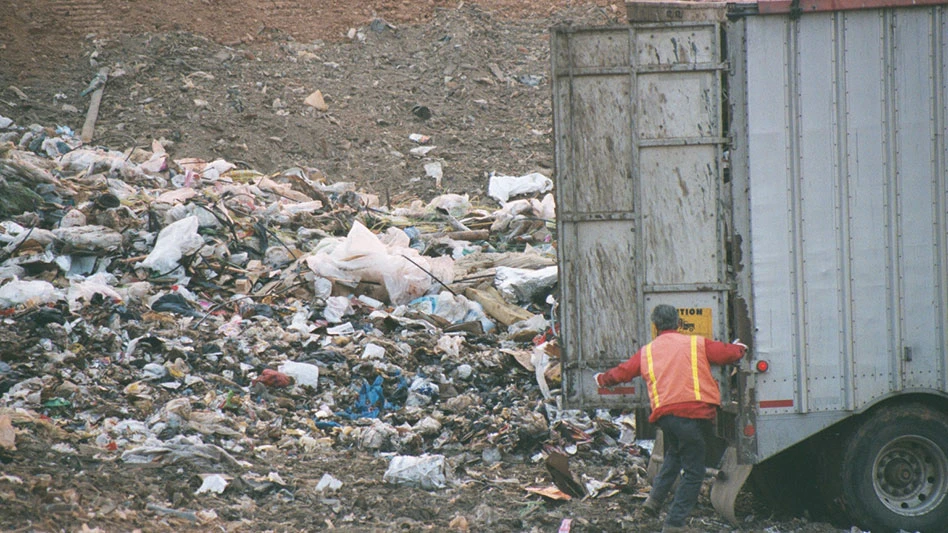
For this example, we’ll address the nonworker risks that are present at the unloading area of the landfill: the tipping pad.
I consider the tipping pad to be the most dangerous real estate at any landfill. Incidentally, that’s an opinion that is supported by history. If someone gets killed at your landfill, chances are it will happen at the tipping pad.
Along that line, here are some ideas for reducing risk at the tipping pad.
Maintain a wide buffer around heavy equipment
As we’ve discussed in previous articles, heavy equipment too often plays a role in an accident or fatality. The solution is relatively obvious and simple: Don’t operate heavy equipment near people of other vehicles. By maintaining a wide buffer of at least 50 feet, the risk of a machine-related incident can be decreased to nil.
Maintain a buffer around vehicles
A similar risk occurs when customers’ vehicles are not separated by a safe buffer. However, this is a bit more difficult for a spotter or other landfill worker to gauge. Many landfills have a specific vehicle spacing policy—maybe it’s 15 or 20 feet. The problem is enforcement. A landfill spotter cannot measure the spacing between vehicles without physically measuring that distance … an act that automatically places the spotter in a dangerous location.
Instead, many landfills instruct drivers to maintain safe separation from other vehicles. Or, in some cases, the landfill could use large tires to mark individual tipping slots for individual vehicles. This automatically imposes a safer degree of vehicle spacing.
Aggressively prohibit scavenging
In my experience working as an expert witness in the waste industry on cases that too often include a serious injury or fatality, I’d estimate that scavenging is a contributing factor to more than a third of the incidents that have occurred.
Signs and verbal instruction by the scale attendant and spotter can help reduce the chance that a customer will attempt to scavenge items, but they won’t prevent it altogether. That’s why the spotter and heavy equipment operators must continually be on the lookout for folks who decide the benefits outweigh the risks. Scavenging is a stupid thing, but unfortunately people are regularly killed while doing stupid things.
Instruct drivers to stay near their vehicles
All drivers at the tipping pad should be instructed to stay near their vehicles. This not only helps prevent scavenging and random wandering, it also reduces the risk that a person will be in a higher-risk zone where dozers and landfill compactors are actively processing waste.
Require customers and others to wear high-visibility vest
It’s a pretty safe bet that drivers and equipment operators don’t run over people they see, they run over people they don’t see. Every truck and tractor have some blind spots where a safety vest might not help. That could contribute to an accident. And, while requiring everyone to wear a vest won’t ensure 100 percent visibility, it will help. That’s why an increasing number of waste facilities, including landfills, are requiring all customers who exit their vehicles to wear a safety vest. For many managers, this could look like an extreme measure—until someone is killed. If that happens, universal safety vests become the new normal.
Segregate customer vehicles by size, type and unloading process
Different vehicles have different goals and different needs. Some customers are in a rush to dump quickly and get back to their routes, while others could be in place as they hand unload. Some vehicles must raise their bodies or beds to unload. Each of these factors could affect the potential risk, and. to a degree, vehicle segregation could help reduce some of that risk. To the extent practical, spotters and signs can help with that process, but individual customers still hold a primary responsibility for determining if a specific dumping location is safe.
Conduct a preincident investigation
After an incident occurs, a great deal of effort goes into analyzing the factors that led to it. This forensic evaluation often turns up many contributing factors, some of which become quite obvious in the clarity of hindsight.
I’ve become an advocate for helping organizations conduct a preincident evaluation. In other words, let’s look at how our current practices might lead to an incident. It’s surprising how often this type of prepostmortem can identify those same obvious contributing factors. Of course, the benefit is that you’ll have time to make operational changes before something bad happens.
Nonworkers at your facility are at risk. Consider what you can do to minimize that risk, and just do it. You might never know about the life you save, but you’ll be glad you did.
Neal Bolton is president of Blue Ridge Services Montana Inc. He has been improving solid waste operations for more than 47 years. Bolton can be reached at neal@blueridgeservices.com.
Latest from Waste Today
- Fleetio launches AI capability to accelerate fleet maintenance approvals
- Recycle Ann Arbor extends drop-off station operating hours
- Sybilion seeks to help manufacturers confidently address volatility
- Ecowaste Solutions partners with city of Trinity, Texas
- Bristal Hauling acquires G&R Garbage Disposal
- Baltimore trash collection expected to slow as WTE facility closes for maintenance
- Landfill Insights | Connecting the dots: Policy to practice
- FCC Environmental Services awarded collection contract in Florida