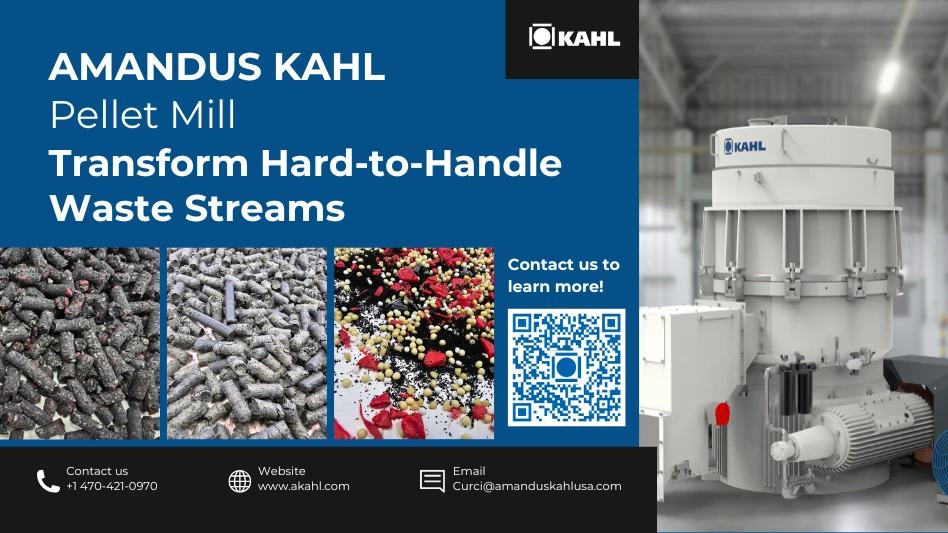
If you’re managing waste, you’re familiar with the headaches: bales of plastic film occupying valuable floor space, fluff scattering across your facility and mounting landfill fees that cut deeply into your budget. These low-density materials aren’t merely inconvenient—they’re costly. Worse, they’re everywhere: plastics, fibers, textiles, tire residues—wastes that traditional recycling processes often can’t handle while causing fire risks.
But imagine turning these problematic materials into products that not only cut costs but also generate new revenue streams. This isn’t just a possibility; it’s a proven reality with Amandus Kahl pelleting equipment. Our pellet mills have demonstrated remarkable performance worldwide.
What exactly is pelletization?
Pelletization is a mechanical densification process that converts hard-to-handle waste materials into dense, uniform pellets. Using a flat-die pellet press, heavy rollers compress shredded waste through a hardened steel die. This mechanical pressure, combined with frictional heat, softens plastics, allowing them to bond naturally without the need for chemicals or additives. The outcome? Strong, dust-free pellets that are easy to store, transport and use as fuel or feedstock for circular economies.
Proven results from U.S. lab facility trials
Our dedicated U.S. testing facility, located in Alpharetta, Georgia, has tackled some of the most challenging waste materials, achieving impressive results:
- Plastic film: Density increased from a mere 2 pounds per cubic foot up to 23–32 pounds per cubic foot—up to a 16 times bulk density increase.
- Tire fluff: Bulk density rose significantly from 9 pounds per cubic foot to over 30 pounds per cubic foot, yielding consistently strong and uniform pellets.
- Mixed plastics: Previously difficult to handle, these materials are now compacted into easily manageable pellets.
The pellets demonstrated outstanding durability, achieving over 98 percent intactness through rigorous transport and handling tests.
Why operations managers are turning to pelletization
Pelleting isn’t just innovation—it delivers proven results:
- Reduce volume by 70–90 percent: Turn ten truckloads of waste into just one, dramatically cutting storage and hauling requirements.
- Lower transportation and storage costs: Fewer loads mean significantly less fuel usage and reduced labor expenses.
- Generate revenue: Transform your waste into refuse-derived fuel (RDF), marketable to cement kilns, biomass boilers and various energy industries.
- Cleaner facility operations: Eliminate dust hazards, significantly reducing environmental and operational mess.
- Achieve sustainability objectives: Landfill diversion and lower carbon footprint in one process.
Your next step: Test before you invest
Considering the pelleting equipment for your operation? Take advantage of our U.S. lab facility to test your specific waste material. See firsthand how your problematic waste can be effortlessly transformed into valuable, manageable pellets.
Amandus Kahl’s pelleting equipment is suitable for multiple industries handling challenging wastes—plastics, films, fibers, tire residues, textiles and more. Our pellet mills can significantly reduce your costs, enhance operational efficiency and unlock profit from what was previously considered waste.
Why continue paying landfill fees when your waste can power the future?
Contact Mike Curci directly at Curci@amanduskahlusa.com or call 470-421-0970 today. Schedule your material trial at our U.S. lab facility and take the first step toward transforming your waste management challenges into sustainable profits.
Latest from Waste Today
- WeSort.AI recovers critical raw materials from recycling plants
- Collective Waste Solutions acquires Alcop Resource Recycling transfer station
- A blueprint for curbside composting
- Aemetis narrows net loss in 2025
- Fleetio launches AI capability to accelerate fleet maintenance approvals
- Recycle Ann Arbor extends drop-off station operating hours
- Sybilion seeks to help manufacturers confidently address volatility
- Ecowaste Solutions partners with city of Trinity, Texas