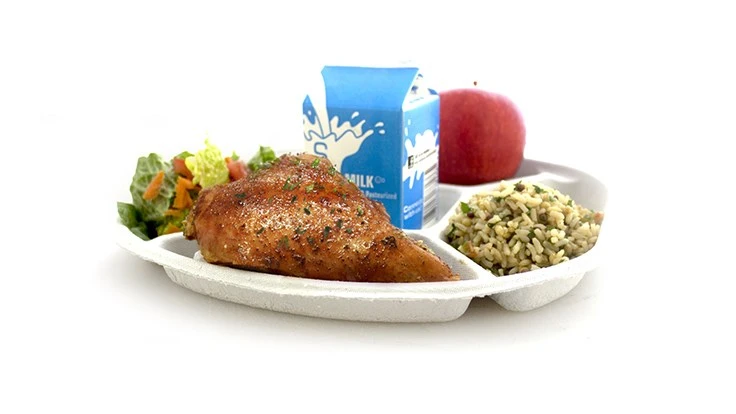
The School District of Philadelphia and Baltimore City Public Schools are the latest school districts in the New York City-based Urban School Food Alliance to replace its polystyrene serving items in schools with compostable round plates. Philadelphia and Baltimore have started the process of rolling out the plates designed by the Alliance in lunchrooms, with the two districts diverting 19 million polystyrene food service items from landfills.
"One of the reasons we joined the Urban School Food Alliance last fall was not only to be able to provide the best quality food for our students, but to also implement sound environmental practices," Elizabeth Marchetta, executive director of the food and nutrition department at Baltimore City Public Schools, says. "With more and more cities striving for zero waste, we wanted to become proactive in making a change for the betterment of our community."
The Urban School Food Alliance is a coalition of school districts in the U.S. that includes New York, Los Angeles, Chicago, Miami, Dallas, Orange County in Orlando, Broward County in Fort Lauderdale, Clark County in Las Vegas, Philadelphia, Baltimore and Boston. In 2014, the original six members of the group (NYC, LA, Chicago, Miami, Dallas and Orange County) challenged the industry to develop an environmentally friendly round plate to replace 225 million polystyrene trays across their six schools districts each year.
The Urban School Food Alliance serves nearly 3.7 million children daily, translating to more than 631 million meals a year. With an annual budget of $831 million in food and supplies, the nonprofit group’s goal is to allow the districts to share best practices and leverage their purchasing power to continue driving food quality up and costs down while incorporating sound environmental practices.
"As one of the smaller districts in the Alliance, we couldn't have afforded to purchase compostable plates on our own," Wayne Grasela, School District of Philadelphia senior vice president of food services, says. "This initiative aligns with GreenFutures, the district's overall sustainability plan and advances the District's work in reducing our environmental impact."
Schools across America use polystyrene trays because they cost less than compostable ones. Polystyrene trays average about $0.4 per piece compared to its compostable counterpart, which averages about $0.12 each. The Urban School Food Alliance districts used their collective purchasing power to create a compostable round plate for schools at $0.5 each.
Philadelphia, which now uses the compostable plate, is meeting with student environmental clubs to help design a marketing campaign to get the word out about the new compostable plates and how they help preserve the environment. The district is also planning a pilot program among its high schools to compost the plates.
Baltimore will roll out the plates over the next three months in the district. It currently has composting in a few middle schools and plans to pilot composting programs in other schools.
The American-made molded fiber compostable round plate is produced from 100 percent preconsumer recycled paper fibers. It is manufactured by Huhtamaki North America, De Soto, Kansas. The Alliance round plate has five compartments, with the beverage compartment strategically placed in the middle to balance the weight of a typical meal. The compartments are designed to prevent hinging or bending.
Latest from Waste Today
- Vermeer announces plan to build new facility in Des Moines metro area
- Buffalo Biodiesel shares updates on Part 360 application to DEC, Tonawanda facility progress
- Capstar Disposal expands roll off dumpster rental services
- Supreme Court strikes down IEEPA tariffs
- Casella details facility closures, expansion efforts
- Zero harm: Building a SIF prevention program for waste and recycling operations
- Casella posts a loss in Q4 2025
- McNeilus names Haaker Equipment first Dealer Partner of the Year