Mark Campbell Productions
Plastic film remains a hard-to-recycle material, although some companies are taking steps to address its low recycling rate, according to speakers at this year’s Paper and Plastics Recycling Conference (PPRC) in Chicago.
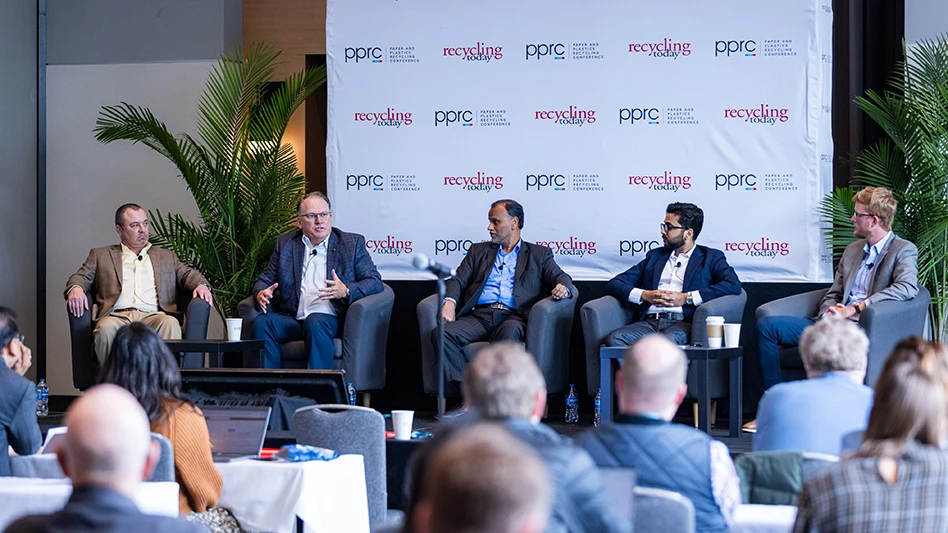
Andy Brewer, director of sustainability and recycling at the Plastics Industry Association (PLASTICS), Washington, moderated the Advances in Film Recycling session Oct. 16 and shared information on the current state of film recycling.
According to PLASTICS data, 10 million metric tons of film is generated in the United States annually, while less than 4 percent is recycled. Postconsumer film typically is collected in one of two ways: through drop-off sites or curbside pickup.
Brewer shared that approximately 22 percent of collected polyethylene (PE) film is used in composite lumber applications, 21 percent goes back into film production and 51 percent is exported.
“If we were to try and reach a 30 percent recycled content rate in our film products, we would need about 8.5 times more film being collected and recycled,” Brewer said. “So, a lot of room for improvement in this space.”
The session included commentary from Raj Bagaria, director at GDB International, New Brunswick, New Jersey; Scott Fidler, manager of commercial recycling feedstock at Nova Chemicals, Calgary, Alberta; Ganesh Nagarajan, senior director for plastics at WM, Houston; and Clint Thompson, chief commercial officer at Nexus Circular, Atlanta.
NEMO trial
PLASTICS’ New End Market Opportunities (NEMO) program has conducted trials to address logistical and technical challenges facing recyclers of hard-to-recycle materials. The program aims to analyze the collection of recycled materials, demonstrate processing methods and identify feasible end markets.
One of NEMO’s trials has focused on linear low-density polyethylene (LLDPE) film, specifically trash bag recycling.
“We wanted to focus on collecting LLDPE from postconsumer sources and then make sure that LLDPE gets fed back into the material that it came from,” Brewer said.
The trial analyzed bales from U.S. and Canadian material recovery facilities (MRFs) and targeted bag-based recycling programs.
According to trial data, the U.S. bale had relatively high contamination, containing less than 50 percent LLDPE. Brewer noted the bale appeared dirty and had a strong odor.
“This specific material did come out of New York City, but we went through some testing at Pellenc, where we sorted this material on a couple of different runs on their optical sorting system,” he said. “At the end of the day, less than 50 percent LLDPE is actually still a high percentage of linear low-density coming out of a film bale, but with all the sorting that was needed, we kind of determined this is not feasible for either mechanical or advanced recycling.”
Conversely, the Canadian bale yielded higher LLDPE—more than 85 percent—and was less contaminated. This material came from Canada’s blue bag system, where consumers place recyclables in blue bags, which are pulled off the line at the MRF and sorted into a film mill.
The material was then sent to different recyclers for processing, including WM’s recently shuttered Natura PCR facility in Waller, Texas.
“Our overall yield of that material … was around 67 percent,” Brewer said. “That may seem a little low, but it’s not. It’s just due to some of the nature of the trial. We were making sure that we were really trying to clean this material very well so that we got a good end product when going to that next phase of end market development.”
Brewer noted that operators in Canada remove the blue bag film from the front of the line, eliminating the need for the material to travel through multiple conveyor systems at the facility and contributing to less contamination.
Addressing challenges
Plastics recycling facilities have faced closures, and film recycling operations are no exception.
WM’s Natura PCR film recycling operation in Waller, Texas, announced its closure in October, citing low demand for LDPE and LLDPE pellets, as well as adverse market conditions. The company specified that if market conditions and demand improve, WM may consider reopening the facility.
“You’ll see one headline, at least once a week, that [a] company is furloughing operations,” Bagaria said during the Oct. 16 session.
Despite this, other film recycling facilities are ramping up.
Nova Chemicals is in the commissioning phase for its 450,000-square-foot mechanical recycling facility in Connersville, Indiana. Capable of recycling 145,000 bales of postconsumer plastic film sourced from retailers, distribution centers and takeback programs, the facility is expected to produce more than 100 million pounds of Nova’s Syndigo brand recycled LLDPE pellets.
Fidler shared that three lines are operating and the fourth is in the final stages of commissioning.
“There was very high demand to make a very high-quality product,” he said. “So, the technology that we ended up going with is going to allow us to make that high-quality resin that our customers are looking for.”
Last October, GDB International, through its subsidiary GDB Circular, acquired the former Myplas USA plastic film recycling plant in Rogers, Minnesota, which has now become one of the company’s flagship facilities, Bagaria said. Since then, GDB has been able to expand its offering of film-grade PCR resins.
He emphasized the importance of original equipment manufacturers (OEMs), especially because there’s no one-size-fits-all solution in film recycling.
“You cannot buy a film recycling line,” he said. “Film is such a high variable commodity, where fail-to-fail, you will see a difference.”
Contamination is a factor affecting this variability.
“The biggest challenge in film sortation is the fibers, the nonplastic material,” Nagarajan said. “If you look at the specifications around a lot of the advanced recyclers, they want to have less than 15 percent contamination, mainly targeting paper. Paper reduces the yield at their operations. In some cases, it could be a safety hazard.”
While advancements are being made to combat contamination at the primary MRF level, Nagarajan noted that the critical mass of film being collected may not justify these investments. If, instead, the industry invested at the secondary level, where there are larger volumes of film, he said this could be justified, although it would still add costs.
“At the end of the day, it’s the market value, the specification that you need to meet for somebody like Nexus to take the film you’re separating,” he continued. “I think that’s where the conversation is. The markets have to be sustainable, predictable and provide the right value for the investments we are making today.”
Thompson echoed Nagarajan’s sentiment and stressed the importance of economic viability, especially in advanced recycling operations. A film bale with relatively low contamination may be too expensive, and a contaminated bale may not yield enough material.
“There’s a fine balance of taking in a highly contaminated material and making sure your yield, your economics of your project are actually going to work,” he said.
According to Thompson, Nexus has worked to lower its costs. For example, the company doesn’t densify its material.
“The reason we do that is there’s an economic advantage,” he said. “For us to not have to pay to put it into a pellet form, to run it through a process because we’re chewing up some of those economics that we have. … Our first level of strategy is just to buy what we can directly from the market, put it into our system and run it.”
Upcoming legislation, like extended producer responsibility (EPR) for packaging, may increase supply of recycled film. However, Nagarajan discussed the disconnect between increasing supply and nurturing end markets.
“A lot of the effort is at the front end of the supply chain, increasing supply, but not the end market demand,” he said. “I think we need to focus more on the end market from an EPR perspective.”
In addition to EPR, recycled content mandates could be key to increasing demand for PCR film.
“Whether it’s a mandate or involuntary or voluntary commitment; our recycled content, that’s going to drive the demand,” Nagarajan said.
“If recyclers do not immediately see the benefit of [EPR and recycled content mandates], then by the time it comes, it’s too late, and half of your esteemed companies have shut down,” Bagaria said. “No one wants to bat second. If you see the guy in front of you get shot down, you don't want to follow his footsteps. So, it’s very important right now that, with some urgency, … EPR starts protecting recyclers, to some extent, against the historically low virgin prices domestically.”
Latest from Waste Today
- Vermeer announces plan to build new facility in Des Moines metro area
- Buffalo Biodiesel shares updates on Part 360 application to DEC, Tonawanda facility progress
- Capstar Disposal expands roll off dumpster rental services
- Supreme Court strikes down IEEPA tariffs
- Casella details facility closures, expansion efforts
- Zero harm: Building a SIF prevention program for waste and recycling operations
- Casella posts a loss in Q4 2025
- McNeilus names Haaker Equipment first Dealer Partner of the Year