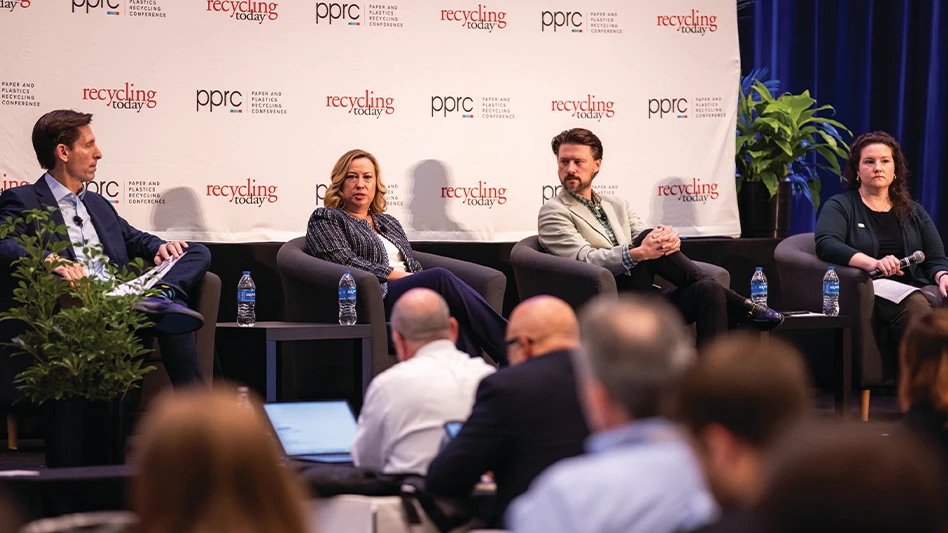
Photo courtesy of Mark Campbell Productions
Seven states have passed extended producer responsibility (EPR) legislation in recent years, and Oregon became the first to launch its program in July.
With Oregon’s implementation serving as a primary example, a panel of packaging and recycling industry stakeholders came together at the annual Paper and Plastics Recycling Conference (PPRC) in Chicago on Oct. 16 to discuss EPR developments and the opportunities that lie ahead.
RELATED: PPRC 2025: Making sense of struggling plastics markets
The session, EPR in Action: State Updates, was moderated by Shannon Crawford Gay, director of recycling and environmental policy at Houston-based WM.
Seeking harmonization
With each state—California, Colorado, Maine, Maryland, Minnesota, Oregon and Washington—passing legislation that will result in differing programs, the Circular Action Alliance (CAA), which has been selected as the producer responsibility organization (PRO) in four of the states, has sought ways to harmonize rules where possible.
Jeff Fielkow, CEO of CAA, said harmonization is “one of the topics we constantly pound our fist on,” and CAA is working to form harmonization principles throughout the industry.
“When a state passes an EPR law, producers have three obligations—register, report their data and pay,” Fielkow said. “We harmonize what that experience is from state to state. We’ve established one place to go to ask a question with our streamlined portal.”
Using Oregon as an example, Fielkow said CAA’s producer portal has provided stakeholders a streamlined experience that will allow them to effectively participate in the program. Along with Oregon, CAA is serving as the PRO in California, Colorado and Minnesota, and also has a presence on Maryland’s advisory council.
“Now that we’re live in Oregon, we have a harmonized experience for suppliers,” he said. “All the suppliers and MRF [material recovery facility] operators needed to report in their data so we could pay them. It takes a little time to get that right, but now we have the model, so we can move that to the next state.
“We’re harmonizing the timeline. When a state passes a law, how many years should go by before it goes into effect? We’re harmonizing who should run the program, harmonizing the definition of what is a producer. Getting all those mechanisms right is the key.”
Fielkow added that ecomodulation, an element of an EPR program that rewards producer behaviors that make packaging easier and more cost effective to recycle and also penalizes those that make recycling more difficult, also requires a level of harmonization across states.
“If you don’t have harmonization of those, you have producers putting their hands in the air," he said.
The importance of REMs
Where recovered materials ultimately end up presents an important challenge for each EPR state, and identifying responsible end markets (REMs) for commodities is a priority stakeholders want addressed sooner than later, according to Scott Byrne, vice president of global sustainability at Hartsville, South Carolina-based packaging producer Sonoco.
Byrne serves on Oregon’s Recycling System Advisory Council and described REMs as “the most contentious issue that I’ve been a part of in that group. … Within that group there’s a lot of tension, but it’s good tension.”
He said there have been differing opinions amongst the board when it comes to topics like ecomodulation, “but there’s a sense of, ‘Let’s kind of get the program rolling, and then we can look at maybe the next program plan amendment.”
However, he said, “If you get [REMs] wrong, it could almost be existential to the program. If the end markets haven’t signed up and MRFs can’t move that material, the whole system becomes very fragile. Some of the stakeholders are saying responsible end markets are almost a cornerstone of the program, [while others say] we need to make sure the program works first.”
Crawford Gay noted that sorting out domestic end markets for material could be helpful given market volatility for different commodities, and posed the question of what is being done to bolster those end markets in the U.S. to prevent a scenario in which there is too much material and not enough end markets.
Fielkow said that markets currently are “extraordinarily weak,” not just in the U.S. but globally.
“The best feature of a well-structured EPR program is to help the industry sort out those markets,” he said. “The high volatility is always what’s created problems for long-term investments, and EPR can help smooth that out and actually promote the industry.
“If markets go weak, [EPR] creates a way for the industry—the haulers and the MRF operators—to remain profitable. It helps to manage the volume of material and the quality of that material.”
If stakeholders can get this right, Fielkow says, “each of the ecosystems for recycling can improve. We can make sure we’re presenting high-quality materials for sale. There are huge needs in terms of what must be collected for recycling. It’s not a wish; it’s in the targets. And we know those [end] markets aren’t there yet. But we’re making sure we get there in the right order.”
Limiting confusion
Lynn Dyer, executive director of Springfield, Massachusetts-based American Institute for Packaging and the Environment (AMERIPEN), said EPR laws should be designed to include existing collection programs for materials already in the marketplace while also preparing for future materials.
“How do we not disrupt what’s working today and prepare for tomorrow,” Dyer said. “People are going to be fighting to get more materials [included in the legislation]. If you’re a producer and start to see those fees assessed on your products, how’s that going to affect materials entering the marketplace? We have to make sure any legislation that comes up is prepared for that.”
Dyer suggested states conduct a needs assessment early in the legislative process and avoid throwing EPR “and the kitchen sink” into the law. “Let’s build EPR laws that move things along. There’s already a huge burden on companies learning how to do this. If you have states coming out with these very different rules, you create all this confusion in the industry.”
Fielkow pointed out that CAA works with different industry organizations, including AMERIPEN, as well as MRF operators, haulers and other stakeholders to develop covered materials lists while also planning for future capital expenditures that will help improve collection outcomes.
“Our role is we’re a nonprofit and we only want to see great outcomes,” he said. “We want the industry to be healthier than it is today. There’s a role for all of the trade associations, the TRPs [The Recycling Partnership], the Closed Loop Partners’. We want to convene all these groups and try to coordinate a plan so we’re using resources efficiently and getting the most impact.
“If we don’t have the answers, the group will come up with the answers. It’s about getting higher impact for the products we know are there where maybe resources are limited in a particular area, then getting capital in to help solve these problems. That’s what we do.”
In Oregon, in particular, Fielkow said producers have “showed up in a big way.”
“I’m really impressed and proud of the producer community,” he said. “They’ve registered and paid, registered and reported. … I’m really proud of the haulers and collectors; they’ve been incredibly collaborative in the states we’re working in. We’ve seen better cooperation than I thought I’d see on my most optimistic day.”
Fielkow said EPR programs will require a degree of patience if they are to be successful in the long run.
“What does a program look like? I’d say, I have no idea. Give it time. Give us time to get the program up and running and some time under our belts to see what it looks like. Allow the time to let these programs incubate, then we can start to build the next wave.”
An alternative view
In the second session, EPR at a Crossroads: Protecting Recycling, Addressing Batteries, National Waste & Recycling Association (NWRA) President and CEO Michael E. Hoffman said the organization does not support EPR for packaging, though it does support collection programs for items such as batteries.
“We do want to recycle,” he said. “Our concern is that [EPR] is an extraordinarily expensive way to try and improve recovery rates.”
Hoffman cited data from a study NWRA conducted in 2021 with the aid of Eunomia Research & Consulting that looked at four different outcomes, though “none were positive.” The outcomes researched included:
- Does the EPR program lead to an increase in recycling rates? Hoffman said the study showed that it is likely but not always certain.
- Does it lead to an increase in recycled content usage? The study claimed there was no evidence to support design-for-recycling improving usage.
- Does it lead to an increase in design-for-recycling practices? The study said there was no evidence.
- Does it lead to an increase in the market value of collected packaging material? The study concluded there was no evidence supporting better secondary market value of recycled packaging.
“If communities don’t have access because they don’t have the markets, there’s ways to work around this,” he said. “With rural recycling programs, we found some that are successful, with exceptional recovery rates at a fraction of what EPR would cost today.
“CAA, AMERIPEN [and others] are working at this in a sensible way, but his process is expensive. This is a grocery tax. Anyone that thinks producers aren’t going to increase prices to make this work is delusional. They’re going to pass these costs on. There are better ways to do this economically.”
Hoffman noted that some groups want producers to pay to support EPR programs, but a smarter economic model exists. “Cost matters,” he said, adding that EPR paired with bottle bills also do not work.
Per the Eunomia study, an alternative approach to EPR would include nationally coordinated recycling standards, targeted infrastructure investment, a focus on efficiency and market incentives and proven material recovery system upgrades.
Hoffman encouraged entities forming EPR programs in different states to include MRF operators in their discussions, since those facilities will be tasked with processing higher volumes of material.
“[When you have] conversations about EPR and putting more volume through MRFs, you have to talk to us,” Hoffman said. “What can go through these plants and still allow us to run them at high efficiency to maintain economics.”
Latest from Waste Today
- My Green Michigan expands depackaging capacity
- Washington selects Circular Action Alliance as PRO
- Ten-8 Industrial opens new central Florida service center
- Triumvirate Environmental acquires Environmental Waste Minimization
- Official NYC Bin availability expands ahead of deadline
- US Food Waste Pact’s 2025 Impact Report shows decrease in food waste
- Coastal Waste & Recycling expands recycling operations with Machinex
- Reconomy acquires German-based GfAW