Photo courtesy of Ramo
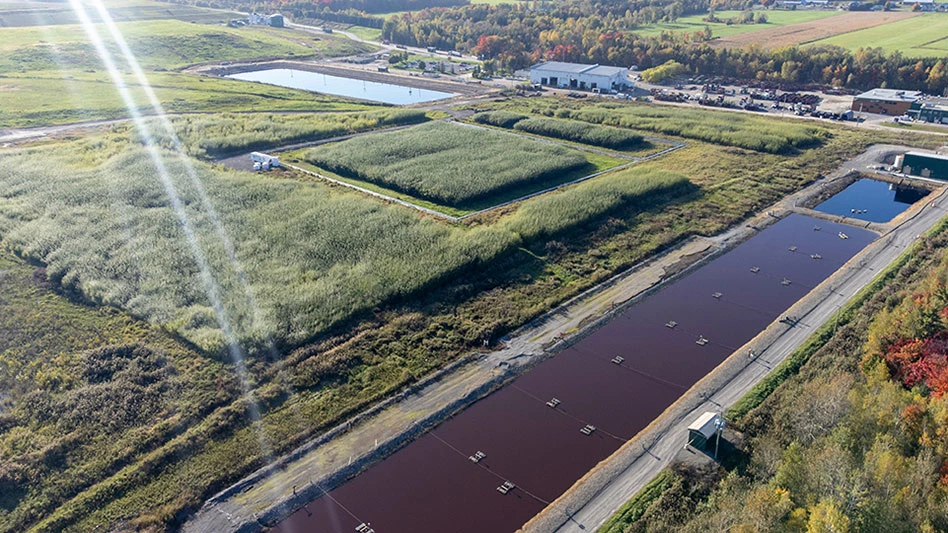
Landfills generate leachate, a liquid formed when precipitation percolates through decomposing residual materials. This water, primarily laden with organic matter, ammoniacal nitrogen and metals, is collected through a drainage system installed at the base of sealed landfill cells before undergoing treatment.
The management of leachate presents a critical challenge for landfill operators, particularly as sites approach their treatment or discharge capacity. When these limits are reached, operators must choose between two often costly solutions: exporting surplus leachate to other facilities with available capacity or constructing a new on-site treatment plant.
Over the past two decades, plant-based technology company Ramo, based in Montreal, has honed its expertise in using willows to tackle various environmental problems, culminating in the creation of a leachate treatment technology it calls Evaplant.
A nature-based solution
Ramo says the Evaplant system complements existing landfill treatment technologies by providing an ecological and economical solution. Its main advantage lies in its ability to significantly reduce leachate volumes through an innovative, patented technology based on precision irrigation with a zero-liquid-discharge approach. The technology uses automated analysis of soil conditions and weather to adjust leachate irrigation onto willows according to their absorption capacity, optimizing the natural process of evapotranspiration.
Evaplant maximizes the resources found in leachate—nutrients, water and metals—by leveraging the natural properties of willows, according to Ramo. These trees absorb leachate through their roots, effectively retaining the contaminants while releasing only water vapor into the atmosphere. Each hectare of willow plantation, composed of 15,000 to 20,000 trees planted using specialized mechanical equipment, can consume up to 7,000 m³ (1.85 Mgal) of irrigated landfill leachate annually. This process significantly reduces leachate volumes without discharging pollutants into the environment.
Managing forever chemicals (PFAS)
In addition to reducing leachate volumes, the company says Evaplant shows significant potential for managing per- and polyfluoroalkyl substances (PFAS), “forever chemicals” prevalent in landfill leachates due to their widespread use in waterproofing and other products. Conventional water treatment systems often struggle to capture PFAS, but recent studies conducted by Institut de biologie végétale (IRBV) researchers at the Université de Montréal indicate that willows can bioaccumulate certain forever chemicals, effectively keeping them on-site rather than releasing them into the environment.
The willows are harvested every three years in the form of wood chips, which may be stored on-site as a preventive measure to ensure the long-term containment of any accumulated PFAS. This solution offers landfill operators a quick and effective way to address the urgent challenge of forever chemical discharge, Ramo says, preventing off-site discharge and providing immediate action to mitigate their environmental impact.
Greening landfill sites
Willow plantations also contribute to the greening of landfill sites. Just a few months after planting, the landscape begins to transform, with willows reaching 20 to 25 feet in only three years. This rapid growth enhances the aesthetic and environmental value of the site, benefiting both employees and surrounding communities. In addition to these benefits, willow plantations actively capture carbon through their biomass, contributing to the site’s overall environmental sustainability and reducing its carbon footprint.
Evaplant technology presents a groundbreaking, nature-based solution to the complex challenges faced by landfill managers, Ramo says. By harnessing the natural properties of willows, Ramo has developed an environmentally friendly and economically viable method to significantly reduce leachate volumes and manage forever chemicals. This innovative approach supports sustainable landfill management and helps repurpose areas of landfill sites, fostering a more resilient and ecological approach to leachate management.
Jérôme Verry is head of communications at Ramo. He can be reached at jverry@ramo.eco.
Latest from Waste Today
- Vermeer announces plan to build new facility in Des Moines metro area
- Buffalo Biodiesel shares updates on Part 360 application to DEC, Tonawanda facility progress
- Capstar Disposal expands roll off dumpster rental services
- Supreme Court strikes down IEEPA tariffs
- Casella details facility closures, expansion efforts
- Zero harm: Building a SIF prevention program for waste and recycling operations
- Casella posts a loss in Q4 2025
- McNeilus names Haaker Equipment first Dealer Partner of the Year