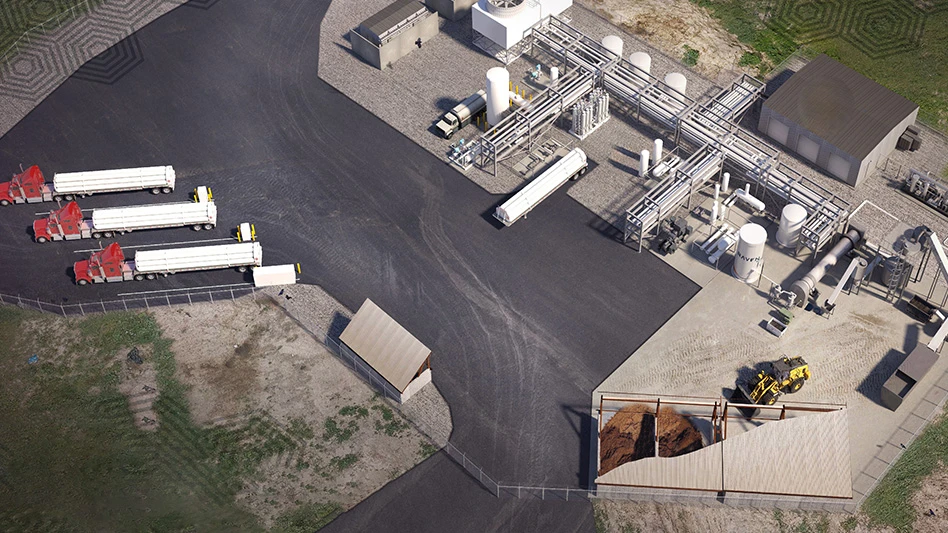
Photo courtesy of Raven SR
Raven SR Inc. received its final air permit and authority to construct (ATC) from the Bay Area Air District (BAAD), paving the way to begin construction on its first facility.
Based in Pinedale, Wyoming, Raven SR converts biomass, mixed municipal solid waste, biosolids, sewage, medical waste and natural or biogas into renewable fuels. Its California facility will convert diverted organic waste into renewable hydrogen through a non-combustion steam/CO₂ reforming process.
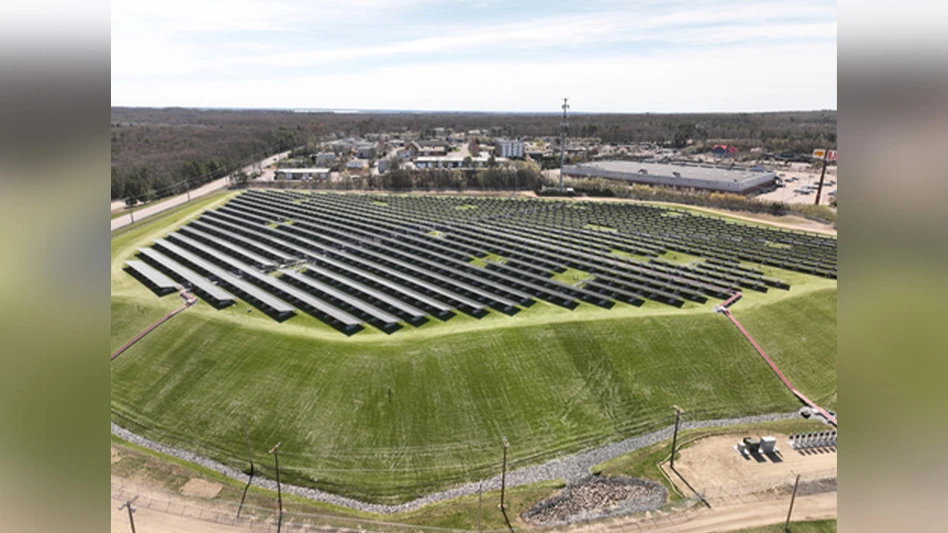
According to Raven SR, the site will process up to 99 wet tons of organic waste per day, producing about 2,400 metric tons of transportation-grade hydrogen annually. It will be located at Republic Services’ closed West Contra Costa Sanitary Landfill in Richmond, California. Hydrogen will not be stored on-site.
“Receiving the ATC marks a major milestone for Raven SR, the City of Richmond, and the broader hydrogen economy,” Raven SR CEO Matt Murdock says. “This facility will commercially demonstrate that we can convert waste that would otherwise emit methane and turn it into clean hydrogen without combustion or toxic emissions.”
Raven SR says the permitting process spanned more than five years, including three-and-a-half years of BAAD review. Now that the ATC has been issued, the firm is completing final engineering revisions required by the permit conditions and preparing building permit packages for submission to Richmond.
“At a time when many hydrogen projects have stalled or been cancelled, Raven SR’s Richmond facility will stand as proof that innovation and persistence still win,” Murdock says. “We believe it will set a new benchmark for waste-to-hydrogen projects globally, and positions Raven years ahead of other developers in bringing clean hydrogen from waste to market.”
According to Raven SR, it is the first company in California to achieve full environmental and air-quality approvals for a waste-to-hydrogen facility. It anticipates holding a groundbreaking ceremony in early 2026 followed by construction once the project financing is finalized.
The extended permitting timeline combined with inflation has pushed the project’s cost to about $75 million. Raven SR says the project will be financed primarily through private equity partnerships. It added that while it intends to leverage the Inflection Reduction Act 45V credit, Raven SA has used no federal grant funding to this point.
The Richmond project is owned by Raven SR S1 LLC, a Raven SR subsidiary, and will operate the facility once complete. The firm says Chevron New Energies is collaborating on the project. Chevron, ITOCHU, Ascent Funds, Samsung Ventures and RockCreek are strategic investors in Raven SR.
“Raven SR’s Richmond facility represents a critical step toward cutting California’s most damaging climate pollutants—methane and black carbon—by turning landfill-bound organic waste into clean hydrogen,” says Julia Levin, executive director of the Bioenergy Association of California. “Reducing these short-lived climate pollutants provides immediate climate and public-health benefits while advancing the state’s clean-fuel transition.”
Raven SR says its technology is a noncombustion, noncatalytic thermal, chemical reductive process that converts organic waste and landfill gas to hydrogen and Fischer-Tropsch synthetic fuels.
According to the firm, the process does not require fresh water as a feedstock and uses less than half the energy of electrolysis. It added that it is more efficient than conventional hydrogen production and can deliver fuel with low to negative carbon intensity.
It plans to generate as much of its own power onsite as possible to reduce reliance on the grid. Raven SR says the site’s modular design provides a scalable means to locally produce renewable hydrogen and synthetic liquid fuels from local waste.
“California and the city of Richmond are leading the transition to a clean hydrogen economy, and projects like Raven SR’s demonstrate how innovation can turn waste challenges into clean-energy and workforce opportunities,” Richmond Mayor Eduardo Martinez says. “This project reflects the type of investment and perseverance needed to achieve Richmond’s and the state’s clean-air and decarbonization goals.”
Latest from Waste Today
- Vermeer announces plan to build new facility in Des Moines metro area
- Buffalo Biodiesel shares updates on Part 360 application to DEC, Tonawanda facility progress
- Capstar Disposal expands roll off dumpster rental services
- Supreme Court strikes down IEEPA tariffs
- Casella details facility closures, expansion efforts
- Zero harm: Building a SIF prevention program for waste and recycling operations
- Casella posts a loss in Q4 2025
- McNeilus names Haaker Equipment first Dealer Partner of the Year