STUDIO MELANGE | stock.adobe.com
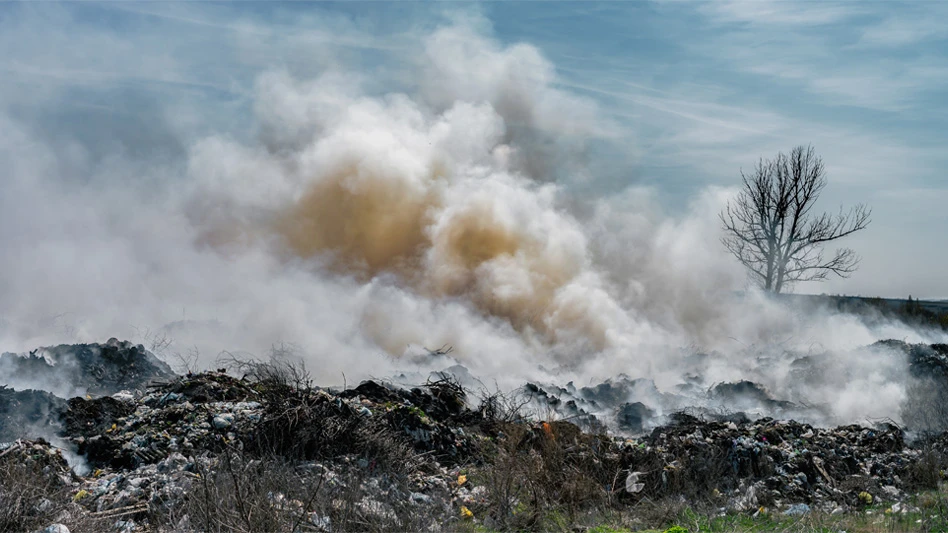
Landfill fires remain a persistent and costly challenge for waste management professionals worldwide.
At RCon, Sheri Praski, an engineer and executive director of the Solid Waste Association of North America (SWANA) Northern Lights chapter, emphasized the importance of proactive measures, staff training, public education and understanding regional differences to combat and prevent fires.
The unique nature of landfill fires
One of the first points Praski highlighted was that landfill fires are fundamentally different from typical structural fires or wildfires, for example. The composition of waste, especially materials such as hazardous waste, batteries and certain plastics, can increase fire risks.
“Most fire crews don't have training, and they don't understand what it is and how they're different,” she said. “What's different than a regular fire: what's burning and chemical reactions in there…We’re dealing with a giant pile of flammable, toxic materials under sunlight.”
Understanding causes and risk factors
Landfill fires can originate from arson, spontaneous combustion or equipment failure, Praski said. Other causes can include:
- equipment overheating;
- plastic and paper materials blocking fans and igniting fires;
- spontaneous combustion of materials as they break down; and
- weather conditions, such as lightning strikes.
Recognizing signs of impending fire—such as smoke, steam, melted snow, stressed vegetation or atypical odors—also is essential for early detection.
The importance of prevention and site management
Prevention hinges on effective site management practices, Praski emphasized. Covering waste appropriately, organizing materials into compartments and reducing air voids can limit oxygen access, thereby slowing fire development.
“Proper compacting and covering, I would say, are the keys to the most important thing that we can do,” she said. “You can cover the top, but if you have air intrusion coming in underneath, it’s still feeding in oxygen.”
Additionally, security measures such as site patrols, surveillance cameras and restricted access can reduce arson and accidental ignitions. Staff training also is another important component.
“[Emergency responses plans] should be developed with your fire personnel,” she said. “Identify the roles. Who’s going to talk to the press? Who’s going to call the fire crews? Walk the site with your firefighters: ‘This is where you come in; this is where you go.’”
Empowering personnel to recognize hazards and respond appropriately can make a difference, Praski added. “Are your people empowered to do that? Do they know you’ll have their back if they find something?”
Praski also emphasized the importance of public education as a component of prevention.
“People don’t know what we do,” she said. “Helping people understand what the hazardous materials are and where they can take them is so important.”
Dealing with fire suppression and response
Suppression methods vary depending on the fire’s nature—whether surface or subsurface—and regional capabilities. Regarding subsurface fires, Praski noted the fear that comes with uncertainty.
“These ones scare me. These kept me up at night,” she said. “Below the surface and extremely deep, they can run for years.”
Fire suppression strategies include depriving the fire of fuel, cooling underground fires and applying extinguishing agents. Praski explained that even the best fire suppression systems have limitations, noting that proper site layout and quick detection are equally crucial.
Regional and geographic challenges
Praski also noted that geographic location can influence fire prevention strategies. In colder, northern regions like the Canadian territories, unlined and poorly managed “dumps” are common. These sites are often susceptible to spontaneous combustion due to permafrost conditions and high organic waste decomposition.
Meanwhile, in more populated regions, the focus tends to be on operational practices and community safety. Larger communities have better infrastructure but still face significant fire risks, Praski said, with some fires costing hundreds of thousands of dollars and impacting public health and safety.
Economic and community impact
The financial toll of landfill fires is substantial. Praski cited an example of a small town of 400 residents facing a fire that cost over $300,000. More extensive fires in larger towns can have more broad consequences, including evacuations, shelter-in-place orders and long-term health implications.
Beyond immediate costs, Praski emphasized that fires also threaten community trust, safety and environmental quality. A poorly managed fire can lead to evacuations, prolonged air monitoring and health concerns.
A call for proactive measures
The session concluded with a call to action: Understanding the unique characteristics of each site, implementing strong management practices, training staff thoroughly and engaging the public are all integral to reducing landfill fire risks.
“There’s 100 reasons why we’re going to have landfill fires, but there’s things that we can do,” Praski said.
RCon was hosted by SWANA in Columbus, Ohio, from Nov. 12-15. RCon 2026 will be in St. Louis from Sept. 29 to Oct. 2.
Latest from Waste Today
- Fleetio launches AI capability to accelerate fleet maintenance approvals
- Recycle Ann Arbor extends drop-off station operating hours
- Sybilion seeks to help manufacturers confidently address volatility
- Ecowaste Solutions partners with city of Trinity, Texas
- Bristal Hauling acquires G&R Garbage Disposal
- Baltimore trash collection expected to slow as WTE facility closes for maintenance
- Landfill Insights | Connecting the dots: Policy to practice
- FCC Environmental Services awarded collection contract in Florida