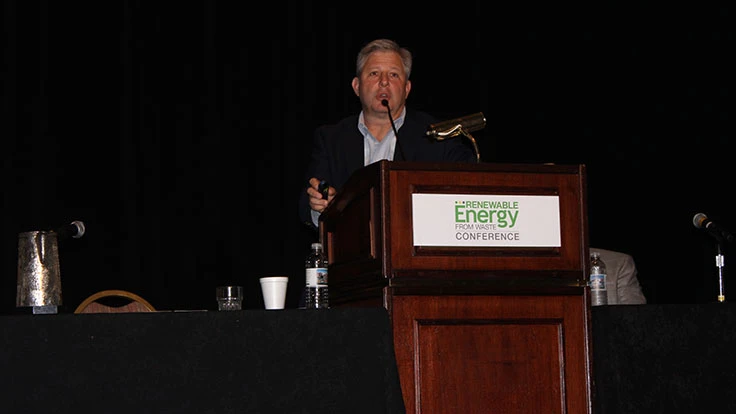
Pictured at podium, Russell Cooper of Vadxx.
2015 has been a year of progress for several waste conversion projects in North America, chief among them being the Enerkem Alberta Biofuels Facility in Edmonton, Alberta, and Vadxx’ pyrolysis facility in Akron, Ohio. As well, Prince Edward County, Virginia, is moving forward with plans for anaerobic digestion. Speakers from all three entities shared the latest updates on these projects at the 2015 Renewable Energy from Waste Conference, held in November in Orlando, Florida.
Nat Egosi, president and CEO of RRT Design & Construction, Melville, New York, who moderated the session titled “Status Updates – Waste Conversion Projects,” began by giving an overview of the waste-to-energy and recycling markets.
He first pointed out that refuse-derived fuel (RDF) is a U.S. developed technology that is proven and has been in use for over more than 40 years. The difference between today and older plants, he said, is the consequence of the changing waste stream, lessons learned and that mass-burn boilers have proven their effectiveness, the need to alter municipal solid waste prior to placing it in a boiler (MSW) has become unnecessary.
Interest is renewed in WTE, says Egosi, as technologies exist to recover more materials prior and to use fuel in in gasifiers or non-MSW furnaces/combustors/kilns.
He also noted changes coming in the paper recycling markets with new bulk paper grades. He mentioned the ongoing debate of mixed-waste processing facilities as an affordable and effective way to recover more recyclable materials from the waste stream but that can affect quality and can undermine existing curbside recycling programs.
Ultimately, he noted, “Landfills are too cheap.” He said cities looking for a $25 per ton waste conversion solution “will not find one.”
Russell Cooper of Cleveland-based Vadxx, discussed his company’s progress on a commercial scale pyrolysis facility in Akron, Ohio. The company’s thermal depolymerization process can take waste inputs such as industrial plastic, postconsumer plastic, auto shredder residue and tires tires and through a continuous process, convert the materials into diesel, naphtha, carbon solids and synthetic natural gas.
The company hot commissioned its Akron plant in August 2015. Cooper said an oxygen leakback was detected in the main reactor and the company is working on repairing the seals and gaskets. Despite this setback, Cooper said, the company is moving forward with Phase II of the project, which is building a distillation column.
He said in the first quarter of 2016, “We hope to start depolymerization.”
Tom Smith, solid waste division chief, Prince William County Department of Public Works, shared plans the Virginia county has for a waste conversion demonstration project as part of a planned Prince William Landfill Eco-Park and Renewable Energy Park.
A waste conversion request for proposals (RFP) was issued on June 20, 2012. The idea was to host a demonstration project of an innovative municipal solid waste (MSW) conversion technology and identify qualified technology companies to design, build, finance, own and operate the demonstration plant.
Three proposals were received and county staff, along with input from a Solid Waste Citizen Advisory Group, ranked proposals. LEEP Holdings LLC was selected to begin negotiations in May 2013.
Ultimately, despite several extensions on deadlines, financing could not be obtained so the agreement was terminated on June 30, 2015. Smith cited increased project costs and a decrease in market value for fuel pellets.
A solar project with GCS Inc., is moving forward at the landfill site and the board approved the agreement with CGS in May to install a phased project with net metering to supply 1.5 megawatts of power to buildings including a Juvenile Detention Home and a fleet/admin facility.
An organics waste conversion project at the Balls Ford Road Yard Waste Compost Facility in the county also is moving forward.
Four proposals were received on March 5, 2014. Proposals were ranked by selection committee and Freestate Farms LLC was selected to begin negotiations in July 2014.
The board awarded the agreement to Freestate Farms LLC on Jan. 20, 2015. The proposed project technologies include 30,000-45,000 tons per year of food waste anaerobic digestion (AD) using quasar Energy Group’s technology; 30,000-50,000 tons per year of advanced aerobic composting of yard waste; 1 MW of combined heat and power electricity generation; 1-2 acres of commercial greenhouses; and mulching of wood waste
Phase II would expand the capacity to 125,000 tons per year of AD and 85,000 tons per year of composing. Smith reported that final plans are being developed for submission to the county and Virginia Department of Environmental Quality for permit approval. Construction is scheduled to begin in spring 2016, and the facility is expected to begin operations to begin in spring 2017.
David McConnell, vice president, business development North America, for Montreal-based waste-to-biofuels company, Enerkem, discussed some of the key drivers for use of waste as an energy feedstock, including increased scarcity of urban landfill airspace and interest in low-cost, unconventional feedstocks.
Enerkem has partnered with the city of Edmonton, Alberta, which operates the Edmonton Waste Management Centre, North America’s largest collection of modern, sustainable waste processing and research facilities.
He discussed the “rigorous path to commercialization,” which took several years from laboratory, to pilot to demonstration facilities that finally led to the completion of Enerkem Alberta Biofuels, which the company says is world’s first commercial MSW-to-biofuels and chemicals facility. Enerkem has a 25-year agreement with city of Edmonton for 100,000 dry metric tons of MSW per year and will produce 38 million liters per year of fuels. It is currently able to produced methanol. A second feed system is being installed and ethanol expected to be produced at the facility in 2016.
The company also has partnered with Vanerco to develop the first advanced biofuels facility in Canada to be co-located with a conventional biofuels production facility. This facility, which is in the preconstruction phase will use urban waste (industrial, commercial, institutional, construction, etc.) as feedstock.
The 2015 REW Conference was Nov. 16-19, 2015, at the Caribe Royal in Orlando. More information about the conference is available at www.REWConference.com.
Latest from Waste Today
- Vecoplan to present modular solutions at IFAT 2026
- Terex Ecotec appoints Bradley Equipment as Texas distributor
- My Green Michigan expands depackaging capacity
- Washington selects Circular Action Alliance as PRO
- Ten-8 Industrial opens new central Florida service center
- Triumvirate Environmental acquires Environmental Waste Minimization
- Official NYC Bin availability expands ahead of deadline
- US Food Waste Pact’s 2025 Impact Report shows decrease in food waste