“Deadliest Catch” is the Discovery Channel’s popular series about the real-life adventures of Alaskan commercial fishermen. The title refers to the high fatality risk suffered by these fishermen who battle great risk and the elements on the open sea. According to Bureau of Labor Statistics (BLS) data, fisherman suffered 41 deaths in 2017, which equates to an industry-leading 99.8 deaths for every 100,000 workers.
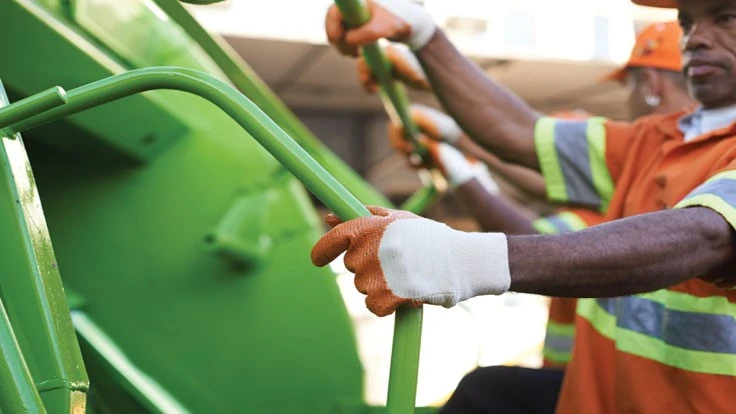
While it might not receive the same kind of television coverage, refuse and recyclable material collectors face similar on-the-job dangers when they report to work. According to BLS data, the industry saw 30 fatal injuries in 2017, with a fatal incident rate of 35 individuals per 100,000 workers.
Due to these metrics, waste collection once again landed as the fifth most dangerous job in America in 2017. This is not a list any profession wants to appear.
The leading cause of death for waste and recycling collection employees is being struck by a motorist in what otherwise could have been a preventable accident. Most of the deaths involving a member of the public occur on roadways, with the lion’s share involving a solid waste vehicle and at least one other vehicle.
What communities are doing to reduce fatalities
According to a study released by the National Highway Traffic Safety Administration, 80 percent of automobile accidents and 65 percent of near accidents involve at least some form of driver distraction.
In an attempt to reduce these avoidable accidents, 22 states have passed Slow Down to Get Around (SDTGA) legislation or variations of it, a national safety campaign aimed at reminding motorists to drive carefully near waste and recycling collection vehicles.
As part of the program, safety-conscious communities remind their citizens to treat sanitation and recycling trucks like other official service vehicles by slowing down and approaching cautiously. And because it takes sanitation and recycling trucks more time than passenger cars to stop, drivers are also advised to keep a safe distance.
What the industry is doing to help
In addition to working with state governments on “Slow Down” legislation, the Solid Waste Association of North America (SWANA) has developed a safety campaign of five simple tips to help solid waste workers stay safe on the job. SWANA asks waste industry professionals to use these resources to create a positive safety culture in the workplace.
The “Five to Stay Alive” safety tips are specialized for workers based on job function and location. These materials provide basic information to help reduce accidents and injuries, and each package of materials is available in English and Spanish.
“We urge companies and local governments to not only take the time to educate supervisors and employees but also commit to making safety a workplace priority,” SWANA Executive Director David Biderman says. “Nothing we do at SWANA is more important.”
Routing technology to keep fleet drivers safe
Fleet managers have little control over whether other drivers on the road drive safely or respect the lives of their workers. The general public’s driving is out of their hands.
What is not out of their hands, however, is their commitment to making safety a priority. And one important way to do that is by arming waste collection drivers with advanced routing technology.
Routing technology offers drivers easy-to-use dashboard-enabled GPS navigation to streamline collection. This technology is able to give drivers all the details needed to follow an assigned route safely. This means little to no distraction, the need to look at paper maps, or drivers having to guess their way around an unexpected obstacle.
These routing systems also come with real-time, back-end portals that connect haulers’ driving data to the back office, which helps facilitate training opportunities and improves compliance.
With the proper technology behind a fleet, haulers can begin to cut down on accidents and improve the safety of workers. And although there is no magic tool for eradicating all risks out on the road, implementing new routing technology is a step in the right direction that can help minimize the number of workplace-related injuries while getting waste off of BLS’s top-five most deadly list.
Latest from Waste Today
- Vecoplan to present modular solutions at IFAT 2026
- Terex Ecotec appoints Bradley Equipment as Texas distributor
- My Green Michigan expands depackaging capacity
- Washington selects Circular Action Alliance as PRO
- Ten-8 Industrial opens new central Florida service center
- Triumvirate Environmental acquires Environmental Waste Minimization
- Official NYC Bin availability expands ahead of deadline
- US Food Waste Pact’s 2025 Impact Report shows decrease in food waste