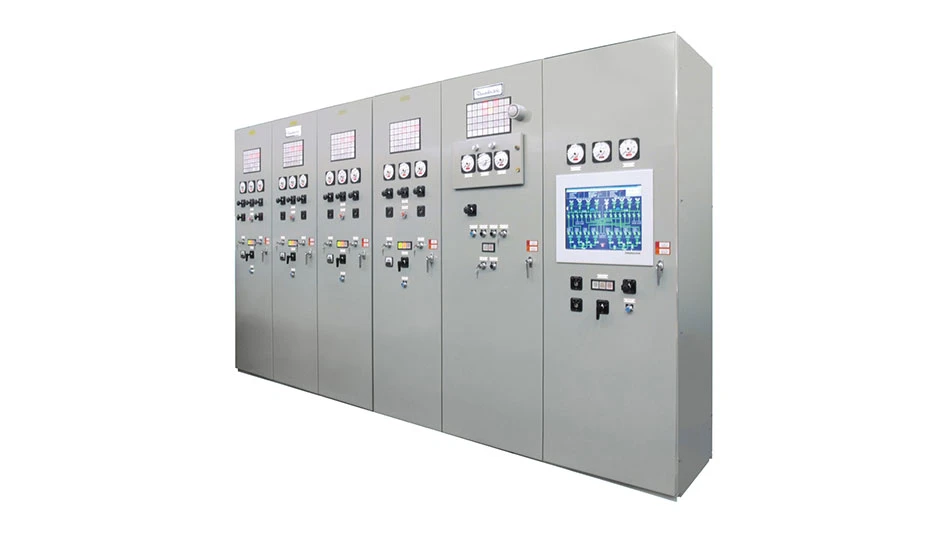
Photo courtesy of Russelectric
Russelectric, a Siemens business, a Hingham, Massachusetts-based manufacturer of automatic transfer switches and power control systems, is spotlighting its Paralleling Systems to protect water and wastewater treatment facilities and the functions they perform.
The company says the systems are ideal for ensuring optimal power support for critical loads when transferring between live power sources in water and wastewater treatment facilities, whether for use in utility paralleling, prime power or open/closed transition emergency systems.
The Utility Paralleling system can also be configured for peak shaving, utility-sponsored load curtailment programs, exporting power to the grid and for a variety of combined heat and power applications, Russelectric says.
Russelectric paralleling systems incorporate dual, redundant, live synchronized programmable logic controllers (PLCs) for system control. Discrete hardwired components, including switches, meters and control devices, are standard to allow for manual control capability in the unlikely event that both system PLCs fail, the company says. In addition, with a Russelectric Utility Paralleling System, users get soft loading transfer and phase lock synchronizing capabilities when paralleling with the utility, which reduces transients and controls the loading to the engine generators, according to the company.
All Russelectric paralleling systems are UL listed, the company says. Selector switches are provided for open/closed transition, automatic/manual paralleling of generators and utility sources and automatic/manual retransfer between both sources of power, where applicable.
The Utility Paralleling System offers a choice of either momentary paralleling with the utility or sustained paralleling for soft loading, Russelectric says. Also available is paralleling of generator sets with the utility upon return of the utility source after power interruption.
Utility Paralleling System operation begins with testing in closed-transition mode with no interruption of the load, the company says. Generators are then paralleled with the utility and the load is transferred to them. Upon completion of testing, the load is retransferred through closed-transition to the utility source without disturbance.
Latest from Waste Today
- Vermeer announces plan to build new facility in Des Moines metro area
- Buffalo Biodiesel shares updates on Part 360 application to DEC, Tonawanda facility progress
- Capstar Disposal expands roll off dumpster rental services
- Supreme Court strikes down IEEPA tariffs
- Casella details facility closures, expansion efforts
- Zero harm: Building a SIF prevention program for waste and recycling operations
- Casella posts a loss in Q4 2025
- McNeilus names Haaker Equipment first Dealer Partner of the Year