Photo by Neal Bolton
Over the years, you might have adopted the idea that the tipping pad and the active face should be kept as tight as possible. This is another operational holdover from the days when most landfills covered trash exclusively with soil.
Consequently, because of the tremendous value of airspace, it was good practice to keep the face small to minimize soil use. Along that line, folks tended to keep the tipping pad small, too. It sort of made sense and went along with the idea that tighter is better.
Alternative daily cover, or ADC, was not a common term and certainly not a common practice.
But since those days, we’ve learned otherwise. A wider face allows more room for segregating and spreading waste. It gives the compactor more room to make long runs, cross-roll and generally be more efficient when it comes to maximizing waste compaction. The downside of a larger face has little impact on airspace consumption because we’re using ADC instead of soil.
At one time, daily cover soil was the biggest unnecessary waste of airspace; but, now, with the widespread use of ADC, the financial issues associated with cover soil have less impact.
Yes, in some situations, a larger face could increase the potential for litter, odor or birds, but if other operational techniques are dialed in, that potential is minimized. Further, the additional cost of applying ADC on a larger face is minimal compared with soil.
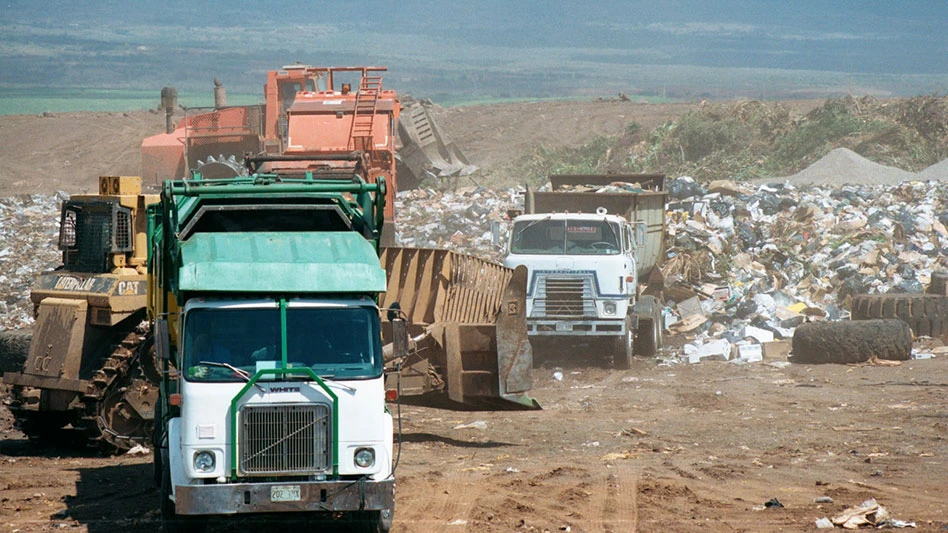
Expanding the size of the working face allows more room for heavy equipment, mainly dozers and compactors, to work together as a team without literally butting heads. Most landfills have experienced the embarrassing and costly effects when two machines try to occupy the same space at the same time. Operators call it a bump, bang or ding, but it is, in reality, a low-speed crash—not something your operators want to explain to their supervisor, nor the manager to the financial department. Crashing machines into each other decidedly is uncool.
But the idea of maintaining adequate spacing between machines becomes infinitely more serious when we’re talking about a David and Goliath mismatch. When a bulldozer and a truck collide, the truck will almost always receive major damage. Even worse, when heavy equipment hits a worker, whether in a truck or on the ground, the results can kill somebody.
A 40-ton machine that pushes 20 tons of trash doesn’t have much trouble sorting out 160-pound drivers or spotters. Thus, when it comes to the tipping pad, providing safe separation from heavy equipment isn’t just a good concept, it’s a matter of life and death. Ignoring good spacing practices is asking for trouble. When someone gets run over by a large bulldozer or landfill compactor, they don’t strap the victim on a gurney and check for vitals, they scoop up bloody clothes, along with some dirt, and put everything into a big, zippered bag.
It's a gruesome sight, and a lifelong memory for anyone who has experienced it. I hope this article is the closest you’ll ever get to experiencing that kind of trauma.
Spacing guidelines
What does safe spacing look like? Well, it has the following components:
- A minimum of 15 feet of spacing between landfill heavy equipment is recommended.
- A minimum of 50 feet of spacing between heavy equipment and customer vehicles is recommended.
These are general guidelines. You’ll want to determine your own spacing policies, keeping in mind that spacing should be increased when pushing bulky items, handling very dusty loads, working in high wind or anytime the situation demands an additional safety buffer.
We’re talking about common sense, not someone with a tape measure monitoring machine separation.
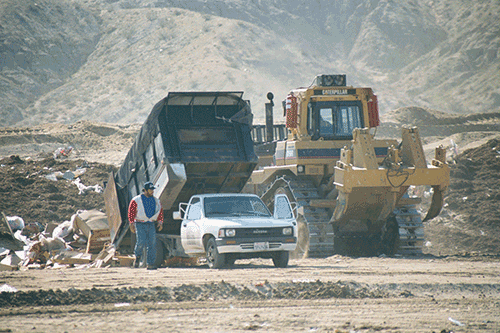
Other spacing considerations and techniques are recommended for customer vehicles. For example, large tires can provide a visible—and physical—buffer between trucks, but that might not be enough buffer between trucks and heavy equipment. The issue of truck spacing also involves driver responsibility—something I might address in another article.
In most cases, heavy equipment operators who are seat-belted in the cab and drivers in their trucks, also wearing the seat belt, usually are safe from a low-speed crash involving a large landfill machine. Not so for workers on the ground.
The idea is to keep those big landfill machines away from everyone else.
A dozer and a landfill compactor could sometimes work closely together while spreading, grading or processing waste. Two machines of similar size also could push side by side to increase production and quickly clear the deck. But, generally, providing a 15-foot buffer for heavy equipment is a good rule of thumb.
Here’s another: When one machine is approaching another, the right-of-way typically goes to the machine that is backing up. If both are backing, use extra caution. Backing is one of the riskiest things any machine does. Similarly, machines pushing or carrying a load generally have the right of way over other machines. But these are not absolute rules. Machines working together should be doing just that, and the guidelines should be based on practicality, productivity, safety and courtesy.
When it comes to pushing trash from the tipping pad to the active face, heavy equipment always should stay far from customers and their vehicles. I previously noted 50 feet as a minimum buffer. This means the dozer, compactor or wheel loader operator should never attempt to sneak in between two trucks to push a load. Nor should he or she push a load that is immediately adjacent to a truck. Just don’t do it. Fifty feet means 50 feet.
The solution
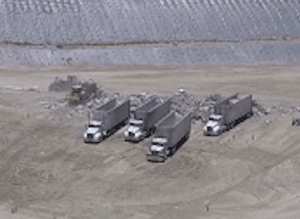
After seeing what works—and what doesn’t—at hundreds of landfills, I’ve become a strong advocate of a typewriter or alternating pattern for managing customer vehicles. Either system provides the critical benefit of keeping landfill equipment safely away from others.
This takes a lot of stress off the equipment operators. Ask your dozer operator, “When was the last time you were pushing a load to the face, and as you turned to look before backing, you saw that a truck had followed you in. If you hadn’t looked before backing, you’d have hit the truck.” When you ask that question, be prepared for some chuckling and eye-rolling, because it happens every day!
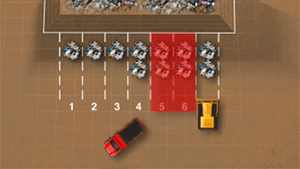
My favorite solution for maintaining safe separation is the typewriter system. It is relatively simple but comes with many nuances. The typewriter system directs trucks to work in a left-to-right or right-to-left pattern. Then, as trucks move progressively across the tipping pad, the dozer follows while maintaining a safe distance from the trucks. When the trucks reach the end of the pattern, they jump back to the beginning and start again.
Depending on traffic flow, they could reverse the pattern. So, it could be 1,2,3,4 and then 7,6,5,4. You should adjust the pattern to match your operation, keeping in mind the primary goal of separating customers from heavy equipment.
Improve safety at your facility by maintaining a safe buffer around heavy equipment.
Neal Bolton is president of Blue Ridge Services Montana Inc. He has been improving solid waste operations for more than 47 years. He can be reached at neal@blueridgeservices.com.
Latest from Waste Today
- Fleetio launches AI capability to accelerate fleet maintenance approvals
- Recycle Ann Arbor extends drop-off station operating hours
- Sybilion seeks to help manufacturers confidently address volatility
- Ecowaste Solutions partners with city of Trinity, Texas
- Bristal Hauling acquires G&R Garbage Disposal
- Baltimore trash collection expected to slow as WTE facility closes for maintenance
- Landfill Insights | Connecting the dots: Policy to practice
- FCC Environmental Services awarded collection contract in Florida