Photos courtesy of Revolution Foods.
Revolution Foods, California's largest K-12 school meal vendor, has launched a compostable school lunch packaging pilot across the 95 San Francisco Unified School District (SFUSD) schools it serves.
The new initiative, in partnership with SFUSD Student Nutrition Services, replaces plastic meal trays with compostable trays made from a byproduct of sugarcane, reducing up to 3,000 pounds of plastic waste per month.
Revolution Foods says it was inspired by SFUSD student activism calling for more sustainable options at lunchtime, and the pilot represents the company’s commitment as a Certified B Corp. to reduce its environmental footprint.
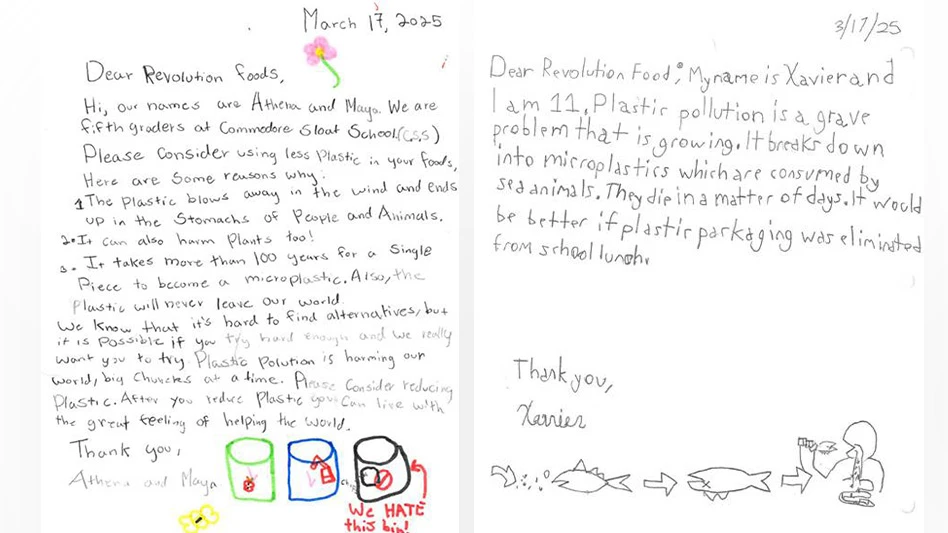
Earlier this year, SFUSD elementary students wrote letters to the company asking for less plastic in school meals, which Revolution Foods says helped accelerate a longtime company goal.
“We as a company, as community members, as parents ourselves, know that reducing the amount of plastic is a goal worth investing in,” says George Blanco, Revolution Foods CEO. “This is the first step in a phased approach to cut back on single-use plastics in our meal program, and we’re proud to start here and now with San Francisco Unified.”
The new per- and polyfluoroalkyl substances (PFAS)-free trays are made from bagasse, a natural fiber from sugarcane processing. The company says the trays can be composted in green bins at SFUSD schools, fully decomposing in commercial facilities within six to eight weeks.
“As a mother who cares about the environment, it’s inspiring to see students step up and lead the way in advocating for plastic waste reduction,” says Heather Clevenger, senior marketing director at Revolution Foods, who helped spearhead the project. “Together, we can make a difference and help others consider small changes that will collectively have a huge impact on our environment.”
In the letters, students at Frank McCoppin Elementary School and Commodore Sloat Elementary School expressed concerns about the environment and the time it takes plastic waste to break down.
“It takes more than 100 years for a single piece to become a microplastic,” students at Commodore Sloat Elementary School wrote in one letter to Revolution Foods. “Plastic will never leave our world. We know that it's hard to find alternatives, but it is possible if you try hard enough, and we really want you to try.”
Students at Jefferson Elementary School also advocated to reduce plastic waste in school meals. With the support of the school’s garden educator, Jefferson students organized and promoted “Plastic-Free Lunch Days,” documented plastic waste trends and lobbied SFUSD leaders about the importance of this issue.
Revolution Foods will work closely with SFUSD kitchen managers to track how the compostable trays perform through transport and reheating. If successful, the company will work to expand the pilot and find a recyclable film for meals requiring more leak-proof packaging.
As a certified B Corp., Revolution Foods says it’s investing time, labor and resources during this pilot to drive long-term, sustainable solutions. The company will evaluate the program throughout the school year with the goal of offering compostable packaging to more schools in the future.
Latest from Waste Today
- Recycle Coach partners with Bartec Municipal Technologies
- CPUC conditionally approves RNG procurement contract for Anaergia’s SoCal Biomethane facility
- EPA proposes abandoned tire cleanup plan with focus on energy recovery
- Global Recycling Foundation recognizes Recycling Heroes
- Equipment finance index takes dip in March
- Oregon DEQ issues enforcement order, $3M civil penalty to Valley Landfills
- Sierra International Machinery adds to sales team
- Vernon County, Wisconsin, landfill expansion remains stalled amid DNR delays