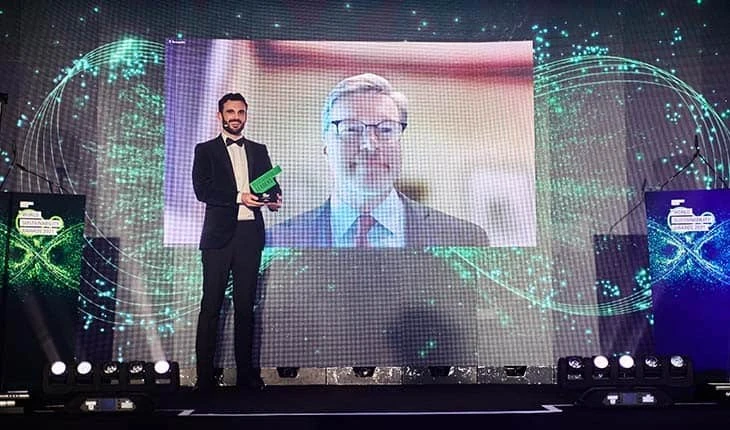
Photo courtesy Smithfield Foods
Smithfield Foods Inc., Smithfield, Virginia, has been awarded the World Sustainability Awards' (WSA’s) Profit with a Purpose award. The company was recognized for its renewable natural gas (RNG) programs that convert methane from pig manure into clean energy for consumers while giving revenue opportunities to family farmers.
Smithfield was selected following a three-stage judging process and was announced the winner during a virtual awards ceremony Oct. 13. The company also received an honorable mention in the WSA's external partnership category for its collaboration with an environmental organization to assist farmers in its supply chain with sustainable farming practices.
"We're honored to receive this prestigious global recognition and are immensely proud of our efforts to meet the world's growing demand for food sustainably," says Stewart Leeth, chief sustainability officer for Smithfield Foods. "As a leader in the food and agriculture industries, Smithfield has worked to ingrain sustainability across its value chain over the last two decades. Through our RNG and agronomics programs, we are responsibly utilizing our resources, expertise and market access to amplify proven technologies that benefit the environment and simultaneously foster growth for us and our partners, suppliers and communities."
The World Sustainability Awards are presented by Sustainability Leaders, a global network designed to accelerate cross-functional sustainability initiatives and World 50, a private community for senior executives to foster collaborative discovery free from press, competition and solicitation.
According to Smithfield, it took the company years to create the method to implement RNG technology on its farms that generate value for the company and stakeholders. Smithfield says its RNG projects reduce carbon emissions across America, removing 25 times more greenhouse gas (GHG) emissions from the atmosphere than are released during the resulting RNG's end-use.
The company's RNG program was developed to accelerate Smithfield's progress toward realizing its carbon-reduction goals. In 2016, Smithfield adopted a GHG-emissions-reduction goal across its value chain with the goal of achieving 25 percent reduction by 2025. The company has since pledged to become carbon negative in its U.S. company-owned operations and to reduce GHG emissions by 30 percent across its U.S. value chain by 2030.
Smithfield's biogas joint ventures with Roeslein Alternative Energy and Dominion Energy are projected to produce a combined 5.3 million dekatherms of RNG, the equivalent of removing 630,000 vehicles from the world's roads.
Latest from Waste Today
- Vecoplan to present modular solutions at IFAT 2026
- Terex Ecotec appoints Bradley Equipment as Texas distributor
- My Green Michigan expands depackaging capacity
- Washington selects Circular Action Alliance as PRO
- Ten-8 Industrial opens new central Florida service center
- Triumvirate Environmental acquires Environmental Waste Minimization
- Official NYC Bin availability expands ahead of deadline
- US Food Waste Pact’s 2025 Impact Report shows decrease in food waste