Stadler
Anticipating the recycling sector’s evolution, detecting new requirements as they arise and maintaining operational flexibility to develop solutions are some of Altshausen, Germany-based Stadler’s strategic priorities for 2020.
“The circular economy is the future, the way to address the main environmental challenges of our century, such as the global waste issue,” says Willi Stadler, CEO of Stadler Group. “Awareness around the world that we need to change our lifestyle is growing fast. In this context, the recycling sector is set to grow significantly, also driven by increasingly stringent policies and regulations.”
The following are a few examples of how Stadler plans to meet its 2020 priorities of serving the growing recycling sector, finding new requirements and market demand as well as remaining flexible to develop solutions.
Prepping for growth
Stadler has noticed that the recycling sector is growing, and the company expects it to continue to grow in the coming years. Based on that growth, Stadler reports that it wants to meet growing demand in this sector in terms of capacity and complexity. In 2014 and 2016, Stadler reports that it invested in the construction of two new production halls in Altshausen and last year the company completed the project with the inauguration of its new headquarters on the same site. The company is also investing in a new production hall in Slovenia in order to increase production capacity further.
Stadler’s focus on meeting customers’ growing needs has led the company to enter into a partnership with Krones, a specialist in the washing and decontamination process that is headquartered in Germany. Through this alliance, Stadler is able to offer a turnkey plant for the complete recycling process, from sorting to the final output of new recycled materials, Stadler reports in a news release on its 2020 strategic goals.
“Our strategic priority is the customer,” says Claus Maier, second CEO of Stadler Group. “They are our priority because at Stadler we know that our success depends on the success of our customers.”
Entering new markets
According to a news release from Stadler on its 2020 strategic priorities, the company has noticed a growing interest in Latin American markets for developing the recycling industry. The company has identified a strong interest in Mexico and, having completed a number of projects in the last two years, Stadler is now planning to establish a more direct presence in that nation through a subsidiary in the coming months to better support customers in that market.
Recently, Stadler also completed an advanced sorting plant for light packaging, plastics, paper and cardboard at Multilixo in São Paulo. According to Stadler, that plant is in the final testing stages. It includes a viewing platform for visitors to examine the plant and its process safely.
Meeting the demand for specialization, flexibility

The recycling industry is requiring high purity levels at sorting plants in order to meet their customers’ demands for high-quality recycled end products that can compete with virgin materials on the market, Stadler reports in a news release on its 2020 priorities. This trend is also driving demand for greater specialization in sorting processes and the ability to sort multiple materials flexibly.
Stadler reports that it has already anticipated this trend, and the company has completed different projects that meet these new needs. In recent years, the company recently helped Integra Plastics, Sofia, Bulgaria, with its sorting plant that specializes in film plastics.
Additionally, Stadler partnered with France-based Schroll Group in 2019 to provide that business with tailored solutions to meet the demand for sorting more fractions and greater operating flexibility. According to a news release from Stadler, Stadler designed the new sorting facility for Schroll Group to process 80,000 metric tons of scrap per year, allowing for future expansion. That facility features two independent plants—one for multimaterials and one for hollow materials—to provide flexibility.
Stadler reports that it conducts extensive testing on proposed solutions at its testing center or at a customer’s plant until desired results are achieved. In addition, the company regularly tries to improve its products in order to meet new needs. For instance, the company reports that it developed a wider version of its label remover in 2019 after having identified a requirement for processing a higher volume of bottles; the new version increased the capacity from 6 metric tons per hour of polyethylene terephthalate (PET) bottles to 9 metric tons per hour.
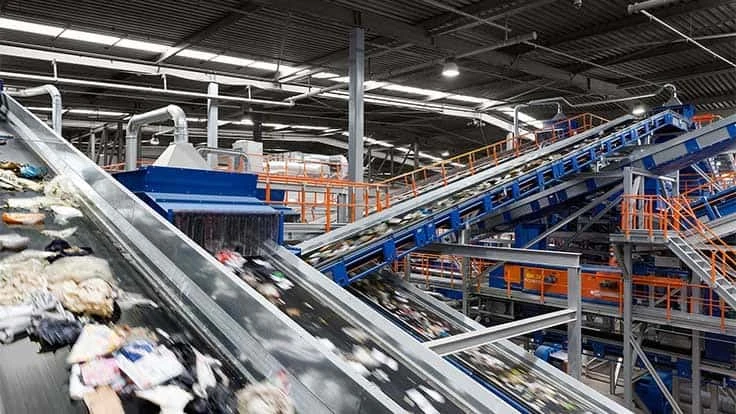
Stadler specializes in designing and assembling sorting plants for the recycling and waste disposal sector.
Latest from Waste Today
- Vermeer announces plan to build new facility in Des Moines metro area
- Buffalo Biodiesel shares updates on Part 360 application to DEC, Tonawanda facility progress
- Capstar Disposal expands roll off dumpster rental services
- Supreme Court strikes down IEEPA tariffs
- Casella details facility closures, expansion efforts
- Zero harm: Building a SIF prevention program for waste and recycling operations
- Casella posts a loss in Q4 2025
- McNeilus names Haaker Equipment first Dealer Partner of the Year