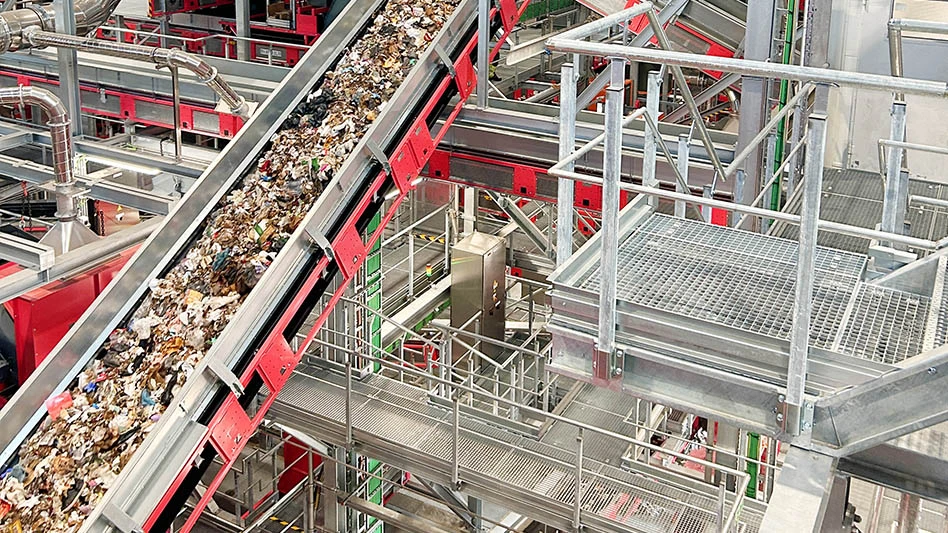
Photo courtesy of Stadler Anlagenbau GmbH
Altshausen, Germany-based Stadler Anlagenbau GmbH has completed the installation of what it calls a highly automated, high-throughput municipal solid waste (MSW) sorting plant for Stockholm Vatten och Avfall (SVOA), that nation’s largest water and waste utility firm.
Stadler, which engages in the planning, production and assembly of recycling and sorting plants, says the SVOA system has been designed to process 50 tons of waste per hour.
“The new facility is equipped with fully automated sorting lines that recover organic [including paper-based] waste from household garbage as well as plastic and metals accidentally mixed in the residual material arriving at the plant,” states Stadler, which has a North American business unit based in North Carolina.
The materials recovery undertaken at the SVOA plant reduces the volume of waste destined for a waste-to-energy incinerator operated by the firm, consequently lowering CO2 emissions, according to Stadler.
“The Resursutvinning Stockholm plant is a leap forward towards ambitious environmental goals while ensuring reliable, high-quality waste management,” says Lars Nyquist, project manager at SVOA.
“It is important that packaging is sorted at home, but plastic and metal packaging can accidentally end up in the residual waste. With Stadler’s expertise, we now have the technology and infrastructure to improve resource recovery, reduce emissions, and move closer to closing the loop on waste in Stockholm.”
The SVOA facility hosts a fully automated process with two parallel sorting lines that can operate independently.
Commissioning of the plant was completed last August and the plant officially was inaugurated in October 2024.
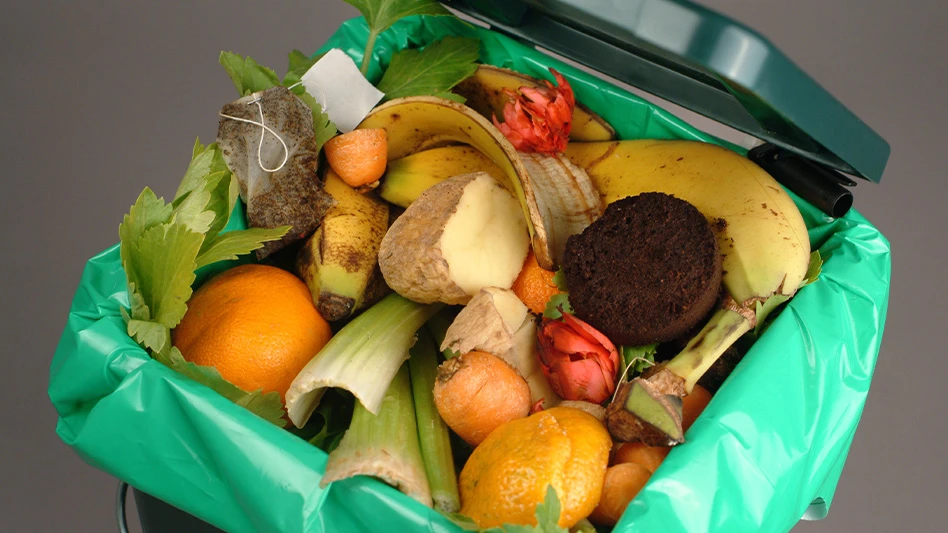
Collected material entering the facility includes green bags that contain organic food waste as well as mixed plastics, ferrous and nonferrous metals that find their way into the residential stream.
The incoming MSW heads to five live floors that transfer it to dosing conveyors designed to produce a uniformly distributed stream of material to feed the sorting equipment. After initial manual presorting to remove bulky or hazardous items, the material stream is separated by particle size by Stadler screening drums.
A Stadler Coloured Bag Sorting System combines five near-infrared (NIR) and visual spectrometer (VIS) devices designed to identify and extract the green bags containing food waste without requiring them to be opened. Those bags are weighed and routed for biological treatment, preventing them from mingling with dry materials.
The remaining material moves through a series of NIR sorting systems to recover plastics by polymer and color and through magnetic and eddy current separators to extract ferrous and nonferrous metals.
“An innovative system of movable conveyors beneath the screening drums allows the plant to quickly adapt to changes in waste composition without interrupting operations,” Stadler says.
Equipment at the Resursutvinning Stockholm plant has been positioned on multiple levels to fit within the facility’s compact footprint, according to Stadler, with a layout engineered for both accessibility and safety.
Drives and maintenance points are accessible via walkways and dedicated platforms, ensuring that servicing can be conducted quickly and safely, according to the firm.
“We at SVOA are impressed with Stadler’s work ethic in both the design and construction phase,” Nyquist says. “Their diligence and attention to detail have been crucial in achieving a great result also in terms of HSEQ (health, safety, environment and quality). They have shown admirable attention to client satisfaction when optimizing the plant, both in regards of delivering better waste treatment and HSEQ.”
Stadler says plant automation is central to its operation. The facility is run entirely through a centralized control system with manual input required primarily for routine maintenance and cleaning.
“With our design, we were able to deliver a facility that combines performance, precision and adaptability within a highly compact layout,” says Uroš Tintor, a project manager at Stadler.
“What stands out in this plant is its adaptability,” says Nejc Božič, another project manager at Stadler. “Everything from the parallel line design to the movable conveyors under the screens gives SVOA the flexibility to handle seasonal variations, keep the line running and optimize performance with minimal manual intervention.”
The design of the plant, featuring two parallel sorting lines, allows for continued operation during maintenance or partial outages, thus ensuring uninterrupted service and long-term reliability, according to Stadler.
Latest from Waste Today
- Fleetio launches AI capability to accelerate fleet maintenance approvals
- Recycle Ann Arbor extends drop-off station operating hours
- Sybilion seeks to help manufacturers confidently address volatility
- Ecowaste Solutions partners with city of Trinity, Texas
- Bristal Hauling acquires G&R Garbage Disposal
- Baltimore trash collection expected to slow as WTE facility closes for maintenance
- Landfill Insights | Connecting the dots: Policy to practice
- FCC Environmental Services awarded collection contract in Florida