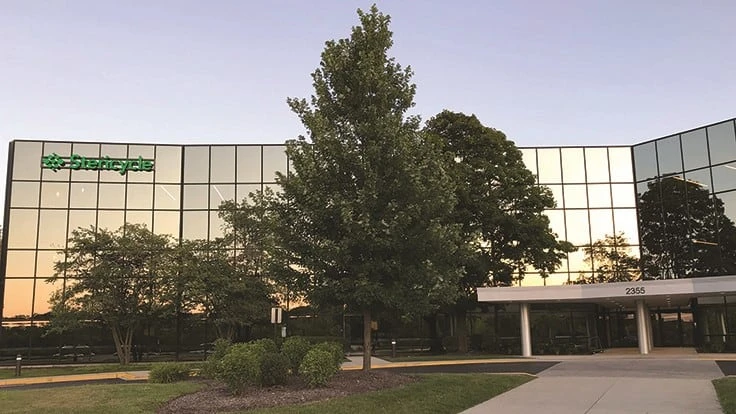
Stericycle Inc., Bannockburn, Illinois, reported results on Nov. 5 for the third quarter ended Sept. 30.
Revenues for the quarter were $636.4 million, a decrease of 23.6 percent compared to $833.1 million in the third quarter of 2019. This decrease was due to the impact of multiple divestitures and the COVID-19 pandemic, according to the company. Organic revenues declined 4.3 percent when excluding the impact of divestitures, foreign exchange rates and changes in sorted office paper (SOP) pricing, primarily reflecting the impact of the pandemic.
Loss from operations was $55.8 million, compared to a loss from operations of $34.5 million in the third quarter of 2019. Net loss was $81.2 million, or 89 cents diluted loss per share, compared to a net loss of $59.2 million, or 65 cents diluted loss per share, in the third quarter of 2019. The year-over-year difference was related to a higher loss from operations of $21.3 million, primarily related to divestitures, and higher tax expense of $15.1 million, which were partially offset by lower interest expense of $12.2 million. Adjusted income from operations was $101 million, compared to $118.8 million in the third quarter of 2019. Adjusted diluted earnings per share was 68 cents, compared to 80 cents in the 2019 comparable period.
Cash flow from operations for the nine months ended Sept. 30 was $365.2 million, compared to $201.2 million in the same period in 2019. Free cash flow for the nine months ended Sept. 30 was $270.5 million, compared to $40 million in the same period in 2019.
Report highlights include:
- Cash flow from operations improved to $365.2 million and free cash flow improved to $270.5 million for the first nine months of 2020, compared to $201.2 million and $40 million, respectively, in 2019.
- Net debt was reduced by approximately $135.5 million in the third quarter, decreasing total net debt to below $2 billion, the lowest net debt in the last five years.
- Income from operations, normalized for divestitures and foreign exchange rates, improved $8.2 million in the third quarter, driven by operational efficiencies and cost reductions.
- Regulated Waste and Compliance Services (RWCS) organic revenues grew 0.6 percent. Excluding the impact on maritime waste services from the pandemic, RWCS grew 1.9 percent.
- The divestiture of the company’s Argentina business was completed in the quarter, the seventh divestiture since January 2019 as the company continued to streamline its portfolio.
“As we continue to manage through the COVID-19 pandemic volatility, Stericycle delivered strong third quarter results with significant year-over-year operating margin improvement and debt reduction,” Stericycle CEO Cindy Miller says. “Our focus on quality of revenue improvements, disciplined cost management and operating efficiency is generating significant free cash flow.”
Additional highlights include:
- Revenues for the quarter were $636.4 million, compared to $833.1 million in the third quarter of 2019. Of the $196.7 million year-over-year decline, the impact of divestitures and lower Secure Information Destruction (SID) revenues excluding SOP pricing was $198.6 million in the aggregate and $162 million and $36.6 million, respectively.
- Loss from operations in the quarter was $55.8 million, compared to a loss from operations of $34.5 million in the third quarter of 2019. The change was primarily due to divestitures, which included higher year-over-year divestiture losses of $20.9 million and decreased operating income of $8.6 million. The decline was partially offset by operational efficiencies and cost reductions of $8.2 million.
- Net loss was $81.2 million, or 89 cents diluted loss per share, compared to a net loss of $59.2 million, or 65 cents diluted loss per share, in the third quarter of 2019. The year-over-year difference was related to a higher loss from operations of $21.3 million, primarily related to divestitures, and higher tax expense of $15.1 million, which were partially offset by lower interest expense of $12.2 million.
- Cash flow from operations for the nine months ended Sept. 30 was $365.2 million, compared to $201.2 million in the same period in 2019. The year-over-year improvement of $164 million primarily includes: lower payments for legal and professional fees, annual incentive compensation, and prepaid software totaling $50.5 million; lower accounts receivable of $26.6 million driven by collections exceeding revenues and collection process improvements; lower accounts payable of $17.4 million primarily driven by reduced costs; U.S. CARES Act net operating loss carryback refund of $48 million received in the third quarter; government relief tax-related payment deferrals of $22.4 million, roughly split between U.S. and international; advances received on executed service agreements of $19.2 million related to the Domestic Environmental Solutions divestiture in the second quarter; cash paid for capital expenditures for the nine months ended Sept. 30 was $94.7 million compared to $161.2 million for the nine months ended Sept. 30, 2019, primarily driven by the timing of 2019 investments in the ERP and disciplined capital management throughout 2020, the company says.
- RWCS organic revenues grew 0.6 percent in the quarter. Excluding the impact on maritime waste services from the pandemic, RWCS grew 1.9 percent. Organic revenues of SID, excluding the impact of SOP pricing, and Communication and Related Services (CRS) declined 16.8 percent and 2.9 percent, respectively, as a result of the COVID-19 pandemic.
- Adjusted income from operations was $101 million, compared to $118.8 million in the third quarter of last year. Excluding the impact of divestitures and foreign exchange rates of $12.9 million, adjusted income from operations declined $4.9 million. However, adjusted operating margin improved 160 basis points, primarily driven by divestitures and sustainable operating efficiencies, despite reduced revenues resulting from the pandemic.
- Adjusted diluted earnings per share was 68 cents, compared to 80 cents in the third quarter of 2019. The year-over-year decline includes the impact of divestitures and foreign exchange rates of 12 cents, higher adjusted tax rate impact of 7 cents, and lower income from operations of 4 cents. These factors were partially offset by lower interest expense of 11 cents.
- Free cash flow for the nine months ended Sept. 30 was $270.5 million, compared to $40 million for the prior year period. The significant year-over-year improvement of $230.5 million was due to higher cash flow from operations and lower capital expenditures, as previously described.